








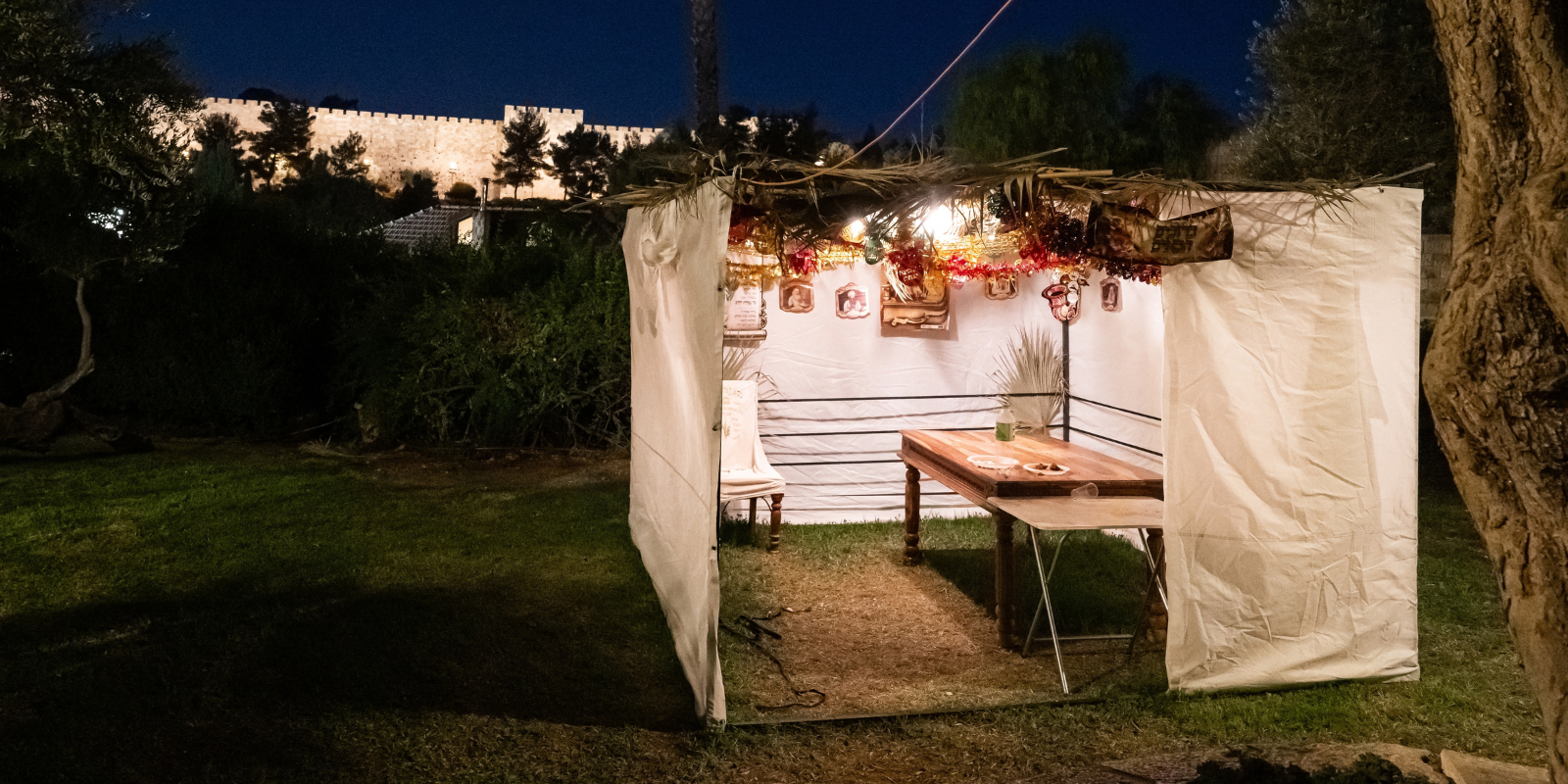
No, I’m not talking about a baseball field. At least not today. At lunch this week, one of my colleagues had brought his son to work, and a few of us started chatting with him. Somehow, the conversation turned to Sukkot. “Did you know you can put a TV in your sukkah?” someone asked. “NO WAY!” our young temporary coworker exclaimed. And suddenly, the sukkah became much more interesting.
There are, of course, actual rules for building a sukkah. It cannot simply be any outdoor fort that we decide to call one. A sukkah needs walls. It needs schach, the natural material that forms its roof. The covering has to provide more shade than sunlight. There are measurements and materials and an entire tractate of the Talmud devoted to the details. The Torah gives the reason for all of this building:
We build something physical so that we can remember something much bigger.
That made me think about something I used to do as a teacher. In education, there is a funny word called a “provocation.” Before beginning a new unit, instead of simply telling the children what we were about to learn, I might arrange unusual objects on a table, put out a photograph, introduce a new material, or leave a question somewhere they would find it. What do you notice? What do you wonder? What do you think this could be? The point was not to give them the answer. It was to create the conditions for curiosity. Sometimes the environment came first, and the learning followed.
In our modern day I think Sukkot works a little bit like that. We do not wait until we perfectly understand what it means to depend on God before entering a fragile little structure. We build it. We carry out the tables and chairs. We decorate the walls. We eat our meals beneath branches instead of a permanent roof. And then, perhaps, the questions begin. Why am I sitting here? Why does the Torah want me to leave the security of my house? What exactly am I supposed to remember?
There is something very Jewish about that order of operations. At Mount Sinai, when the Israelites accepted the Torah, they famously said, “Na’aseh v’nishma,” “We will do and we will listen”
Action comes first. Understanding follows. That does not mean understanding is unimportant. Quite the opposite. It suggests that sometimes understanding is born from participation. We enter the practice before we have fully mastered the meaning. The same pattern appears in the construction of the Mishkan. For chapter after chapter, the Israelites gather materials and build. God had told Moses:
And when the work is finally complete, the Torah tells us that the cloud covered the Tent of Meeting and the Presence of God filled the Mishkan. First they built the space. Then something filled it. Sukkot may be the most visceral expression of that idea. For one week, Judaism asks us to move faith out of the abstract and into a physical structure. We sit in it. We eat in it. We notice the weather. We look up through the schach. We feel, in a very literal way, that permanence is not the same thing as security. And maybe the fact that it lasts only one week is part of the point. We are not meant to live in a sukkah all year. We step into it briefly, intensely, and then return to our ordinary lives carrying something from the experience with us.
That idea does not only belong to families with young children, or to people who are excited about decorating a sukkah, or to anyone lucky enough to have a backyard! What does it look like to build the conditions for faith in our own lives? Sometimes it may be opening a book before we feel inspired to study. Showing up to pray before we feel particularly spiritual. Setting aside time for a conversation we know we need to have. Creating a Shabbat table, even when the week has been exhausting. Asking a question before we know whether we are ready for the answer.
Sometimes we simply need to build the space first, and then we see what comes.