






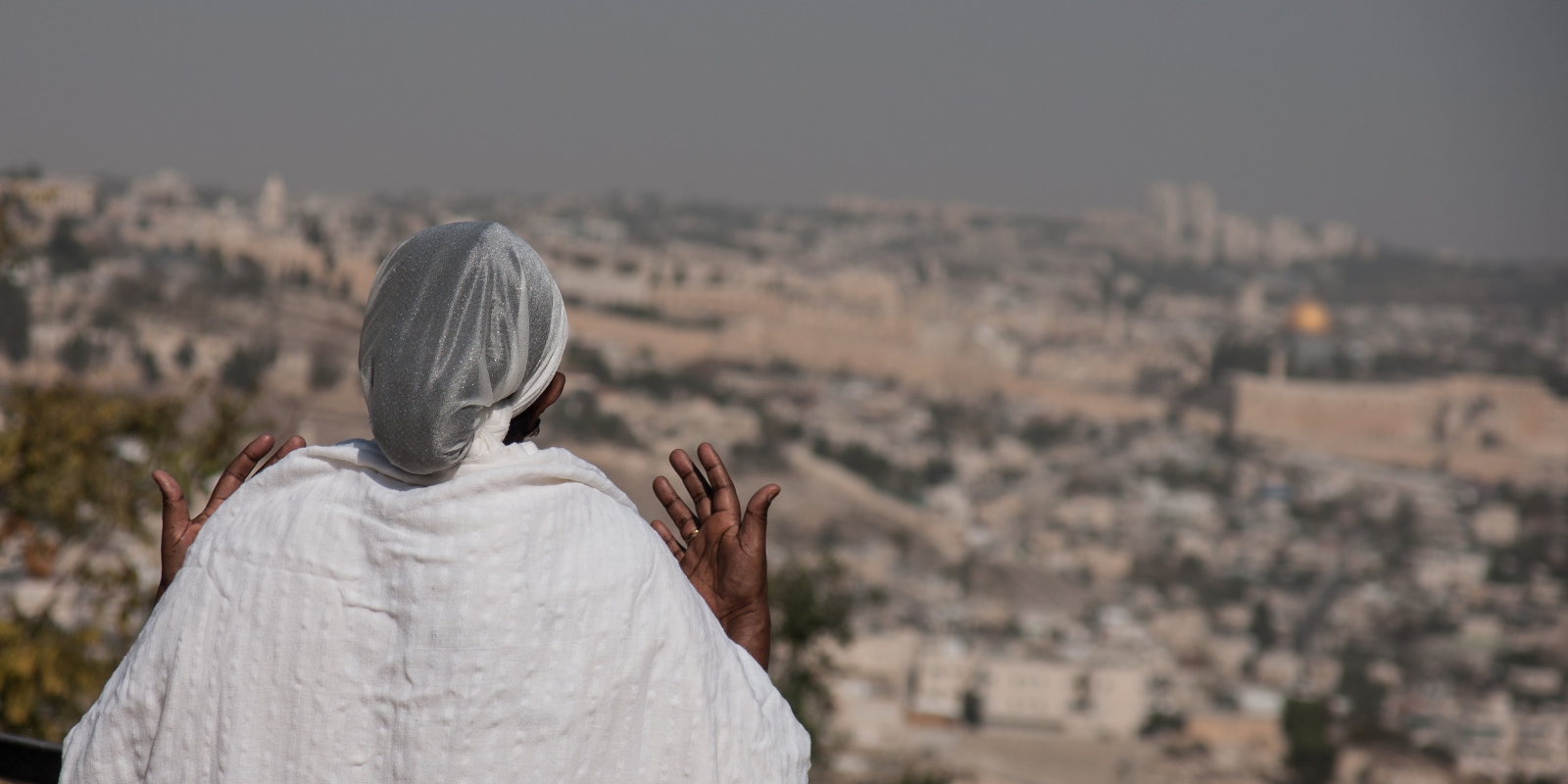
Before dawn on the 29th of Cheshvan, whole villages in the Ethiopian highlands began to climb. Grandparents leaned on walking sticks, parents carried small children, and the kessim, the community’s spiritual leaders, walked ahead holding a Bible written in Ge’ez, an ancient language almost no one else on earth could read. Nobody ate. When they reached the top of the mountain, they turned north toward a city more than a thousand miles away, and they began to confess their sins. At the edge of the crowd, women scattered grains of wheat on the ground and asked the birds to carry their prayers for the dead up to heaven.
Sigd is the holiday of the Beta Israel, the “House of Israel,” as Ethiopian Jews call their community. It falls on the 29th of the Hebrew month of Cheshvan, fifty days after Yom Kippur (the Day of Atonement). On that day the community fasts, prays, confesses its sins, and renews its covenant with God. In 2008, the Knesset made it a national holiday of the State of Israel.
On Yom Kippur Jews around the world fast, confess, and beg God for forgiveness. Why, seven weeks later, would Ethiopian Jews climb a mountain and do it all over again?
The answer begins with a tribe that made a terrible choice.
According to their tradition, Ethiopian Jews descend from the tribe of Dan. A ninth-century traveler named Eldad the Danite first recorded the connection, and in the sixteenth century Rabbi David ibn Zimra, the chief rabbi of Egypt, ruled that the Jews of Ethiopia were “without doubt from the tribe of Dan.” In 1973, Israel’s Sephardic Chief Rabbi, Rabbi Ovadia Yosef, relied on that ruling to recognize them as Jews.
Dan’s record in the Bible is troubling. In the days of the Judges, the tribe set up a carved idol in its territory and kept it there for generations (Judges 18:30-31). Then, after King Solomon died and the kingdom split in two, Jeroboam, the new king of the northern tribes, faced a problem. If his people kept going up to the Temple in Jerusalem, their hearts would drift back to the kings of Judah. So he gave them somewhere else to go:
The city of Dan became one of the two places where Israel bowed to a golden calf instead of going up to Jerusalem. After Assyria conquered the northern kingdom, the tribe went into exile. Traditions differ on exactly when it left the land, but its descendants eventually settled in the highlands of Ethiopia, cut off from the rest of the Jewish people for more than two thousand years. With no Sages among them to pass down the Oral Law, the teachings that explain and apply the written Bible, they held tightly to the plain meaning of Scripture.
One way to understand Sigd is as a direct answer to Dan’s sin. Jeroboam built his calves for one purpose, to keep the people away from Jerusalem. Sigd exists for the opposite purpose: an entire day devoted to longing for Jerusalem and renewing the covenant with the God of Israel. Even the name points back to the sin. Sigd means “bowing down,” from the same root as the Hebrew word sagad (to bow or prostrate oneself). In Dan, the ancestors bowed to a calf. Once a year, their descendants bowed toward Jerusalem.
The setting tells the same story. Jeroboam’s words to the people, “Here are your gods, O Israel, who brought you up from the land of Egypt,” were not original. Israel said almost the same thing about the first golden calf, at the foot of Mount Sinai (Exodus 32:4). Jeroboam was reviving the oldest sin in the nation’s history. The mountain the Jews of Ethiopia climbed on Sigd was meant to recall Sinai itself. Their ancestors in Dan chose an idol set on an altar by a king. Every year, their descendants climbed back up the mountain of God and chose Him instead.
But why isn’t Yom Kippur enough to atone for that sin? Here Beta Israel tradition refuses to let anyone off the hook. Yom Kippur is a day when each person examines his own life before God, but a people in exile cannot go home one person at a time. You can make peace with God on Yom Kippur and still be stuck in exile, because the return depends on the repentance of the whole community. For Beta Israel, Yom Kippur is the day that individual sins are forgiven, and fifty days later the community returns to fasting and prayer to seek forgiveness together as a people.
The model for this holiday comes straight from the books of Ezra and Nehemiah. After the Jews returned from Babylon, Ezra gathered the people in Jerusalem and opened the scroll of the law before them. They answered “Amen, Amen,” lifted their hands, then “bowed their heads and fell down before the LORD with their faces to the ground” (Nehemiah 8:6). Soon after Sukkot (the Feast of Tabernacles), with Yom Kippur behind them, they gathered again:
They confessed their ancestors’ sins, not only their own, and then they sealed a new covenant with God (Nehemiah 10). The Jews of Ethiopia turned that gathering into a yearly event. To this day, the kessim read Nehemiah 9 aloud on Sigd, as the community confesses, bows, and renews its covenant just as the returning exiles did in Jerusalem.
Sigd did not always fall on this date. Until the mid-nineteenth century, the community observed it on the 29th of Kislev, a month later. When they moved it, they placed it exactly fifty days after Yom Kippur, and many explain the choice by pointing to the most famous fifty-day count in the Bible. Shavuot, the Feast of Weeks, falls fifty days after Passover (Leviticus 23:15-16), and Jewish tradition marks it as the day God gave His law at Sinai. By following the same count from Yom Kippur, Sigd became a yearly return to Sinai.
On the mountaintop, the kessim read aloud from the Orit, their Bible in Ge’ez, and led the people in prayer. In the afternoon, they recited a memorial prayer for the dead, remembering every generation that died in exile without ever seeing Jerusalem. Then the shofar (ram’s horn) sounded, and the whole community followed the kessim down the mountain to the villages, where they broke their fast with singing, dancing, and a great feast, as if receiving God’s law for the first time.
Today, most Ethiopian Jews live in Israel. Every year on Sigd, thousands gather at the Western Wall and on the Armon Hanatziv promenade, where the Temple Mount spreads out before them. The kessim stand on a raised stage in their traditional robes, holding the scrolls under brightly colored umbrellas, and they read and pray in Ge’ez and in Hebrew. Their ancestors climbed mountains to look toward Jerusalem from a thousand miles away. Their children and grandchildren stand in it now.
Most of us, Jews and Christians alike, think of repentance as a private matter between ourselves and God. Sigd challenges that. Some sins belong to a family, a congregation, or a nation, and they don’t go away because each person feels sorry on his own. The descendants of Dan carried a sin their ancestors committed nearly three thousand years ago. Instead of shrugging it off as ancient history, they built a holiday to answer it, and they kept that holiday for centuries until it carried them home. What sins do our own communities carry together, and when did we last stand together to face them?
For centuries, the Jews of Ethiopia climbed mountains to look toward a city they never expected to reach. They fasted, they wept, and they sent their prayers north toward Jerusalem. Their grandchildren now stand at the Western Wall and look out over the Temple Mount from the Armon Hanatziv promenade, in the city their ancestors could only imagine.
You don’t have to imagine it either. This May, join Rabbi Elie Mischel and Rabbi Tuly Weisz on the Israel365 Heartland Tour, and walk the land of the Bible with two teachers who live here and love it. You’ll stand in Jerusalem, open the Bible where its stories happened, and see the return of the Jewish people with your own eyes.
Spaces are limited. Reserve your spot today!