







During the Soviet era, when practicing Judaism could cost a person his job or his freedom, something strange happened in Moscow once a year. Thousands of Jews gathered in the street outside the city’s main synagogue and danced. Most of them could not read Hebrew. Many had never kept a Shabbat or fasted on Yom Kippur. But on one night a year, they came out in public, as Jews, and danced with the Torah scrolls.
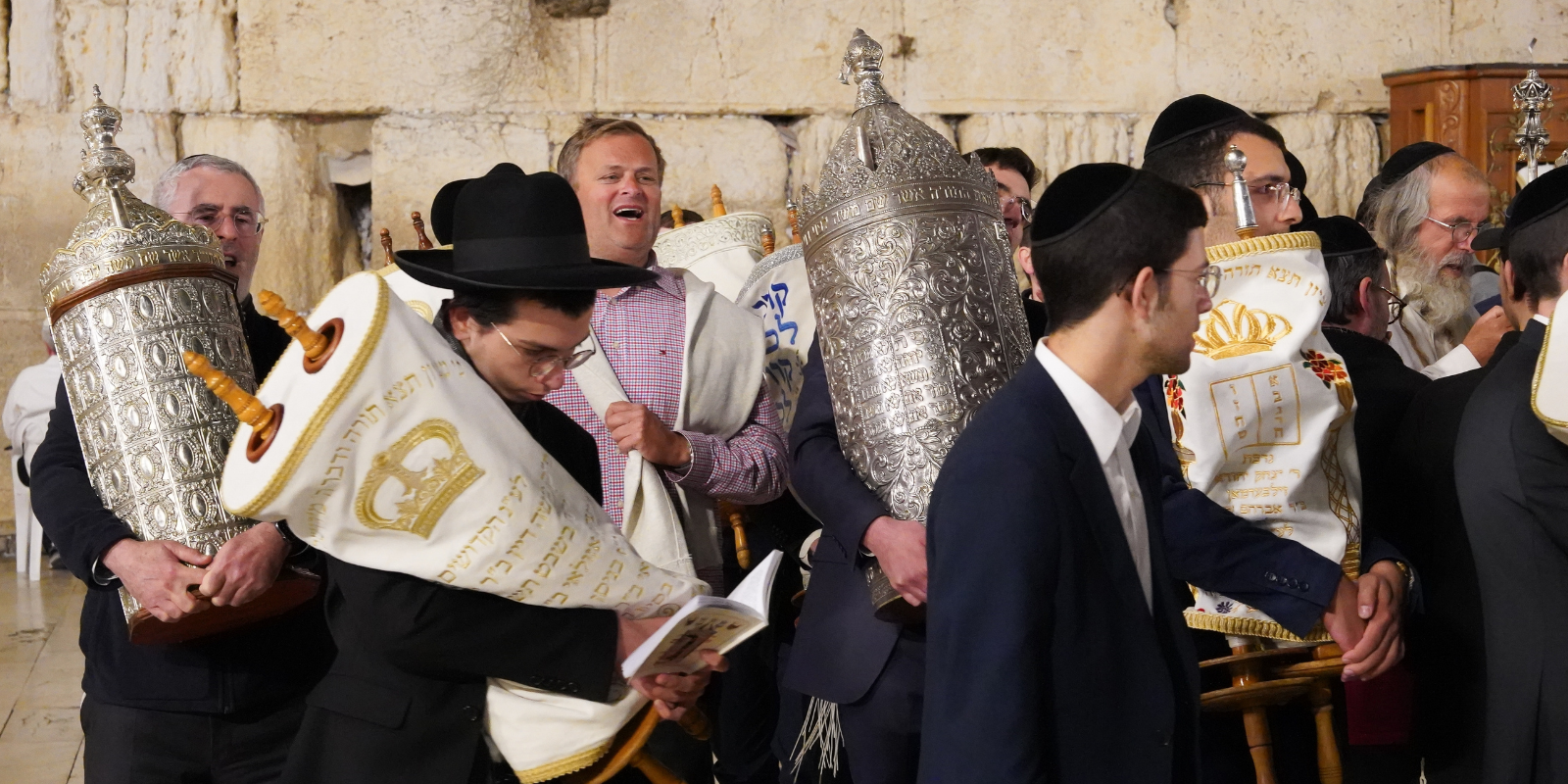
That night was Simchat Torah, “rejoicing with the Bible.” On this day, the last of the fall holidays, synagogues finish reading the final verses of Deuteronomy, immediately begin again with Genesis, and celebrate with seven circuits of dancing around the bimah, the platform at the center of the synagogue. These circuits are called hakafot.
As Rabbi Yitzchak Breitowitz points out, nothing in the Bible commands us to finish reading it in a yearly cycle, let alone to celebrate on this particular day. The custom developed many centuries after Sinai. And it raises an obvious problem. The Bible was given at Mount Sinai on Shavuot, in the late spring. If we want to celebrate the gift, why not celebrate it on the anniversary of the day we received it?
Why do Jews pour their greatest joy for the Bible into a day that has nothing to do with Sinai?
Rabbi Breitowitz answers by reminding us that the Torah was actually given twice.
The first time was on Shavuot. The people who stood at Sinai had spent seven weeks preparing, and in that moment they reached a level of purity they would never reach again. But it did not last. Forty days later, while Moses was still on the mountain, the people built the Golden Calf. Moses came down, saw them dancing around it, and shattered the tablets on the ground.
Moses went back up the mountain to plead for his people. God forgave them, and Moses came down with a second set of tablets. According to Jewish tradition, he came down on Yom Kippur.
The second gift was very different from the first. The first tablets were given to a nation at its peak. The second were given to a nation that had just fallen about as low as it could go, and had been forgiven. Rabbi Breitowitz calls this the Torah of the ba’al teshuva, the one who returns. It is a Bible given not to perfect people, but to flawed people who came back.
That is the Bible we celebrate in the fall. Hardly any of us can claim the perfection of the people at Sinai. But every one of us can claim the second tablets, because they were never given on the basis of perfection in the first place. As Rabbi Breitowitz puts it, this is a gift we cannot lose, no matter how far we stray. It is our birthright.
This explains the Moscow street. The Jews dancing there knew almost nothing of what was written inside the scrolls. But they understood, somewhere deep inside, that the scroll belonged to them anyway. Shavuot celebrates the Bible we received when we were at our best. Simchat Torah, coming just days after Yom Kippur, celebrates the Bible we receive when we return.
Then there is the dancing itself. Why circles, and why seven?
Rabbi Breitowitz cites the Kabbalistic teaching that circling seven times is a way of breaking down walls. The Bible’s clearest example is Jericho, whose walls fell after Israel circled the city once a day for six days and seven times on the seventh. The same idea lies behind the custom of a bride circling her groom seven times under the wedding canopy: to break down the walls that inevitably stand between two people, so that they can truly become one.
On Simchat Torah, we circle with the scrolls in our arms to break down the walls between us and God. The Vilna Gaon, the great 18th-century sage of Lithuania, taught that on this day the Shechinah, the Divine Presence, rests on the bimah itself. For that reason, Rabbi Breitowitz notes, he would not let anyone stand on the bimah during the dancing. The circles are a preview of a future the Sages describe, when God will gather the righteous in a circle with Himself at the center, and each one will point and say, “This is our God; we have waited for Him, and He will save us” (Isaiah 25:9).
The walls between us and God are built from our failures, the same failures that shattered the first tablets. Yom Kippur repairs the relationship. Simchat Torah celebrates it by dancing the walls down. Rabbi Yeruchem Leibovitz, the great spiritual guide of the Mir Yeshiva, once said he did not know which was more powerful, the prayers of Yom Kippur or the dancing of Simchat Torah. Both break down the walls between us and God.
On this date in the Hebrew calendar in 2023, Simchat Torah fell on Shabbat. Early that morning, as families prepared for synagogue and the dancing, sirens began to sound and Hamas terrorists broke through the border into southern Israel. By the end of October 7, about 1,200 people had been murdered and 251 had been dragged into Gaza as hostages. It was the deadliest day for the Jewish people since the Holocaust. In many synagogues, the hakafot never began.
It would have been understandable if the Jewish people did not feel like dancing on this date again. But Israelis have come back to the synagogue every year since, lifted the scrolls and danced.
The Bible itself shows us why. The very last verse of Deuteronomy, the one read just before the congregation starts again with Genesis, describes the great deeds Moses performed “before the eyes of all Israel” (Deuteronomy 34:12). Rashi explains that this refers to the moment Moses shattered the tablets in front of the people, and that God approved of what he had done. On the day we celebrate the Bible, its final words point to the moment it broke.
The Sages teach that when the second tablets were placed in the Ark of the Covenant, the broken pieces of the first were placed there alongside them. Israel carried both, the whole and the shattered, everywhere it went.
In Israel, Simchat Torah has always held both. Because it falls on the same day as Shemini Atzeret, the day includes Yizkor, the prayer in memory of the departed, as well as the dancing. Since October 7, the names remembered in Yizkor include the ones murdered on that very morning. And the same congregation that recites those names lifts the scrolls and circles the bimah seven times, carrying the whole and the broken together, just as the Ark did.
That is the Bible of the ba’al teshuva, the one who returns. It was never given to people who were whole. It was given to people who had seen something shatter and came back anyway. And every year on Simchat Torah, Israel proves it still knows how to receive it.