








The morning after Yom Kippur has its own kind of quiet. Or at least it does for a few moments. Just a day earlier, I stood in synagogue feeling as close to God as I will all year, promising Him and myself that this time things would be different. Then the morning arrives with its dishes, its emails and its traffic, and by lunchtime I have already lost my patience with someone I love.
Anyone who takes the High Holidays seriously knows this moment. We climb for forty days, from the first day of the month of Elul through Rosh Hashanah and the Ten Days of Repentance, and reach the summit on Yom Kippur. Then we have to come back down. The descent can be jarring, even discouraging, and it is tempting to decide that the day didn’t really work.
Jewish tradition says something surprising about exactly these days. According to the Sages, the four days between Yom Kippur and Sukkot are not counted. God does not begin recording our sins again until the first day of Sukkot. Why would He wait? If we were fully forgiven on Yom Kippur, why hold off on opening a new account? And what does that pause tell us about the fragile days that follow a spiritual high?
The teaching grows out of a single word in the Bible’s command to celebrate Sukkot:
Sukkot begins on the fifteenth day of the month (Leviticus 23:34), so the Sages asked why the Bible calls it “the first day.” Their answer: it is the first day for the reckoning of sins (Vayikra Rabbah 30:7).
To explain, the Midrash tells a parable. A certain city owed the king a large fine, and the king set out to collect it. When he was still ten miles away, the city’s leaders came out to greet him and honor him, and he canceled a third of the debt. As he came closer, the prominent citizens came out, and he canceled another third. When he reached the gates, the entire city, men, women and children, came out to welcome him, and he forgave the whole debt. “What is past is past,” the king told them. “From here on, we begin a new account” (Vayikra Rabbah 30:7).
The parable ends at the city gates. But when the Sages applied it to the Jewish calendar, they added a stage the parable never mentioned. On the eve of Rosh Hashanah, the leaders of the generation fast, and God forgives a third of the nation’s sins. Between Rosh Hashanah and Yom Kippur, the especially devout fast, and He forgives another third. On Yom Kippur everyone fasts, men, women and children, and God wipes the slate clean. So far, the story matches. Then they keep going. From Yom Kippur until Sukkot, the whole nation is busy with commandments, one with building his sukkah (the booth Jews dwell in during the festival) and another with preparing his lulav (palm branch). Only on the first day of Sukkot, when all of Israel stands before God holding the four species, does He say, “From here on, we begin a new account” (Vayikra Rabbah 30:7).
In the parable, the new account opens the moment the debt is forgiven. On the calendar, there are four extra days in between. What are they for?
The common understanding is that these days go uncounted because the people are busy with good deeds and commandments. It is a lovely picture. But busy is not the same as blameless. Building a sukkah can involve as much impatience as holiness, and the gap between Yom Kippur and real life shows up almost immediately. There must be more to it.
Rabbi Zalman Baruch Melamed points to a deeper reading from Rabbi Abraham Isaac Kook, the first Chief Rabbi of the Land of Israel. Rav Kook explains that repentance on Yom Kippur lifts a person so high that the soul is lit with the light of the World to Come. But that height comes at a price. It carries us away from the physical world, and the return has to be handled carefully. It is a little like stepping out of a dark theater into bright afternoon sun. For a few moments we can’t see clearly, and we have to wait for our eyes to adjust before we trust our steps.
Rav Kook warns that in this return it is easy to lose our balance. Losing our balance can happen in two directions. We can come crashing down into the very habits we renounced a day earlier. Or we can try to stay up in the clouds, impatient with dishes and errands and people who don’t seem to feel what we felt. Rabbi Melamed puts it plainly: one must not remain too elevated. Both the fall and the float are failures of proportion. During these four days, Rav Kook teaches, we have not yet found that proportion, and the holiness of Yom Kippur covers for us in the meantime.
Rabbi Melamed draws out the symmetry. The climb to Yom Kippur is gradual, beginning on the first of Elul and building for forty days. The descent must be gradual too. We come down in stages, not in one great leap. Only on the first day of Sukkot, when we take up the sukkah and the lulav, does ordinary life settle back into place with the right measure of holiness. That is why the fifteenth of the month is the first day of the new account.
Read this way, the pause is not a reward for four perfect days. It is an act of understanding. God knows that the person who walks out of Ne’ilah (the closing prayer of Yom Kippur) is not yet ready for the full weight of the world. So He does not start counting yet. He gives us room to land.
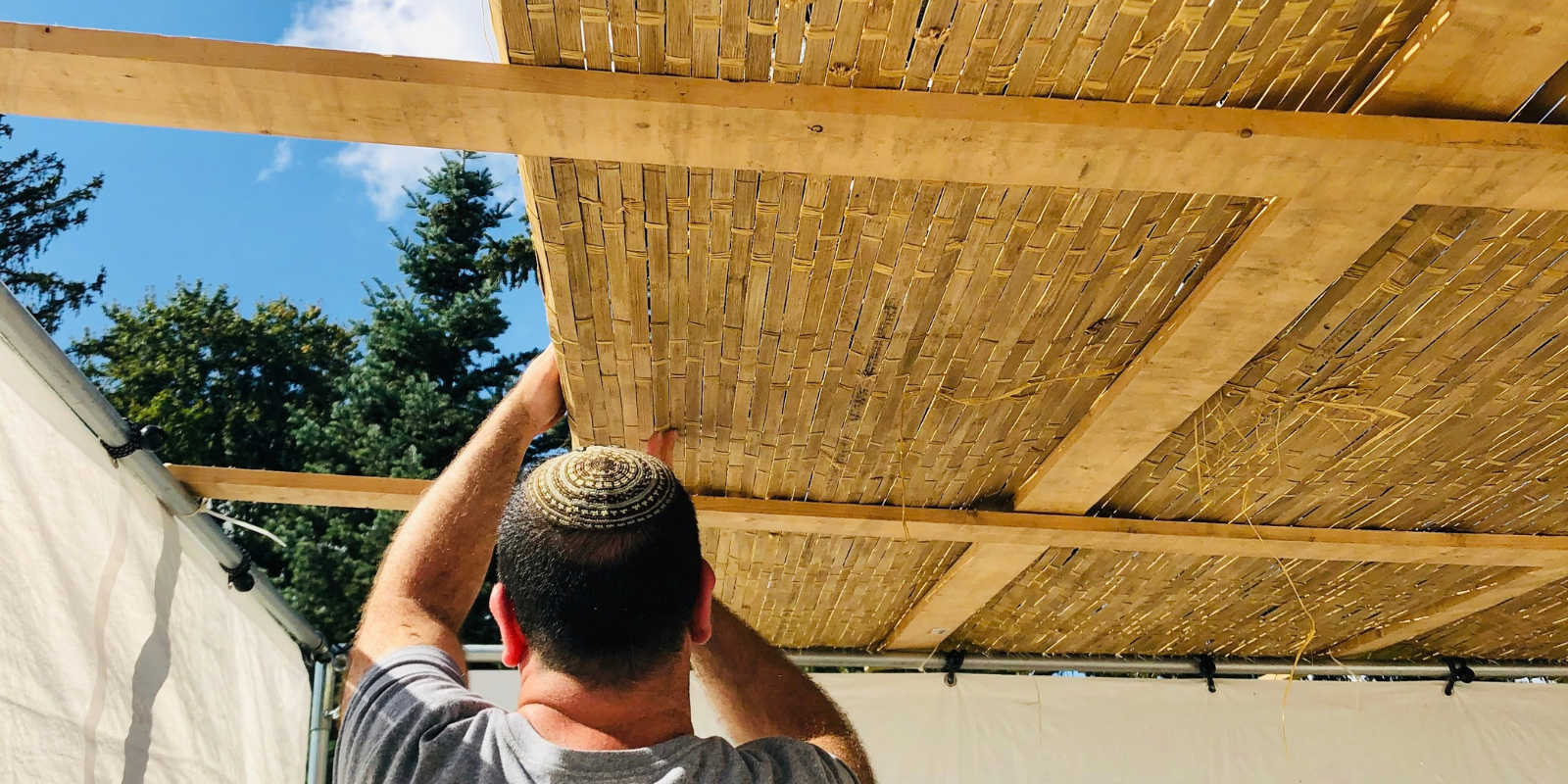
Where do we land? In a hut. The sukkah is a place where the most ordinary things, eating, talking, resting, even sleeping, happen in the presence of God. The one part of the sukkah that Jewish law cares about most is its roof, and that roof must be made of material that grew from the ground (Mishnah Sukkah 1:4). Above our heads is a piece of the earth, and through its gaps we can still see the sky. It keeps us from falling and keeps us from floating. It is not the synagogue and it is not quite our home. It is a halfway place, built for exactly the person Rav Kook describes: someone who has been very high and now needs to learn to live on the ground again without leaving holiness behind.
This idea speaks to anyone who has had a spiritual peak, whether on Yom Kippur, on a retreat, at a revival or on a first trip to Jerusalem. The return is always harder than we expect. We tend to read that difficulty as failure, as proof that the experience was not real. Rav Kook suggests the opposite. The difficulty is the natural cost of having been somewhere high, and God makes allowance for it.
So if this week feels less holy than you hoped, be gentle with yourself. The goal was never to live on the mountaintop, and it was never to rush back to life as it was. The goal is to carry what we found there into a sukkah with a leaky roof, a table with too many guests, and an ordinary life lived before God. The new account opens on Sukkot. Until then, He is not counting our stumbles. He is watching us find our footing.