








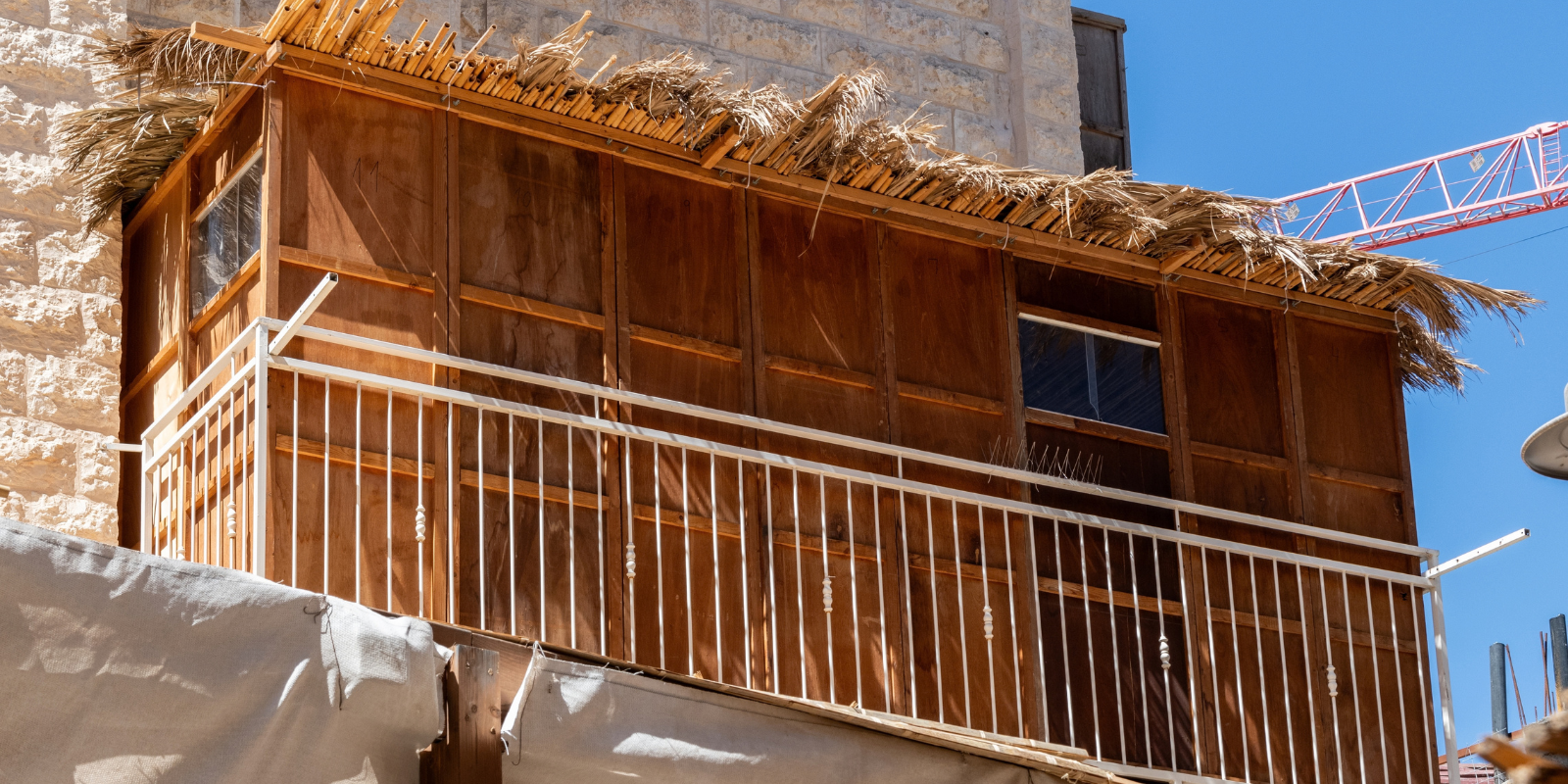
Sukkot gives us a physical way to experience ideas that can otherwise feel abstract.
That is one of the things Rabbi Tuly Weisz explores so beautifully in his Bible Plus course on Sukkot. The course begins with the biblical foundations of the holiday, but what stayed with me most was the way he connects the physical practices of Sukkot to much larger questions about trust, security, gratitude, joy, and our dependence on God.
For seven days, those ideas are not only things we think about. We leave our houses, carry our food outside, and spend time beneath a roof made of branches. We notice the wind. We notice when it gets chilly. We notice if it rains. We look up and can sometimes see the sky through the schach above us.
And suddenly, a very big question becomes much more immediate: What actually makes us feel safe?
The Israelites knew something about that kind of dependence. During their years in the wilderness, they did not have permanent homes, fields producing crops, or the ordinary structures people rely upon to create stability. And yet, looking back on that period, the prophet Jeremiah records God saying, “I remember the devotion of your youth, your love as a bride, how you followed Me in the wilderness, in a land not sown” (Jeremiah 2:2).
That is such an unexpected way to remember the wilderness.
We tend to think about those years in terms of difficulty. The uncertainty. The complaints. The hunger and thirst. But this verse remembers something else too. Israel followed God into a place where they could not possibly provide everything for themselves.
There is trust in that.
And every year, we recreate a small piece of that experience. Of course, our sukkah is not the wilderness. We know our solid homes are only a few steps away. We have refrigerators and running water and weather apps telling us whether we should bring a sweater outside. But for one week, we deliberately loosen our grip on some of the structures that usually make us feel secure.
Rabbi Tuly spends time in the course exploring this exact tension. The sukkah is intentionally temporary. Its roof lets in starlight and rain. We still use our homes, our resources, and the tools available to us, but for a short time we live with a greater awareness that those things are not the ultimate source of our security.
And then the Torah gives us another command that almost seems to pull in the opposite direction: rejoice.
Deuteronomy describes Sukkot as a time when we are to celebrate with our families and communities, including the stranger, the orphan, and the widow, and concludes with the command to be joyful. Rabbi Tuly points out that this is not accidental. Sukkot comes at the end of the harvest, at the exact moment when people might be most tempted to look at full storehouses and believe that their own work alone produced their security.
That combination is fascinating to me. Leave the permanent house. Sit beneath a temporary roof. Remember how little is completely within your control.
And rejoice.
In truth, those ideas are not opposites at all.
Maybe joy becomes deeper when it is not dependent on everything around us feeling completely secure first.
That does not mean pretending hard things are easy. It does not mean that planning, working, saving, or protecting ourselves are somehow signs of insufficient faith. The course is careful about that distinction. The sukkah is not an argument against responsibility. It is a reminder to keep responsibility in perspective.
For one week, the sukkah makes that distinction unusually difficult to ignore.
We eat differently. We live differently. We look up more often. We become a little more aware of the weather, of the people sitting beside us, and of just how many things have to go right every day that we cannot manufacture entirely on our own.
Rabbi Tuly also connects this experience to gratitude and simplicity. When we step away, even briefly, from some of the comforts and routines we usually depend upon, we often begin to notice more clearly what we have been given and what actually matters.
And then, after seven days, we go back inside. Of course, the return back to normalcy is part of the wisdom of too. We do not need to abandon our houses in order to remember that the walls were never the whole story. Sometimes we just need one week outside to see them differently.
Rabbi Tuly Weisz’s full course on Sukkot goes much deeper into these themes, from the biblical foundations of the holiday to its spiritual meaning, its connection to joy and trust, and even the prophetic vision of Sukkot’s future. You can access this course, along with many more Bible studies just like it, now on Bible Plus.