








This teaching is drawn from a new Bible Plus course by Dr. Tuvia Book, “Biblical Archaeology.”
Imagine two teams of workers, standing at opposite ends of a mountain, given nothing but hand axes and a task that sounds impossible. Start digging toward each other through solid rock, with no compass, no laser level, no way to hear or see the other team, and somehow end up in the same place. No modern engineer would attempt this without sonar and satellite mapping. And yet nearly 2,700 years ago, under the city of Jerusalem, two teams of Israelite workers did exactly that, and the proof is still there for anyone to walk through today.
This is not a legend passed down through oral tradition with no way to verify it. It is a documented engineering feat, described in the Bible itself, and confirmed by an inscription carved by the very men who dug it. So here’s the question worth sitting with: why would a king go to this kind of trouble, digging a tunnel 1,200 cubits long through bedrock, when it would have been far easier to simply build a bigger wall and hope for the best?
The answer starts with a king named Hizkiyahu, Hezekiah, who ruled Judah during one of the most dangerous periods in its history. The Assyrian Empire, the superpower of the ancient Near East, had already crushed the northern kingdom of Israel in 722 BCE and scattered its ten tribes. Judah was next, and Hezekiah knew it. The single greatest vulnerability of Jerusalem was its water supply. The main source, the Gihon Spring, sat outside the city walls, which meant that in a siege, Jerusalem’s own water could be cut off or poisoned by the enemy camped right beside it. Every empire in the region knew this weakness. So Hezekiah decided to remove it entirely.
The Bible records what he did in a single understated sentence:
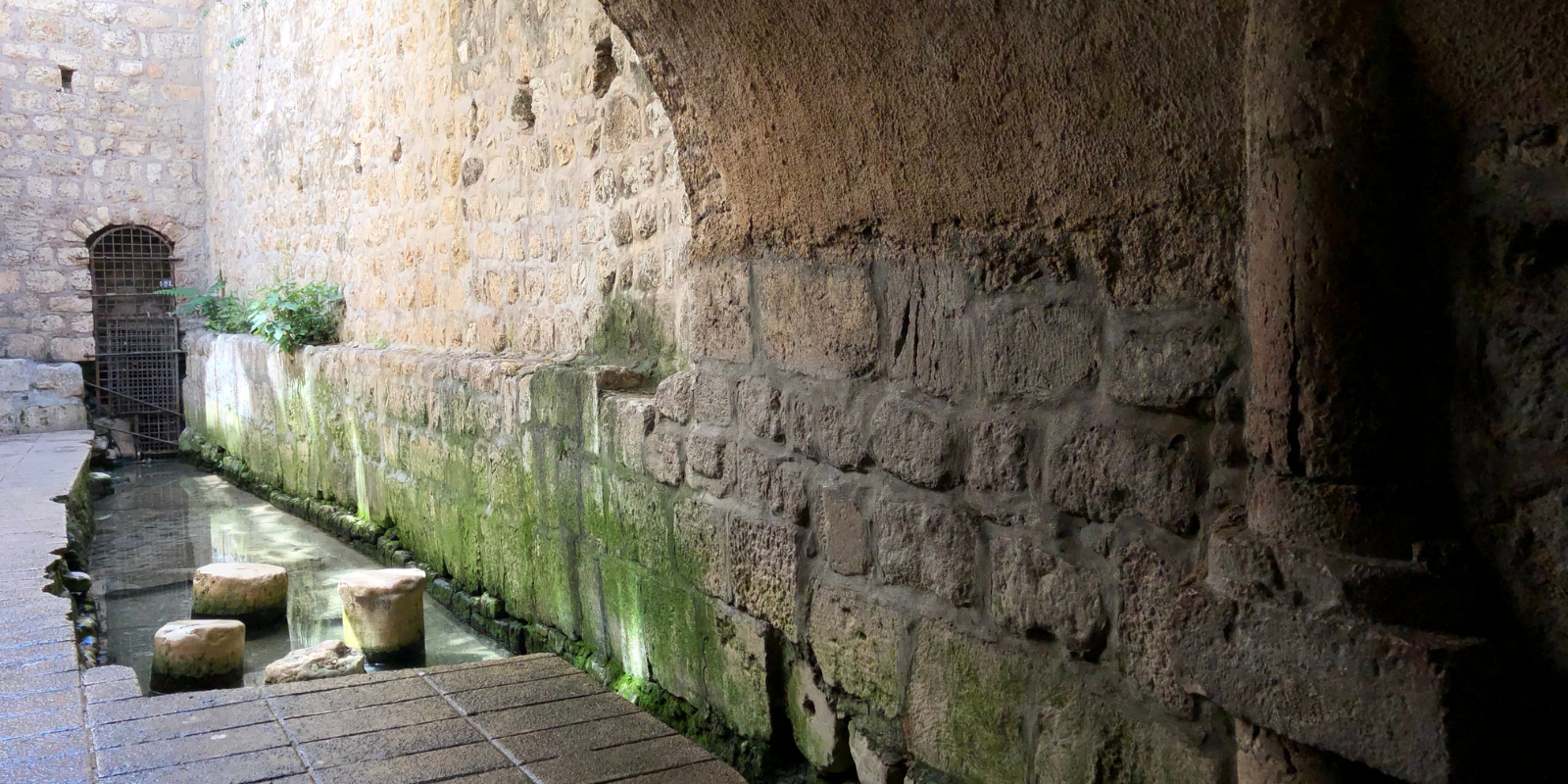
Read past that verse quickly and you’ll miss what actually happened. Hezekiah commissioned a tunnel to be carved through solid rock, redirecting the Gihon Spring’s water into a pool safely inside the city walls, at the Siloam Pool, the Shiloach. Then he camouflaged the original spring source outside the walls so the Assyrians, when they came looking, could not find it.
Here is what Dr. Book found that makes this more than an engineering curiosity. In 1880, a group of boys playing near the tunnel’s exit discovered an inscription carved directly into the rock wall, right at the spot where the two digging teams met. Written in Paleo-Hebrew, in the same script used during Hezekiah’s actual reign, the inscription describes the moment itself: the workers hearing each other’s voices through a crack in the rock as they closed the final gap, swinging their axes toward one another until they broke through, axe against axe. The water then flowed from the spring to the pool exactly as planned.
What the inscription does not say is just as telling as what it does say. It never mentions God. It never mentions Hezekiah’s name. It is not a religious document or royal propaganda. It is a plain, almost businesslike account written by engineers describing a job well done. And that is precisely why it matters so much. This was not composed to convince anyone of anything. It was carved by workers with no reason to exaggerate or invent a story, and it matches the biblical account down to the geography, the timeline, and the script.
Consider what this means. Skeptics can dismiss ancient religious texts as legend all they want. It is much harder to dismiss a hydraulic engineering project you can still walk through with your own feet, filled with water flowing along a measurable one-tenth of one percent gradient, connecting two points that two separate teams somehow met in the middle of solid bedrock without modern tools. The Bible said Hezekiah built it. The rock confirms he did.
This is what makes the Hezekiah tunnel different from so much of what people call biblical archaeology. It is not a single artifact sitting behind museum glass. It is not a fragment you have to take on faith was interpreted correctly. It is a functioning piece of ancient infrastructure, still doing exactly what it was built to do, still carrying water through the mountain beneath Jerusalem after nearly three millennia.
Dr. Tuvia Book’s full course walks through Hezekiah’s tunnel alongside two other remarkable finds: the Tel Dan Stele, the first archaeological proof of King David outside the Bible, and the Assyrian monument that confirms a battle involving King Ahab that the Bible itself never mentions. If Hezekiah’s tunnel captured your attention, wait until you see what else has been carved in stone.
Bible Plus is our online Bible study platform, built for anyone who wants more of the Hebrew Bible in their life. Sign up for as low as $5 a month with an annual subscription, or $7 a month if you’d rather go month to month. Inside, you’ll find an incredible community of people who all want the same thing: to go deeper into the Old Testament, taught by real scholars and teachers who know the text and the land it came from.
New courses are added every month, and you can hop around and choose whatever speaks to you. There’s no set path here. Go at your own pace, and let the Bible meet you where you are.