








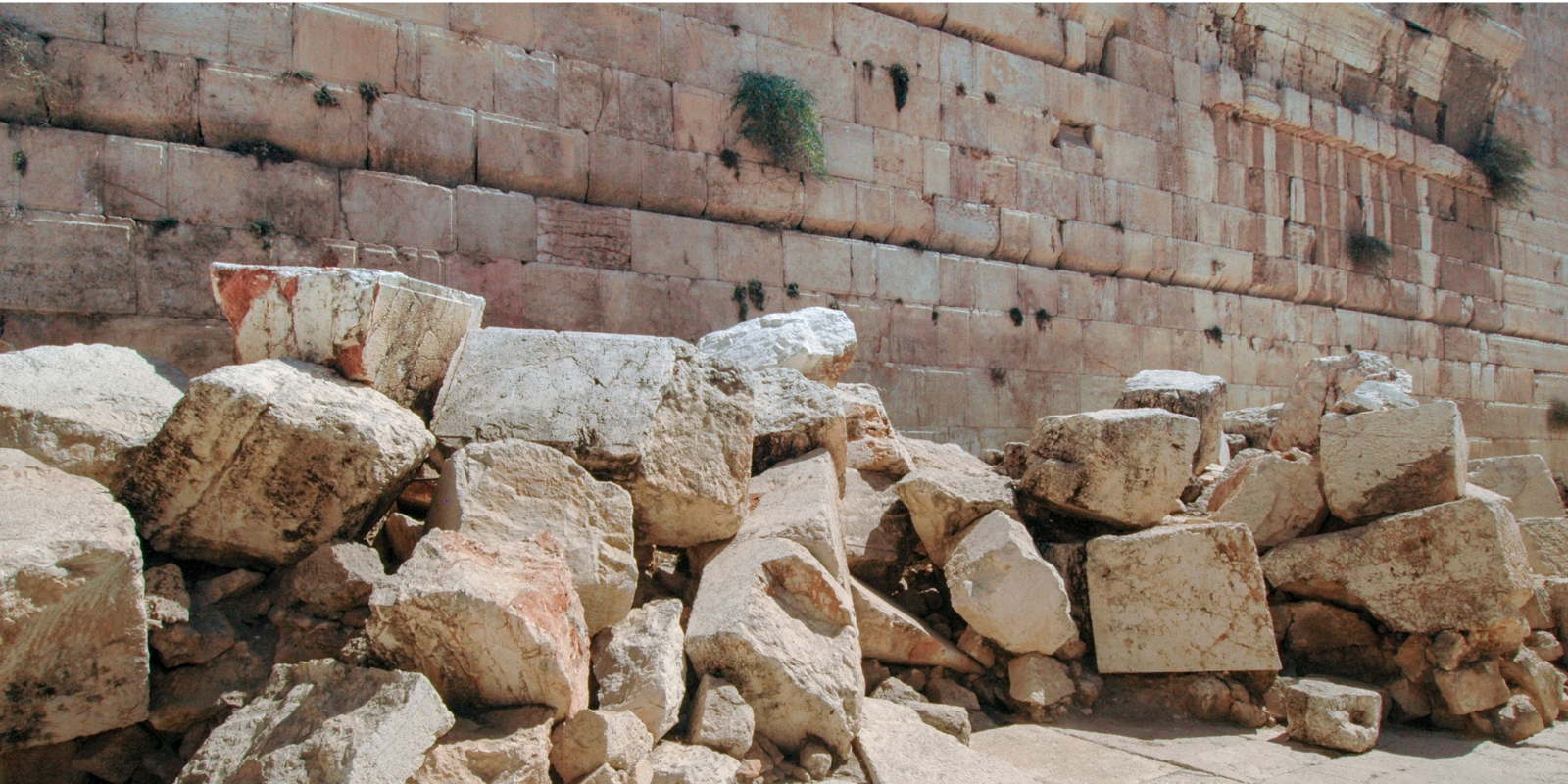
Tonight begins Tisha B’Av, the saddest day on the Jewish calendar. Both Temples were destroyed on this date, centuries apart. So was Betar, the last stronghold of the Bar Kochba revolt. The expulsion from Spain took effect on this day in 1492. And over the centuries it became the day on which we mourn all the tragedies that have befallen the Jewish people as well, gathering the Crusades, the pogroms, the Holocaust, and now October 7 into a single day of grief.
So tonight we sit on the floor like mourners and read the Book of Lamentations, in which Jeremiah walks through the ruins of Jerusalem and describes what he sees. A city once full of people now sitting alone like a widow. Mothers unable to feed their children. Princes hunted like deer. Jeremiah does not soften any of it, and the book does not build toward a happy ending. Its final verse gives no comfort at all: “For truly, You have rejected us, bitterly raged against us” (Lamentations 5:22).
That is where the scroll ends. But that is not where we end.
When the reader reaches the final verse, he stops, backs up, and the congregation repeats the second to last verse out loud with him. Only then do we close the book. Of everything in Lamentations, that one line is what we choose to carry out of the room:
Rabbi Adin Steinsaltz reads the Hebrew words exactly as they are written: return us to You, Lord, and if You do so, we will return, willingly and actively. God moves first. Only then do we.
That seems backwards. Malachi lays out the order plainly: “Return to Me, and I will return to you, said the Lord of Hosts” (Malachi 3:7). We take the first step. Heaven answers. The one who walked out is the one who has to walk back in. So why, at the lowest moment in the Hebrew Bible, does Israel reverse the terms?
Because there are two ways a return begins, and Scripture describes both.
Sometimes a person sees clearly what he has done. The guilt is sharp, the failure obvious, and something inside him rises up and says: enough. That is Malachi’s teshuvah (repentance/return). The people initiate, and God comes to meet them.
But other times the fall is too deep for that. Jeremiah is describing a nation whose city is burned, whose leaders are dead, whose survivors are scattered and starving, a people whose “dance has turned into mourning” (Lamentations 5:15). Ask a man in that condition to generate his own inspiration and you are asking for something he does not have. He cannot return to a Father he can no longer feel. What he needs first is a sign that he is still wanted. Elsewhere, Jeremiah hears exactly this prayer coming from Ephraim: “Receive me back, let me return, for You, O Lord, are my God” (Jeremiah 31:18). Bring me back first. Then watch how fast I run.
Now ask which kind of generation we are.
For nineteen centuries our people prayed hashiveinu, take us back, and the answer seemed to be silence. Then, within a single lifetime, Jews came home from Yemen and Morocco and Poland and Ethiopia and Russia. A dead language started being spoken by children in the street. Hills that Isaiah described as desolate now grow wheat and grapes. Jerusalem, the city Jeremiah found sitting alone, has more Jews living in it today than at any point in history.
Rav Kook taught his generation to read the return to Zion as teshuvah in progress, a national return that begins in the physical rebuilding of the Land and rises from there toward the soul of the nation. That is why he could see holiness in pioneers who did not think of themselves as religious at all.
The first word of the verse has already been answered. God took the first step. He showed us the love we spent two thousand years asking for.
Which leaves the second word sitting there, unfinished.
V’nashuva. And we will return.
If that sounds like an odd thing to dwell on during a day of mourning, look at what we read from the Torah on Tisha b’Av morning.
Rabbi Joseph B. Soloveitchik noted that this was a deliberate choice. The lamentations we recite on this day are pure grief, and the prophetic reading matches them. Then the Torah reading interrupts with something else entirely, calm and matter of fact: you have cried, and you were right to cry, and the answer to all of it is teshuvah. However far you have traveled from God, Rabbi Soloveitchik insisted, the road back is never blocked. Tisha B’Av is not only a day of disaster. It is a challenge, and teshuvah is the response the day is asking for.
God has already answered the first half of the verse in full view of the entire world. He has begun to renew our days as of old. The return He is waiting for now is ours.