








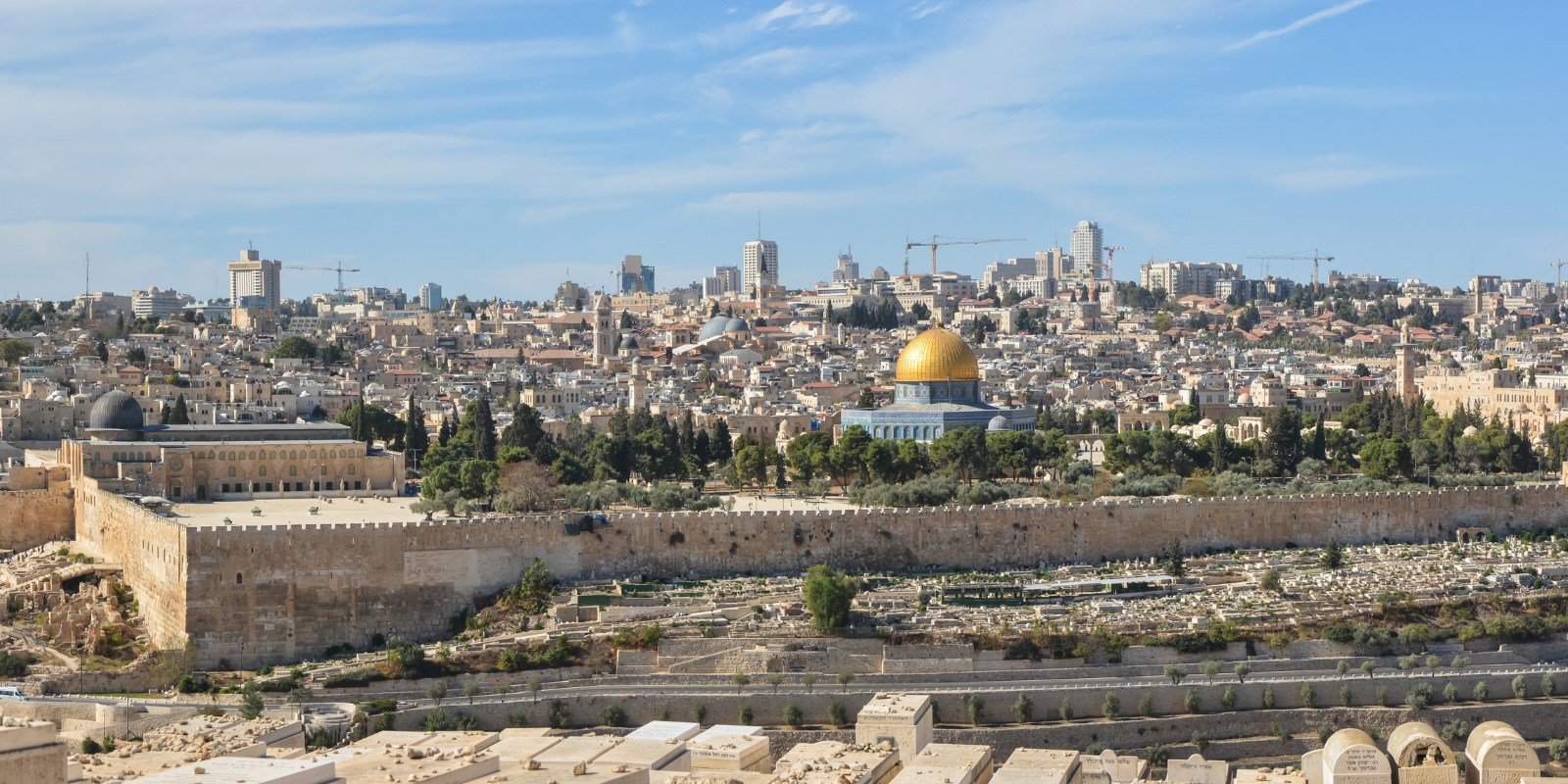
On June 7, 1967, Israeli paratroopers reached the Western Wall. For nineteen years Jordan had kept every Jew away from it, and for nineteen centuries before that, Jews scattered across the world had turned toward that mountain in prayer three times a day.
Those stones are the retaining wall of the Temple Mount, the western face of the platform that held up the Temple itself. The Temple stood on Mount Moriah, the summit where Abraham bound Isaac and where Solomon later built the House of God. That mountain is the place God chose, the site every one of those prayers was aimed at across nineteen centuries and six continents.
Moses refers to “the place that the Lord your God will choose” sixteen times in the Torah portion of Re’eh. He says it over the sacrifices, over the tithes, over the release of debts, over each of the three festivals. More than twenty times across the book of Deuteronomy. But he never names the place.
Jerusalem does not appear by name a single time in the Five Books of Moses. The city that would hold the Temple, the city David would capture, the city the exiles would face in prayer from Baghdad and Vilna and Marrakesh, and Moses leaves the space blank. The name finally surfaces in the book of Joshua, where it belongs to a Canaanite king who hears that Israel has taken Ai and starts assembling a coalition against them (Joshua 10:1).
Moses is standing on the plains of Moab delivering the last address of his life, mapping out where his people will worship God. Why not tell them exactly where they are going?
Maimonides gives three answers. First, had the surrounding nations known which city God had chosen, they would have fought to hold it. Second, the Canaanites living there would have destroyed it rather than hand it over. Third, and most dangerous, the twelve tribes would have gone to war with each other over whose portion would contain it. That third one is not hypothetical for a nation that had already watched Korah rebel over who gets to serve at the altar.
Look at the news on any given week and the first of those three is still running. The nations are arguing over whose city it is, whether it should be divided, whether a capital can be recognized. Eight centuries after he wrote it, Maimonides is still right.
But the verse says something more, and it is easy to read past. “You shall seek out His dwelling and come there” (Deuteronomy 12:5). Not wait for it. Seek it.
God had used this construction before, and both times He used it on Abraham. Go to the land that I will show you (Genesis 12:1). Take your son to one of the mountains that I will tell you (Genesis 22:2). A destination commanded and withheld in the same breath. Abraham walked three days toward a mountain nobody had named for him, and the mountain was Moriah.
Moses is doing to the nation what God did to its founder. The withholding is not only a security measure. The walk toward an unnamed place is itself what is being asked for, because a relationship with God is not a location you are handed. It is something you go looking for. An early rabbinic commentary on this verse presses exactly that point: do not wait for a prophet to announce the site. Search, find it, and then the prophet will confirm what you found.
David searched. And the confirmation came on the worst day of his life. A plague was tearing through the nation when the prophet Gad told him to build an altar on the threshing floor of Araunah the Jebusite (II Samuel 24:18). Araunah offered him the land free, the oxen free, the wood free. David refused. “I will not offer to the Lord my God burnt offerings that have cost me nothing” (II Samuel 24:24).
He paid full price for a hilltop in the middle of an epidemic. Fifty shekels of silver for the threshing floor and the oxen, and Chronicles records six hundred shekels of gold for the site itself (I Chronicles 21:25).
Rashi notes where that gold came from. The threshing floor lay in the portion of Benjamin, but David collected the payment from every tribe in Israel. Set that beside Maimonides and the shape of it emerges. The catastrophe he feared, twelve tribes at war over who owns the holiest ground, was headed off by a king who made all twelve of them buy it together. No tribe could claim the mountain, because every tribe had paid for it.
That threshing floor is Mount Moriah. Scripture says so directly: Solomon began to build the House of the Lord in Jerusalem on Mount Moriah, at the place his father David had designated, the threshing floor of Ornan the Jebusite (II Chronicles 3:1). The mountain Abraham climbed, the hill David bought, and the platform whose western wall still stands are one location.
Then the Temple burned, and burned again, and the question became what happens to a commandment to seek a place when the place is unreachable.
It is taught in the name of Rabbi Menachem Mendel Schneerson that because exile would scatter Jews across the earth and force them to reach God from everywhere, any place of prayer and Torah study becomes the place where God causes His name to dwell. Ezekiel had promised precisely this. God would be a small sanctuary for His people in the lands where they had gone (Ezekiel 11:16), which the sages understood as the synagogue and the study hall. The relationship survived the address. This, Rabbi Schneerson said, is another reason why Moses left the place unamed.
But a small sanctuary was never a replacement sanctuary. Solomon built the exile instructions into the dedication of the Temple itself, praying that when Israel was carried off to the land of its enemies and turned back toward their land, toward the city God chose, and toward the House he had built, their prayers would be heard (I Kings 8:48). Every synagogue in Babylonia, Spain, Poland, and Morocco was constructed facing one hill. And the Talmud teaches that those buildings will not be left behind when the Temple stands again. The synagogues and study halls of the exile will be transported to the Land of Israel (Megillah 29a). Even the improvised sanctuaries are going home.
The search was never called off. It was carried.
Moses left a blank space in the Torah because he was not describing a place we would be given. He was describing a place we would have to come and take hold of. The inheritance was never in doubt. The arrival was.
Abraham walked three days toward a mountain he could not name. David refused to take that mountain as a gift and bought it at full price in the middle of a plague, with silver and gold collected from every tribe in Israel. Jews who had no hope of reaching it built rooms that faced it for nineteen hundred years. That is the Jewish claim to that hill, and it is not written on a deed. It is written in the fact that we never stopped moving toward it.
The space is still blank. The command still stands. Seek out His dwelling, and come there.