








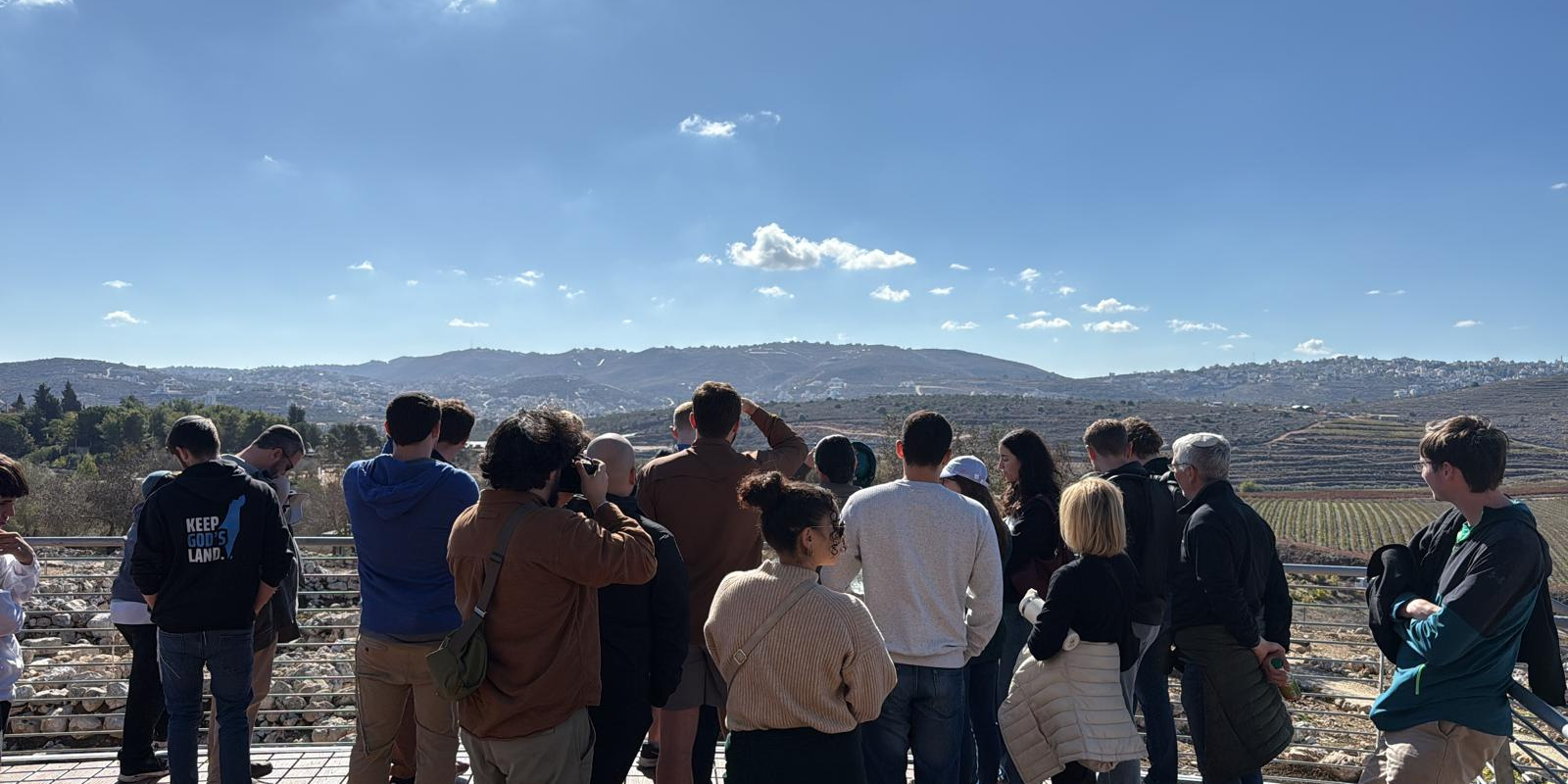
The hills of Shiloh look almost exactly as they did three thousand years ago.
That is the first thing that stops you. You expect Israel to feel ancient and remote, like a museum exhibit behind glass. Instead it feels immediate. The same limestone ridges. The same dry wind moving through the same valley. The same sky that watched the Mishkan — the Tabernacle — stand on this hilltop for three hundred years as the beating heart of an entire nation.
The young leaders who came to Shiloh on Israel365’s Young Leadership Trip stood on that hill and felt something they were not entirely prepared for. One of them put words to it afterward:
“Right now, especially my generation, Gen Z and young millennials, we’re looking for something deeper. For years, we’ve been very surface level, and now we’re looking for deeper relationships, deeper connections. And for anyone who claims to be a Christian, if you’re looking for that deepness, no matter your political affiliation, no matter what your belief about Israel is or isn’t, I think the number one reason Christians need to come to Israel, especially young Christians, is because what we’re searching for – meaning and depth and realness in our lives and relationships – we need to look back to where the most important part of our identity is. And ultimately, that’s here in Israel.”
Shiloh is where you go to find that. But Shiloh is not only a place of beauty. It is a place of catastrophe.
This is what most people do not know. Shiloh was Israel’s first great destruction, centuries before the Temple, centuries before Babylon. The Philistines came, captured the the Holy Ark and burned the sanctuary. The prophet Jeremiah later invoked Shiloh as shorthand for total devastating loss:
And yet Israel did not end there. Hannah had prayed in Shiloh. She stood in that same sanctuary, wordless with grief, pouring everything she had toward God.
Out of that weeping came Samuel, the prophet who would anoint the first kings of Israel. Out of Shiloh’s deepest grief came Israel’s next chapter. This is the pattern this land keeps repeating. Destruction is not the final word. It never has been.
The young leaders did not only stand in Shiloh. They stood at the Me’arat HaMachpelah in Chevron, where Abraham purchased the very first piece of this land and buried Sarah inside it.
That cave is still there. The Jewish families living around it are still there.
They sat at Shabbat tables in Efrat, where Rachel was buried on the road. “So Rachel died and was buried on the road to Efrat, which is Bethlehem.” (Genesis 35:19)
The matriarch is still there. So are her children. So are their children.
And then the bus drove south. And the mood shifted.
The Nova music festival site is flat, open ground. Just a field, a few memorial markers, the same dry grass and open sky that 364 young people danced under on the last night of their lives. You stand there and you think of Shiloh. Of Hannah weeping. Of a nation that has absorbed blow after blow across three thousand years and is still, incomprehensibly, here.
The young leaders standing at Nova were, without knowing it, fulfilling a prophecy. Their presence on this ground, their willingness to come, to feel it, to carry it home, that is what makes Israel rise. One of them said it simply:
“This trip is one of a kind in many ways. But my favorite reason, and probably the most unique reason, is that this is going to be the only trip where young Christians and Jews are coming to Israel together to understand the depth and the richness from both perspectives, but also to understand what it is that unites us. And that, I think, is not only unique, but so important.”
What unites them is harder to name than it is to feel. The weight of standing somewhere that matters. The recognition that this land is not a backdrop to history. It is where history is still being made, fought for, lived. The sense that being here was not accidental. That something called them across an ocean to stand on this ground at this moment.
Every young leader who makes this trip goes home different. They are the person in the room who has actually been there, who stood in Shiloh and understood why this land cannot be divided, who sat at a Shabbat table in Efrat and understood why these families will not leave, who stood in the dry grass at Nova and understood what October 7th actually was.
They go home as witnesses. And witnesses change rooms.
Hannah wept in Shiloh, and from her weeping came a prophet who changed Israel’s history. These young leaders are going home as something Israel needs just as badly today.
“Behold, a people that rises like a lion, and lifts itself like a young lion; it does not lie down until it devours the prey.” (Numbers 23:24)
That lion is awake. Help send the nations to walk beside it.