








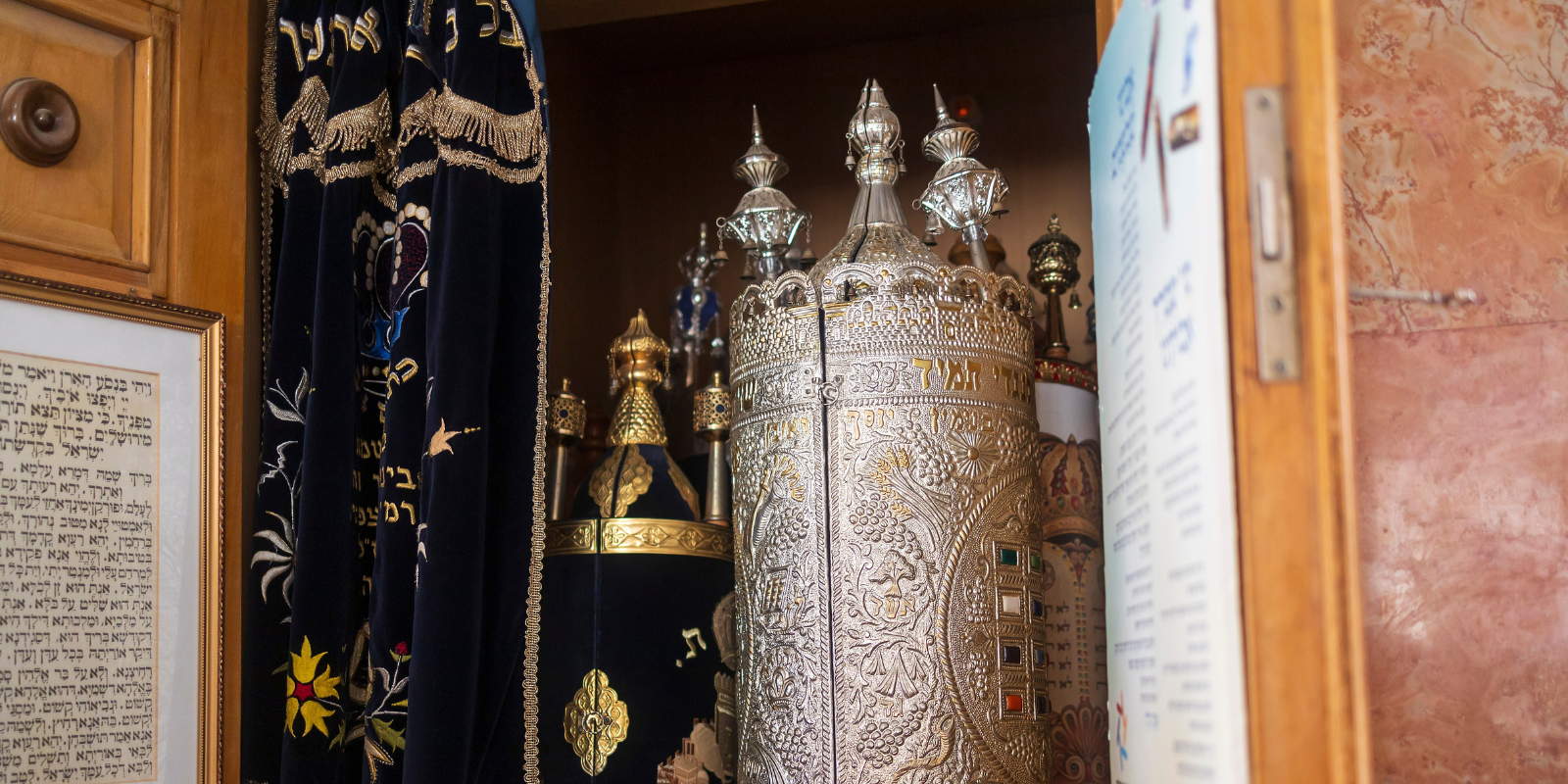
While Rom Braslavski spent two years underground in Gaza, a man named Tzachi Amoyal began to write a Torah scroll, dedicating it “to the hasty return of the abducted soldier Rom Braslavski.” A Torah scroll contains 304,805 letters. Every one of them went onto the parchment except the last, and that one Amoyal refused to write. It would stay empty until Rom came home to fill it in himself.
Amoyal waited, and Rom came home. Video from the dedication shows him bent over the parchment with his hand resting on the scribe’s, the two of them closing together the letter that had been holding a place for him. “Father,” he said, addressing God directly, “thank you for the privilege of having a Sefer Torah in my name.”
I do not know where that particular scroll is kept today, but it is safe to assume it was brought into a synagogue, where it can be taken out and read publicly. That is what a Torah scroll is for. It belongs in the ark, in the room set aside for holiness, surrounded by people who came there to hear it.
Which makes the following law in Parshat Shoftim very strange.
Israel’s king receives a commandment that applies to no one else:
The Hebrew phrase mishneh haTorah is translated here as “a copy of this Teaching.” But the word mishneh means double, or repeat, and is understood by the Sages to mean the king wrote two scrolls rather than one.
Rabbi Moshe Sofer, known as the Chatam Sofer, draws the obvious conclusion from the requirement to read every single day. This is not a devotional practice. The king is being told to consult the Torah before he rules, so that no decree leaves his throne room without first passing through God’s law.
But the more revealing detail is what the king did with the two scrolls. The medieval commentator Rashi explains that one accompanied him wherever he went, out to war, into court, through the streets of Jerusalem. The second was placed in his treasury, the vault where the gold and the silver and the jewels were kept under guard.
This is surprising. A Torah scroll belongs in a synagogue, or at least in a personal library of Hebrew books. Why did the king keep one in his treasury?
Rabbi Ephraim Mirvis, Chief Rabbi of the United Hebrew Congregations of the Commonwealth, states the reason plainly. The Torah was housed in the part of the palace that stood for materialism, so that when the king consulted it every day of his reign, spirituality would triumph over materialism and the word of God would guide him in everything he did.
The passage itself points the same way. Two verses before the commandment to write the scrolls, the king is warned away from the three things most likely to ruin him: too many horses, too many wives, and silver and gold amassed to excess (Deuteronomy 17:16-17). The Torah names the danger and then places a Sefer Torah inside it. Solomon accumulated all three, and Scripture is blunt about where that led him.
Israel’s king was not permitted the arrangement most of us settle for, where spirituality occupies one carefully maintained corner of life and everything else runs on its own logic. The scroll in his treasury was a permanent ruling on which of the two was in charge.
Joseph governed Egypt this way centuries before there was a king in Israel to command it.
When he finally revealed himself to his brothers, he sent them home to Canaan with a message for their father: “God has made me lord over all Egypt” (Genesis 45:9). Read plainly, it is a report on his career. Sold as a slave, imprisoned on a lie, and now second to Pharaoh.
Rabbi Menachem Mendel Morgensztern of Kotzk, known as the Kotzker Rebbe, read the Hebrew against the grain, and Rabbi Mirvis brings his reading here. Samani Elokim does not only mean “God has made me.” It can be understood as “I have made God,” and what Joseph made God was adon lechol Mitzrayim, lord over all Egypt. Joseph is not describing his promotion. He is describing his policy.
Every grain decision, every appointment, every emergency measure during seven years of famine passed through a single question in Joseph’s mind: what does God want done here? He held the most powerful administrative post in the ancient world, and he used it to install a Ruler above himself. That is the same instruction the king of Israel would later receive in the form of a scroll placed among the treasure. Joseph simply did it without being told.
We don’t all own a Torah scroll, but we do all have a treasury. It is the room where the household budget gets decided, or the office where the quarter’s numbers get reviewed, or the hour of the day when the calculation of what something will cost quietly overrules the question of whether it is right. The room varies. The temptation does not. We are all capable of running two separate operations, one governed by God and one governed by the spreadsheet, and of never letting them meet.
The king was forbidden that arrangement. Joseph refused, running Egypt on God’s terms when he could have run it on Egypt’s.
Tzachi Amoyal made his own calculation, and by every reasonable measure it was a bad one. A Torah scroll sat ninety-nine percent complete, and there was no evidence whatsoever that the young man in the tunnels was coming back. Closing that last letter would have been the sensible move. Leaving it open was a statement about who was actually running things, made at a moment when every number said otherwise.
That is what it looks like when the Torah is kept in the treasury. Not a scroll set safely apart from the hard rooms of our lives, but a scroll placed exactly where the hard decisions get made, close enough to overrule us.