






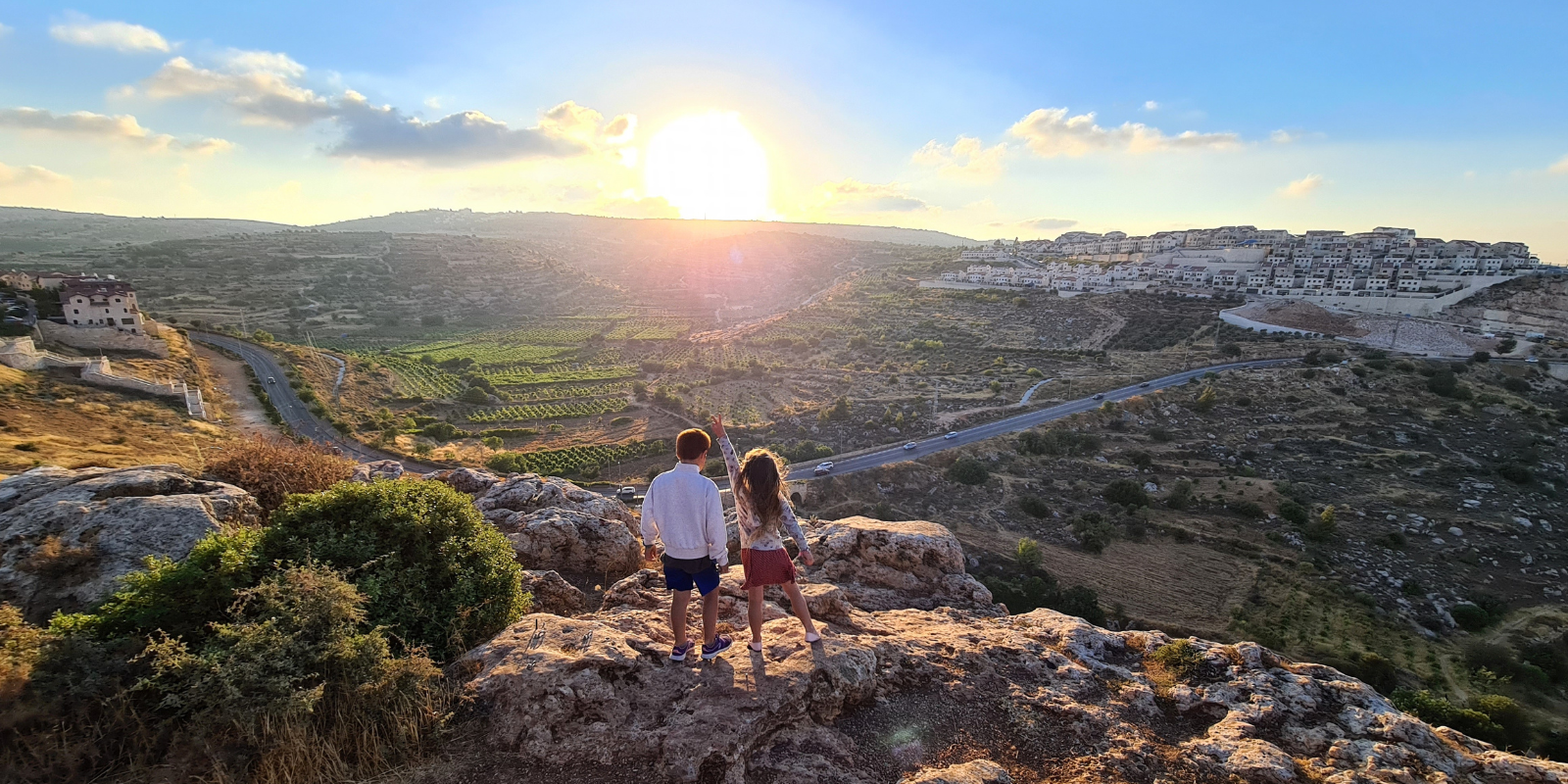
One recent Friday night, nearly one hundred young Christian leaders from Eagles’ Wings walked through the streets of Efrat, Israel, as the sun went down over the Judean hills. They had been matched with local families for a night none of them expected to feel so personal. These were Christian leaders in a Jewish community in the biblical heartland, being handed the Sabbath table in a form they could actually follow, and by most accounts, nobody at those tables wanted the evening to end.
It is a striking image: representatives of the nations, brought not to hear about Torah but to sit inside it for an evening, without being asked to become Jewish in order to do so. And it is not, in fact, a new idea. It is written into stone.
This week’s Torah portion, Ki Tavo, opens with Israel standing at the edge of the land they have waited forty years to enter. Before a single city is conquered, before a king is crowned, before the nation has done anything at all as a sovereign people in its own territory, Moses gives an unusual command.
Set up large stones, he says, plaster them, and write on them all the words of the Torah, very clearly. The Hebrew phrase, ba’er heitev, means not merely written, but made distinctly legible.
Why does the very first act of a nation entering its homeland involve publishing its founding document in the clearest possible terms? Rabbi Joseph ben Isaac of Orléans, a 12th-century French rabbi known as the Bechor Shor, explains that letters should be legible and easily seen. In other words, it should be clear and accessible to all.
Rashi, citing the Sages, offers a different interpretation. The phrase ba’er heitev means that the Torah was inscribed on those stones in seventy languages, the languages of each of the seventy nations of the world. Israel was not building a wall around Sinai’s inheritance. At the literal border of the land, in its first act of sovereignty, the nation was instructed to make sure that anyone passing through could stop, read, and understand exactly what this people believed and why they were there.
This is the whole argument of Universal Zionism in a single verse. We tend to think of Jewish particularity and universal mission as being in tension, that the more specific and set-apart Israel’s covenant becomes, the less it has to do with everyone else. Ki Tavo says otherwise. Israel’s task has always been to serve as a light unto the nations, and the establishment of a sovereign Israelite kingdom in its own land is not a distraction from that mission but the very thing that makes it possible. God did not ask the seventy nations to become Israelites in order to read what was written at Gerizim and Ebal. He asked Israel to make its own inheritance legible to other people so that the word of God would be accessible to all.
That is precisely the model quietly operating in Efrat that night. The young leaders who walked through the Zayit neighborhood were not being asked to cross into Israel’s covenant. They came as Christians and left as Christians. What changed was access: Shabbat table booklets in hand, a family beside them at every step, the Sabbath translated for one evening into a form they could actually enter rather than simply observe from a distance. Rabbi Tuly Weisz, watching the phenomenon play out again and again, called the experience magical for a simple reason: guests who had only ever read about Shabbat were suddenly living inside it, for one night, in their own language and at their own pace. That is the seventy languages at Ebal, translated into the language of the twenty-first century.
The stones at Gerizim and Ebal have long since crumbled to dust, and no one alive has seen them. But the instinct behind them has not disappeared. This week, as we read of a people commanded to inscribe its Torah in every tongue at the very moment it entered its own land, it is worth remembering that the impulse is still very much alive. When a Christian guest in Efrat sat down to a Shabbat table she had never seen before and did not want the night to end, she was taking part in something that began not with her, and not even with her hosts, but with a nation standing at the Jordan, plastering stones so that anyone could find their way to what was written there. This was what those seventy nations were always meant to find at Ebal, not just words they could decode, but something close enough to move them. That was never just an act of translation. It was an invitation.