








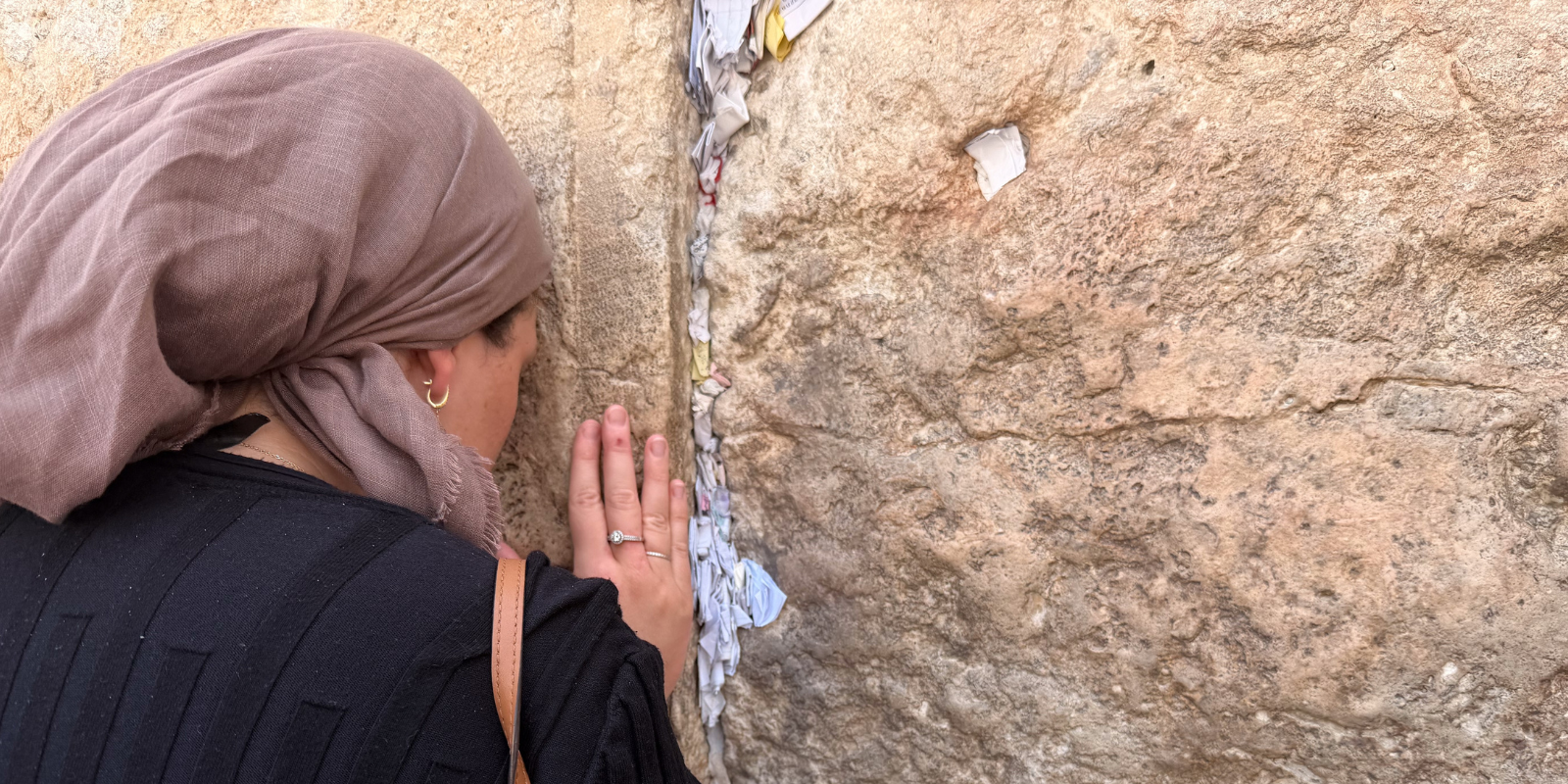
On the first morning of Rosh Hashanah, the reading from the Prophets is not a coronation, not a battlefield, not a vision of the end of days. It is the story of a woman who could not have children.
Her name was Hannah. Her husband Elkanah had a second wife, Peninnah, who had children and made sure Hannah never forgot it. Once a year the household traveled up to the sanctuary at Shiloh to offer sacrifices, and every year Peninnah used the occasion to torment her. Hannah would weep and refuse to eat. Then everyone would go home, and the next year the same thing would happen again.
On one of those visits Hannah got up from the family meal and went to pray on her own. She prayed silently, her lips moving without sound, which was strange enough that Eli the priest assumed she was drunk and told her to sober up.
That is the reading the Sages chose for the Day of Judgment, and the Sages explain why: Sarah, Rachel, and Hannah were all remembered on Rosh Hashanah (Rosh Hashanah 10b). All three barren women conceived on this day.
Hannah’s prayer was answered on Rosh Hashanah, and the son she was begging for was Samuel, who would grow up to anoint Israel’s first two kings.
But look closely at the story and something does not add up. Hannah had been going up to Shiloh year after year. The text says so plainly:
She was not a woman who had neglected to pray. She had been praying for a very long time.
So why this year? What was different about this particular prayer, in this particular moment, that finally moved heaven?
The answer is hiding in the sentence right before she prays, and it comes from an unlikely source: her husband.
Elkanah sees his wife crying at the festival meal and tries to comfort her:
Read that in a warm voice and it sounds like devotion. A husband telling his wife that she is enough for him, that their marriage does not depend on children, that he loves her regardless. But Rabbi Joseph B. Soloveitchik heard something else entirely.
He heard a man who genuinely loved his wife and genuinely could not reach her. Elkanah was not being cruel, and he was not being selfish. He was trying to help. He simply could not feel what she was feeling. He saw a wife who was sad and thought sadness was the problem, so he offered her the thing he had to offer, which was his own love. What he could not grasp was that the ache she carried was not an empty space his devotion could fill. It was a loss with its own shape, and he could not stand inside it.
So he asked the question a person asks when they have run out of understanding. Am I not better to you than ten sons? Hannah gives no answer. The text records none. What could she have said to a man who loved her and still could not relate to what she was feeling?
And in that instant, Rabbi Soloveitchik taught, Hannah understood something she had not understood in all the previous years of going up to Shiloh. She was alone. Utterly, completely alone. The one human being on earth who was supposed to carry this with her could not carry it, could not even name it correctly. There was no one left to lean on. No one to intercede for her, pray on her behalf, or help her attain the thing she wanted most.
That is when her prayer changed. Real tefillah, prayer, is not a religious exercise performed by a person who is basically fine. It is what happens when a human being runs out of everything else. As long as there is another door to knock on, another person to call, another plan to try, prayer stays polite and shallow. It becomes real only in the moment a person discovers there is nothing between them and God.
That is the moment the text records.
The Hebrew is marat nefesh, literally “bitter of soul,” a phrase describing something that has gone all the way down. Not disappointment. Not sadness. Bitterness that has reached the floor of a person.
And then she prays in a way no one in the Bible has prayed before her.
The Sages notice this and treat Hannah as the master teacher of prayer, deriving law after law from her few verses (Berachot 31a). That a person praying must direct their heart. That the words are spoken quietly, with only the lips moving. That one does not pray while drunk. The entire architecture of Jewish prayer, the silent Amidah that Jews recite three times a day standing before God, is built on the model of a heartbroken woman at Shiloh who had run out of people to talk to.
When Eli accuses her of being drunk, her answer is the definition of what she is doing. She has not been drinking, she tells him. “I was pouring out my soul before the LORD” (1 Samuel 1:15).
Not reciting. Pouring out.
Four verses later the Bible reports the result with almost no fanfare: “and the LORD remembered her” (1 Samuel 1:19). The Hebrew verb is vayizkereha, from the root zachar, to remember. It is the same root that gives Rosh Hashanah one of its biblical names, Yom HaZikaron, the Day of Remembrance. On the day God remembers the world, He remembered Hannah.
So what does this have to do with us? Most of us treat loneliness as a problem to be solved. When something breaks in our lives, we look for the person who will understand. We find the friend, the spouse, the pastor, the rabbi, the group of people who have been through the same thing, and there is real value in all of it. But somewhere underneath the search is an assumption that if we could just find the right human being to fully understand us, the ache would resolve.
No one will fully understand. Not even the person who loves you most. That is not a failure in the relationship, it is the condition of being a person.
Hannah’s discovery was that this is not the end of the road. It is the beginning of one. The place where human understanding runs out is exactly where prayer starts, and it turns out that place is not empty. Someone is already there. “They cry out, and GOD hears, and saves them from all their troubles. GOD is close to the brokenhearted; those crushed in spirit are delivered.” (Psalm 34:18-19).
Rosh Hashanah puts every one of us in Hannah’s position. The shofar sounds and no one can stand in for you. Your spouse cannot answer for you, your children cannot answer for you, your reputation cannot answer for you. You are alone before the King, holding whatever you are actually holding.
Hannah walked into that aloneness and discovered she was not alone in it. Neither are we.