








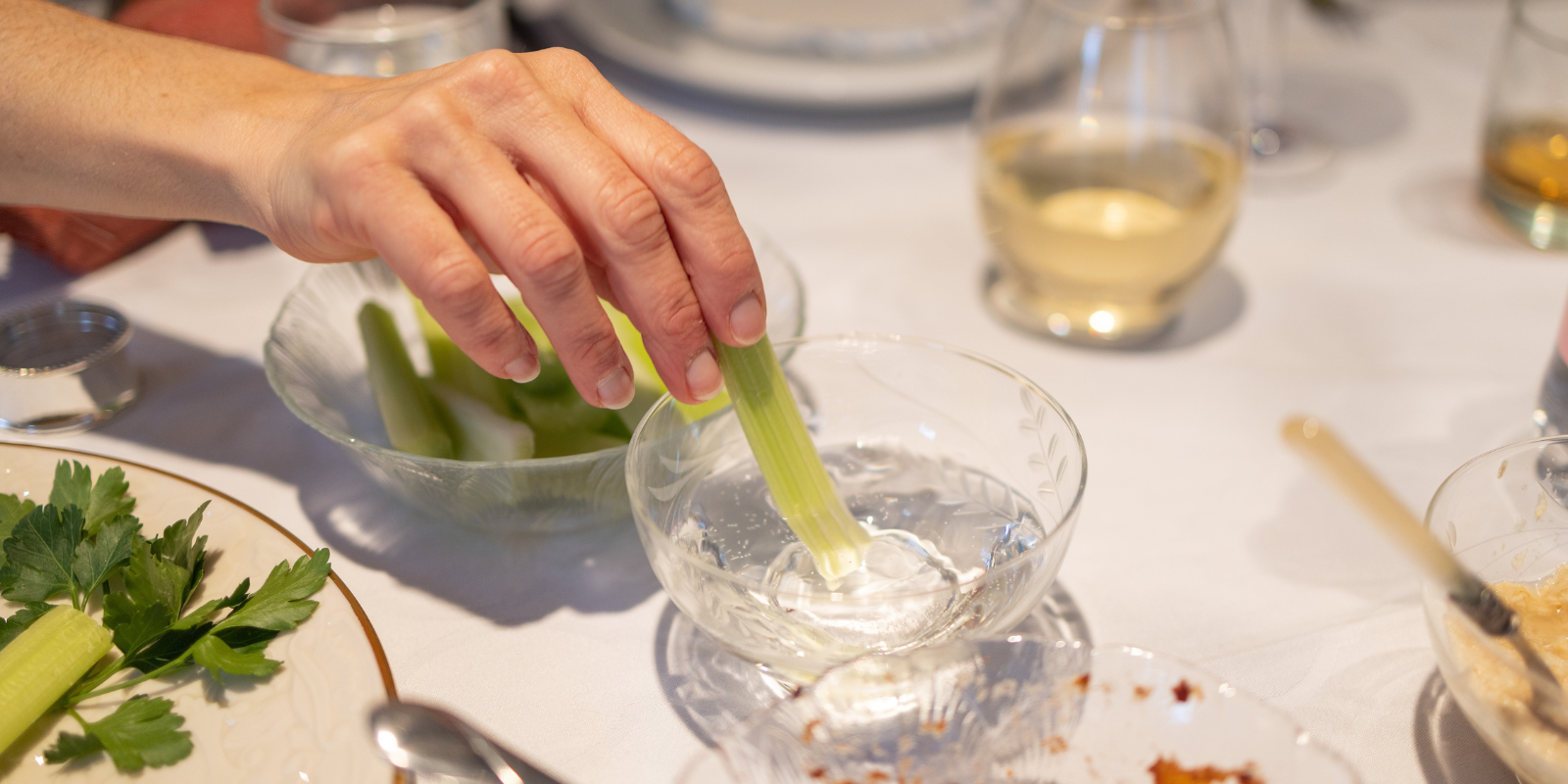
Near the beginning of the Passover Seder — the ritual dinner at which Jews retell the story of the Exodus — every participant dips a piece of vegetable into salt water and eats it. The traditional explanation is straightforward: the dipping is unusual enough to catch children off guard and prompt them to ask questions — and keeping children engaged is one of the Seder’s central goals.
That is the standard explanation. But the 19th-century rabbi Shlomo Kluger noticed something hidden in the ritual that points in a very different direction.
The Hebrew word for this vegetable is karpas. It is an obscure term that appears in the Book of Esther, where it describes a fine type of wool. Rashi, the most important medieval Bible commentator, explicitly identifies this wool as the same material used in the coat of many colors — ketonet passim — that Jacob made for his son Joseph. The very coat that Joseph’s jealous brothers stripped from him before throwing him into a pit, then dipped in goat’s blood and presented to their father as proof that Joseph was dead.
In other words: every Passover, before a single word of the Exodus story is told, every Jew at the table picks up a piece of karpas and dips it — reenacting, in miniature, the dipping of Joseph’s coat in blood. So argues Rabbeinu Manoah, a 13th-century scholar from Provence, in his commentary on Maimonides’ Mishneh Torah. The Seder opens not with Egypt, but with the act of betrayal that sent Joseph to Egypt in the first place.
Rabbi Jacob J. Schacter, who drew attention to Rabbi Kluger’s insight, points out that this is not the only place Joseph appears at the Seder. Every participant at the Seder drinks four cups of wine over the course of the evening. One reason the Sages give for this practice is that the word “cup” appears four times in Joseph’s conversation with Pharaoh’s imprisoned butler, as Joseph interprets the butler’s dream:
The four cups that Jews raise on the night of Passover, Rabbi Schacter notes, are an echo of those four cups mentioned in Joseph’s dungeon.
Joseph’s coat. Joseph’s conversation. Why does Joseph keep appearing at the Seder?
Rabbi Schacter’s answer cuts to the heart of what Passover is actually teaching. The Exodus story is dramatic and unambiguous — ten plagues, the sea splitting, an entire nation liberated in a single night. God acts openly and overwhelmingly, and no one watching could mistake what is happening. But Joseph’s story looks nothing like that. His life is a series of ups and downs: But Joseph’s story looks nothing like that. His life is a series of ups and downs: from favorite son to slave, from trusted overseer of his master’s household to prisoner, from prisoner to second-in-command of all Egypt. The road is long, circuitous, and often looks like it is heading nowhere. The Torah never even records a direct conversation between Joseph and God.
That, says Rabbi Schacter, is precisely why Joseph belongs at the Passover table. Redemption does not always arrive the way it did in Egypt. Sometimes it looks like the Joseph story — slow, complicated, and invisible to everyone living through it. By weaving Joseph into the very fabric of the Seder, the Jewish people acknowledge that there are two models of redemption, and that both are real. The dramatic and the gradual. The sudden and the step-by-step.
On the night that celebrates the greatest redemption in Jewish history, we are reminded not to mistake our own difficult and circuitous moment for the absence of redemption. We may simply be living inside a Joseph story — still waiting for the dungeon chapter to end.
Want to learn more about Passover? Passover from the Inside: A Jewish Guide for Christian Readers walks you through the entire holiday — the rituals, the rabbinic debates, the songs, the theology, and the living tradition behind all of it. Order Passover from the Inside today!