








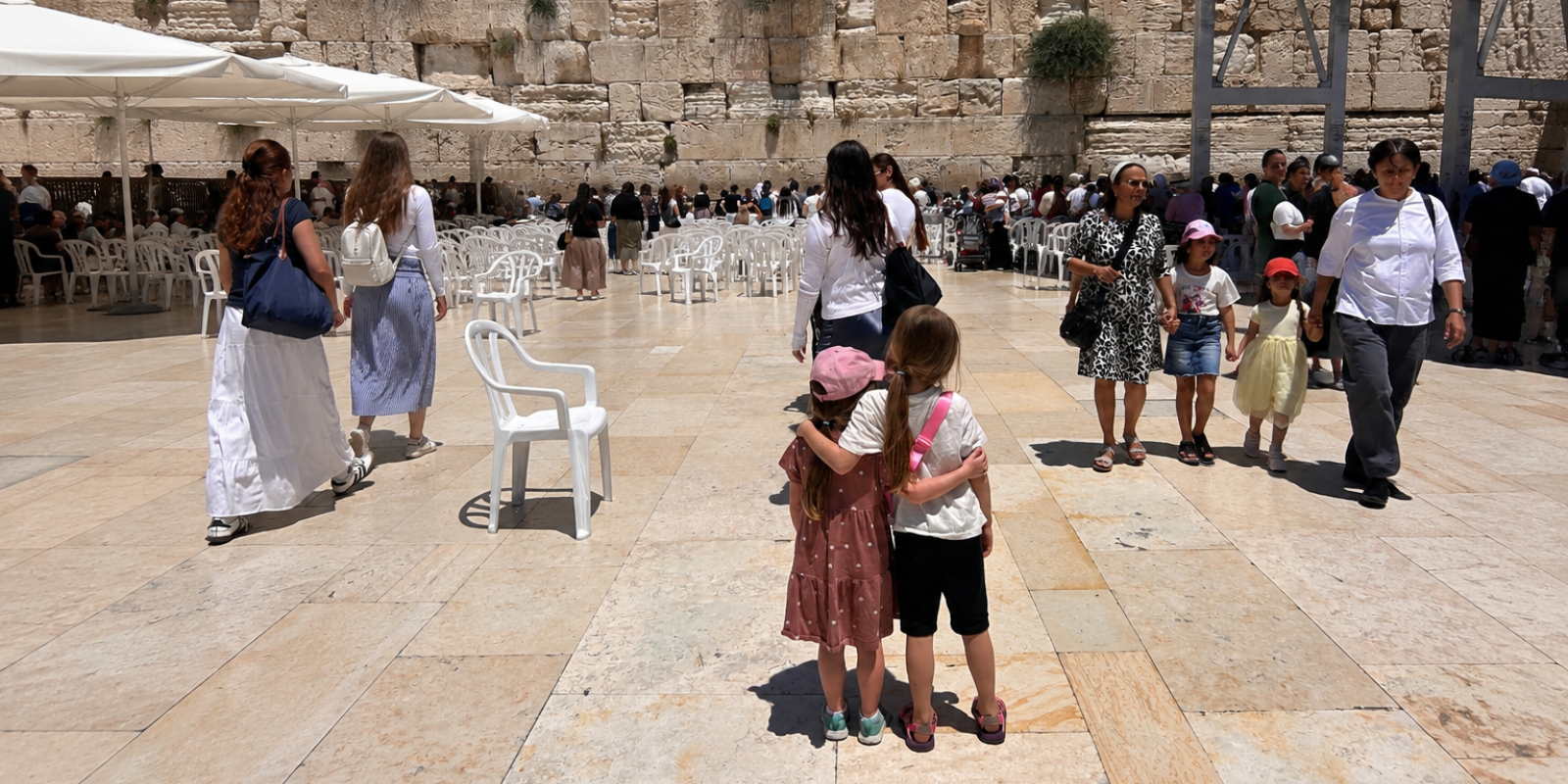
Every year, on the Friday before the Ninth of Av, the Day we remember the destruction of the first and second temples, I take my children to the Kotel, the Western Wall in Jerusalem. We write notes to tuck into its cracks, eat lunch with their grandparents, buy candy in the shuk, the open-air market, and walk the Old City streets. It’s a very exciting day for my kids – we also get to take the train into Jerusalem – which is an exciting enough adventure, in of itself. This past Friday, as my daughter folded her note into a tiny square, I read it before she pushed it into the stone. It said: “Hashem, You are the greatest and You are the most beautiful Hashem there ever is. Please can You get me an egg with a stuffed animal inside of it?” My kids know this trip is tied to the ninth of Av. They know it is the saddest day on the Jewish calendar, the day we mark the destruction of the First and Second Temples, along with a string of other catastrophes tradition attaches to this date. What they do not have yet is the weight of it. They are too young to feel exile as a loss. So my daughter stood at the last remaining wall of a building destroyed twice, in the week we mourn it, and asked God for a toy. To her, this is one of the best days of her year. To me, standing beside her, it is something else entirely: joy and grief occupying the exact same square foot of Jerusalem stone.
How does a place built on destruction produce a child’s most uncomplicated happiness? The Hebrew Bible of course, has a direct answer, and it is not the one most people expect.
We are currently in the Nine Days, the stretch from the first of the Hebrew month of Av through Tisha B’Av (the ninth of Av) itself, when mourning intensifies ahead of the tragic date on the Hebrew calendar. This is not manufactured drama. The Babylonians burned the First Temple in 586 BCE and the Romans burned the Second Temple in 70 CE, both, by tradition, on the ninth of Av. The book of Lamentations, opens with language that has never softened with age:
Jews have sat on the floor in mourning and read those words aloud for nearly two thousand years. Here is what surprises most people though: the same prophetic books that record Jerusalem’s grief also name its reversal, on this exact date. The prophet Zechariah wrote, in the name of the Lord:
The fast of the fifth month is Tisha B’Av. Zechariah does not say the fast will disappear. He says it becomes joy. The day built to hold the worst of Jewish memory gets converted, not deleted, into a moed, an appointed festival. This is an old rabbinic teaching: when the Mashiach comes and the final geulah, redemption, arrives, Tisha B’Av stays on the calendar. Only its character changes, from tzom, fast, to simcha, joy.
My daughter’s note was not evidence that she missed the point of the day. She stood exactly where the Temple stood, in the week we mourn its loss, and treated God as someone obviously listening, obviously good, obviously worth asking for what she wanted. She does not carry the churban, the destruction, yet. She only knows this is the place where you talk to God and He hears you. Zechariah is describing the same instinct on a national scale: a Jerusalem where mourning is not cancelled by joy, it is completed by it.
I am not in a hurry to hand my children the full weight of the day yet. That will come, and living in a country that sits this close to war, it may come sooner than I would choose for them. For now, though, they get the egg with the toy inside, the candy in the shuk, lunch with grandparents, and a special time to pray by The Western Wall. And I do not think that is a childish exception carved out of a sad week. I think it is the one piece of the final geulah my children are already old enough to hold. The fast will end. Zechariah said so, in writing, by name. My daughter has simply arrived early.