








Most Fridays, I don’t have time to look up.
Between the cooking, the cleaning, the last-minute errands, and the inevitable scramble to get everyone ready before candle-lighting, the hours before Shabbat have a way of collapsing into productive chaos.
But this past Friday was different. We had been invited out for Shabbat lunch, which freed up a surprising stretch of Friday morning. And in that unexpected gap, I made a decision I rarely make on a Friday: I went outside.
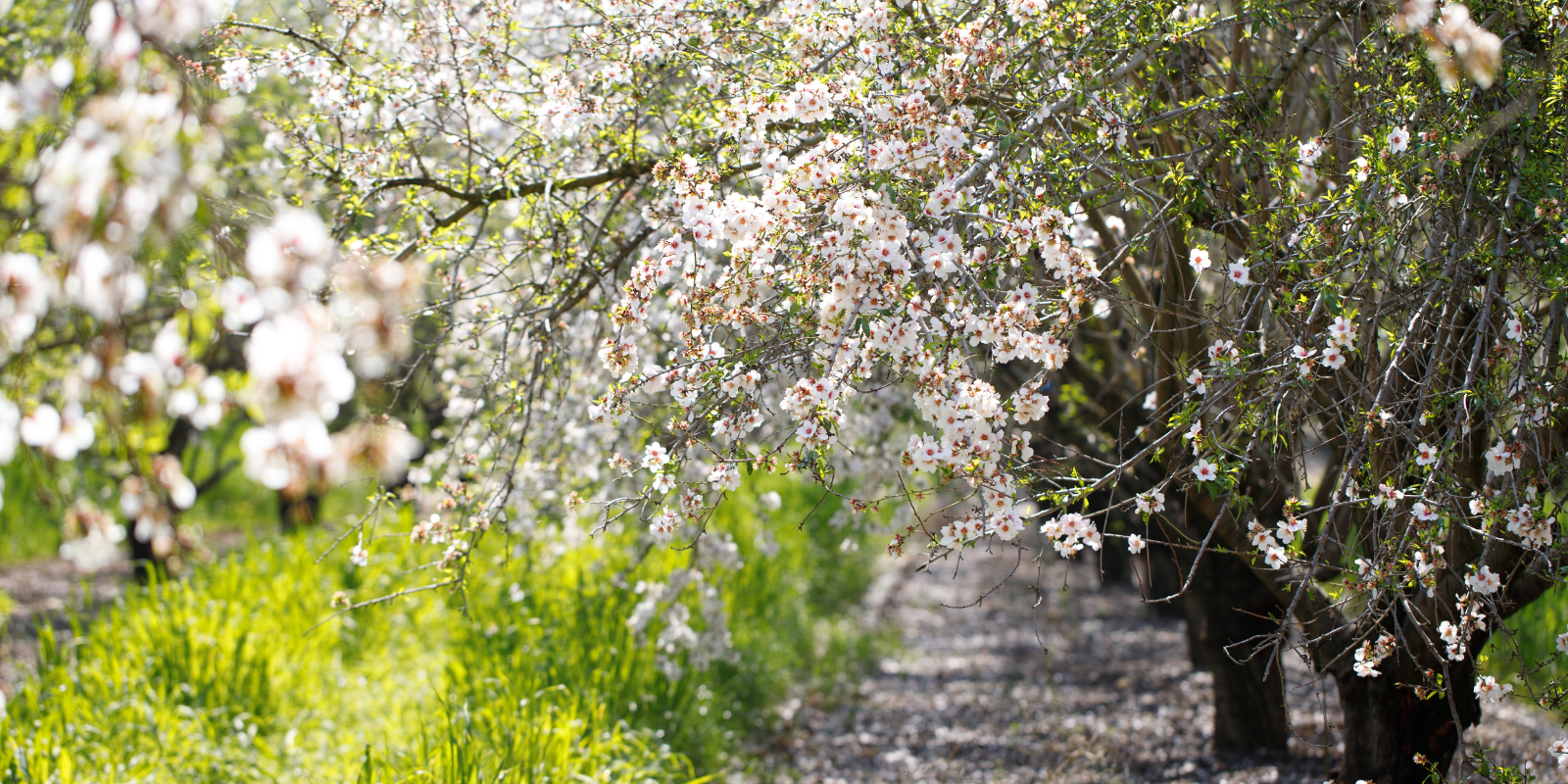
I grabbed three of my kids and headed out into the Israeli countryside. The weather was extraordinary. Almond trees were in full bloom, their white and pink blossoms the first bold announcement that winter was losing its grip. And everywhere we walked, wildflowers were pushing up through the soil. Reds and yellows and purples scattered across the hillsides as if painted there deliberately.
Standing there with my children, I wondered if this was what it had looked like in the Garden of Eden. It was only later that I started to wonder whether I had accidentally walked into the Torah portion.
The portions of Terumah and Tetzaveh describe the construction of the Tabernacle — the portable sanctuary that the Jewish people built in the desert and carried through forty years of wandering. Most people read it as an architectural text: measurements and acacia wood, gold and silver, curtains and clasps. It seems remote and technical.
But the Torah signals that something far more significant is happening through a series of unmistakable linguistic parallels between the construction of the Tabernacle and the story of Creation itself.
The Sages make this explicit, drawing point-by-point parallels between each day of Creation and a different element of the Tabernacle. The curtains of the Tabernacle, for example, correspond to the heavens spread out on the first day. The great dividing curtain separating the Holy from the Holy of Holies corresponds to the firmament separating the waters on the second day. The Tabernacle was not merely a building. It was a miniature cosmos — a deliberate recreation of the world as God originally made it.
Which leads to a startling conclusion: if the Tabernacle recreates Creation, it also recreates what stood at Creation’s center. It recreates the Garden of Eden.
Rabbi Amnon Bazak has identified four textual parallels that make this connection precise rather than merely poetic. The first is the phrase “to tend and to guard” — the role God assigns Adam in the Garden of Eden (Genesis 2:15). These exact words define the role of the priests and Levites in the Tabernacle: “They shall keep all the vessels of the Tent of Meeting… to perform the service of the Tabernacle” (Numbers 3:8). Adam’s role in Eden was the original template for the priest’s role in the Tabernacle.
The second parallel is even more striking. God’s presence in the Garden is described with the phrase “going about”: “They heard the sound of the Lord God going about in the Garden” (Genesis 3:8). The Torah uses this exact word for what God promises to do among Israel when they build the Tabernacle: “I shall go about in their midst and I shall be their God” (Leviticus 26:12). The Tabernacle didn’t just recall Eden — it invited the same divine presence that once walked in the Garden to walk again among the people.
The third parallel is the cherubim. These angelic figures were placed at the entrance of the Garden of Eden specifically “to guard the path of the Tree of Life” (Genesis 3:24). In the Tabernacle, two cherubim spread their wings over the Ark — which contained the Torah, itself called “a tree of life to those who grasp it” (Proverbs 3:18). Same guardians. Same sacred charge. A different garden.
The fourth parallel is the clothing. After the sin, “God made coats of skin for Adam and his wife and clothed them” (Genesis 3:21). During the inauguration of the Tabernacle, Moses performs a parallel act:
The priest, dressed by Moses as Adam was dressed by God, takes up his position in the recreated Garden.
The Tabernacle, in other words, was not merely a building for worship. It was a repair — a correction of Adam’s sin. The expulsion from Eden had created a rupture between God and man. The Tabernacle was God’s invitation to repair it. Come back into the Garden. Take up your role again. I will walk among you as I once walked in the trees.
The verse that launches the entire Tabernacle project is deceptively simple: “Make Me a sanctuary and I will dwell within them.” Not within it. Within them. The Tabernacle’s ultimate purpose was never the building — it was what the building would create inside the people who built it. The discipline of showing up daily to tend the flame, to keep the service, to tend and to guard — was designed to cultivate something in the people themselves. A capacity for divine presence. An inner garden.
Rabbi Bazak notes that the story ends with a warning. Just as Adam was expelled from Eden, Israel was eventually expelled from the land — and the Divine Presence left the Sanctuary: “He has stripped His dwelling like a garden, and has destroyed His meeting place” (Lamentations 2:6). But that is not the final word. Ezekiel sees a vision of the restored Sanctuary from which living waters flow outward, and along those waters, trees bearing fruit every month (Ezekiel 47:12). The garden restored. The presence returned.
We are living in the early chapters of that return. The evidence is in the fields.
I didn’t plan that Friday hike. I just grabbed three kids and walked outside, and the land did what it does every year — came back to life, extravagantly, as if it can’t help itself.
I will dwell within them.