








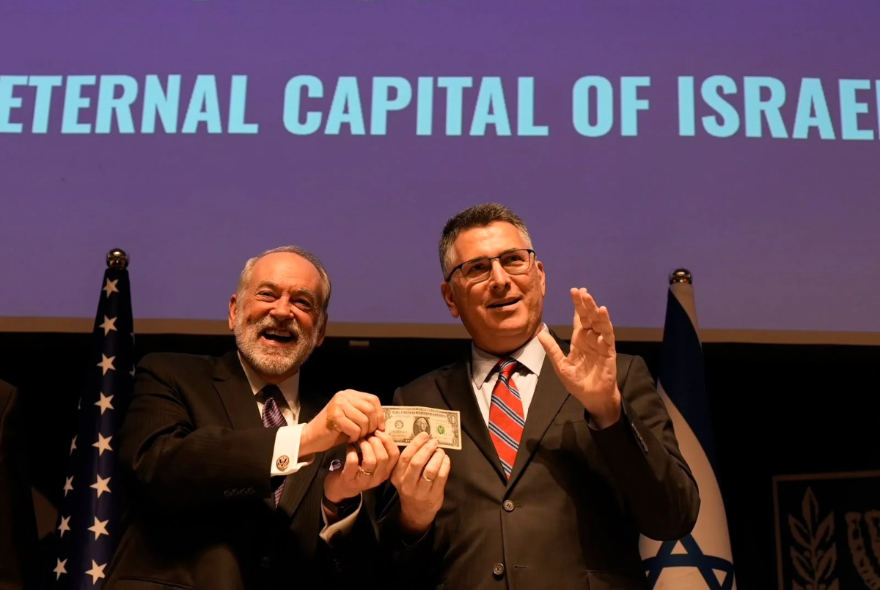
I was at a wonderful ceremony yesterday where US Ambassador Mike Huckabee handed Israeli Minister of Foreign Affairs Gidon Sa’ar a single dollar — the symbolic payment to acquire land for the massive new U.S. embassy complex in Jerusalem. The timing could not be more significant. America is celebrating its 250th anniversary this weekend, and the U.S.-Israel alliance has never felt more essential. Yet polling suggests that American support for Israel is dropping fast, particularly among younger generations who show little enthusiasm for this kind of commitment.
The timing on the Jewish calendar is equally auspicious. The ceremony took place on the eve of the 17th of Tammuz, the day we commemorate the breaching of Jerusalem’s ancient walls — the fateful calamity that set in motion the destruction of the Temple on the 9th of Av. It also marked the 1,000th day since the start of the Hamas war, a grim reminder of the modern-day assault on our people and our sovereignty.
Ambassador Huckabee, whose remarks were repeatedly interrupted by rounds of applause, declared that the building — and the commitment it represents — are eternal, and therefore irreversible:
“If anyone were to think that this decision by the president was simply a temporary one, only to last through his term, and that someone would come and change it, reverse it — let it be known: by the transfer of this property, and by the construction of what will ultimately be a very expensive, massive building for a new embassy complex, this represents not just a decision but an irreversible decision. So that once and for all, we will put our flag — but it will be set in a massive amount of concrete, so that nobody will ever try to move that flag from Jerusalem and take it away from its proper capital.”
Yesterday’s ceremony at the Ministry of Foreign Affairs called to mind another land purchase in Jerusalem, made at an equally auspicious — and far darker — moment.
Some 2,613 years ago, in the most somber days of the First Temple period, the prophet Jeremiah was urgently warning the Jewish people of the Babylonian threat, pleading with them to repent before the Lord. As the army of King Nebuchadnezzar laid siege to Jerusalem — and Jeremiah himself sat imprisoned — God came to him with an unusual request, to purchase a field in Anatot, just north of Jerusalem.
The prophet was bewildered. Why would God ask him to buy land on the very eve of disaster?
Because God was teaching a lesson — to Jeremiah, to his generation, and to future generations of Jews and Christians who would later read in the Bible:
By purchasing land in Jerusalem, Jeremiah performed a prophetic act. Even as unthinkably hard days approached, he was declaring that the Jewish people would one day return, reclaim, and rebuild the city.
Jeremiah was never merely a prophet of doom. He was, just as powerfully, a prophet of consolation and return. At one of the darkest hours in Jewish history, on the very eve of destruction, he offered this prayer and promise:
As we enter the Three Weeks between the 17th of Tammuz and the 9th of Av, there is much uncertainty — over Iran, Lebanon, Gaza, and Judea and Samaria. There is much to be anxious about.
Ambassador Huckabee’s signature on the paperwork with Gidon Sa’ar, acquiring land for America’s embassy complex at this precise moment of uncertainty, echoes Jeremiah’s purchase of land in Jerusalem millennia ago: an act of faith in God and hope for the future.
At yesterday’s ceremony, the Ambassador remarked, “Most of all, it sends a message to the world — America is here to stay. We are proud of our partnership with the people of Israel, a partnership as enduring as the Jewish people’s bond with their homeland.”
So while we don’t yet know what lies ahead for Israel in the short term, we know our fate is secure — sealed in what God promised Jeremiah so long ago: