





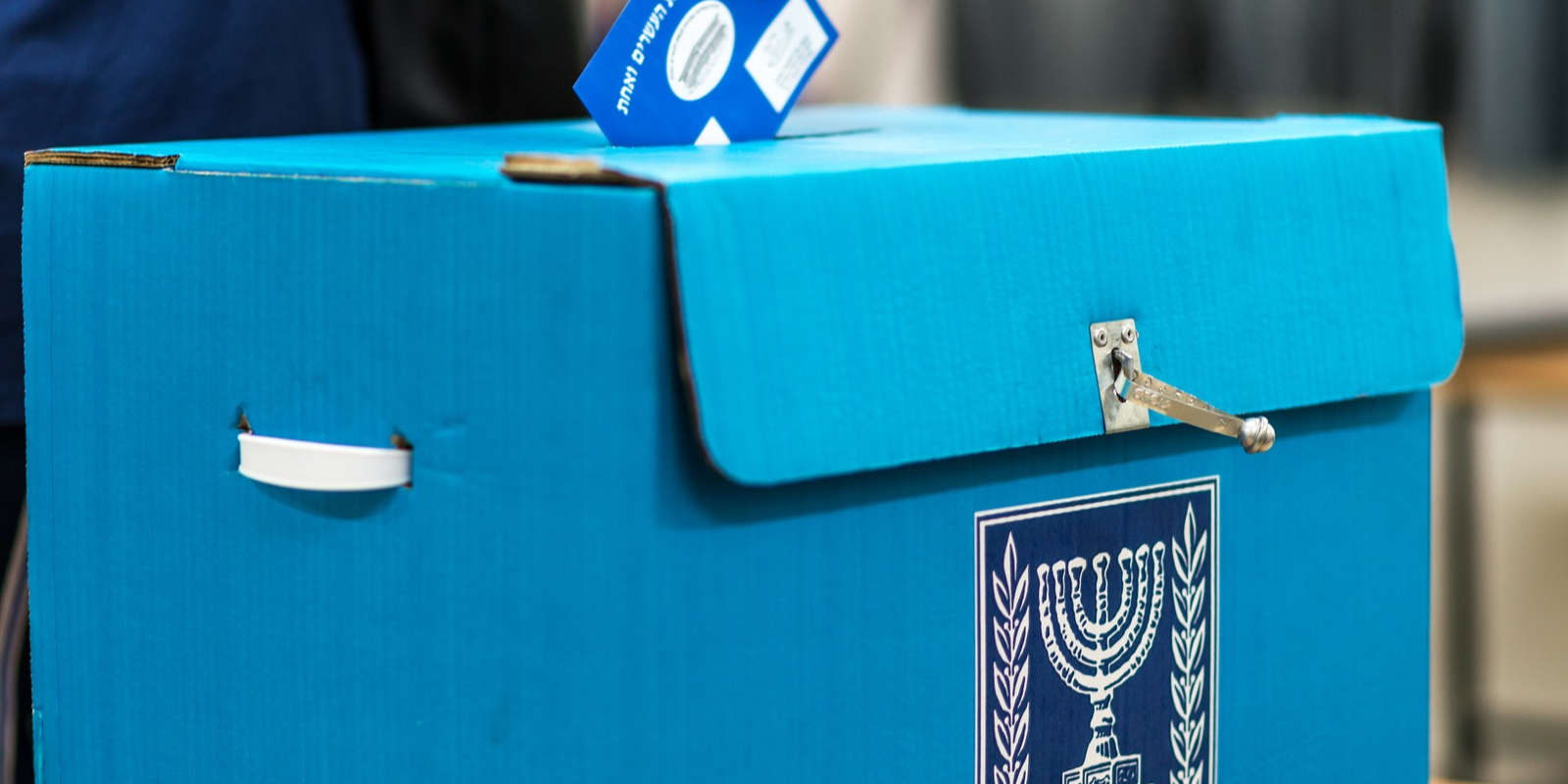
This morning, Israeli schools closed their doors to children and opened them to voters. Election Day in Israel is a national holiday. In a country where the work week starts on Sunday, it is the closest thing Israelis get to an American-style Sunday, and (in theory) it only comes around once every four years. Families pack sandwiches, the parks fill up, and somewhere between the morning coffee and the afternoon picnic, millions of Israelis step behind a cardboard screen, choose a paper slip printed with a few Hebrew letters, seal it in an envelope, and drop it in a box.
The day itself is calm. The weeks leading up to it were anything but. The billboards, the WhatsApp groups and the evening news all carried the same message: if the other side wins, the country is finished. Fear brings people to the polls, so campaigns use it.
Rabbi Chagai Londin offers a different way into the voting booth. Ahead of this election, he composed a prayer for Election Day that opens with thanks: “I thank You, Lord my God and God of my fathers, for the privilege of choosing a government for the people of Israel.” Then comes the heart of the prayer: “May I choose with pure intent… not out of hatred, anger, or despair, but out of faith and trust.”
Hatred, anger and despair are exactly what election season sells. So how does a person of faith walk into that booth with a quiet heart, while still taking the stakes seriously?
King Solomon gives us a starting point:
The Hebrew phrase here is palgei mayim, channels of water. Solomon is describing irrigation, something every farmer in ancient Israel understood. In a dry land, water goes where the farmer sends it. He takes a hoe, cuts a trench in the soil, and the water follows the path he digs. A few strokes open one channel and close another.
Solomon uses that picture for the most powerful person in any kingdom. Presidents, prime ministers and coalition partners seem to shape history. In his eyes, they are water moving through ground God already furrowed.
That verse is the first answer to panic. If I believe today’s vote decides the fate of the Jewish people, I will walk into the booth trembling. If my candidate loses, I will despair. If my candidate wins, I will start trusting a politician with something only God can carry. Solomon protects me from both mistakes.
But that raises an obvious problem. If God directs the hearts of leaders wherever He wants, why should anyone take the day seriously? Why not stay at the park?
Rabbeinu Bachya ibn Pakuda, an eleventh-century sage from Muslim Spain, took up this question in his classic work Chovot HaLevavot (Duties of the Heart). In the section on bitachon (trust in God), he teaches that trust in God never cancels a person’s duty to act. A farmer who trusts God for rain still has to plow and plant (Chovot HaLevavot, Shaar HaBitachon). The Sages call this duty hishtadlut, human effort.
God put us in the world to work alongside Him. He expects us to pursue justice and care for the society we live in. The outcome belongs to Him, and the effort belongs to us.
Rabbi Chaim Yerucham Smotrich, a veteran Religious Zionist educator, treats Election Day almost like a holy day. He puts on a suit in the morning, goes straight from prayers to the polling station, and does not eat beforehand, the same way a person refrains from eating before performing a mitzvah (commandment). For him, casting a ballot belongs in the same category as prayer.
When I vote, I do my part and leave the rest to God. Holding both of those at once takes effort. It would be simpler to believe everything depends on me, or that nothing does. Faith asks me to act with full seriousness and then trust God with the result.
Rabbi Londin asks to stand “behind the pargod with a quiet heart, clean and whole.” In modern Hebrew, pargod is the voter’s screen. The word is also ancient. The Sages use pargod for the heavenly curtain before God’s throne, where heaven’s decrees are announced. With that one word, Rabbi Londin turns a cardboard partition in a school classroom into a place where a person stands before God.
And standing there, he worries less about who will win than about who he will become on the way to voting.
The Sages teach that the Second Temple in Jerusalem was destroyed because of sinat chinam, baseless hatred between Jews, even though the people of that generation studied God’s word and kept His commandments. Their faith was real, and their hatred for one another brought down the House of God.
That is a hard lesson for an election in Israel. A person can vote for the “right” party and still lose something precious along the way, if the vote comes from contempt for the neighbor who votes differently. The person in line behind me at the polling station today might disagree with me on every issue. He is still my brother, and his grandchildren and mine will share this land.
A vote cast in spite harms the voter, whatever happens to the candidate. A vote cast out of love for the land, for its people, and for the values of the Bible leaves the voter whole, whatever the results.
Here is what I plan to do today, and I invite you to join me, whether you are voting in Israel or praying for Israel from far away.
First, before I choose my slip of paper, I will remember the line Rabbi Londin borrowed from a hymn many Jews sing on the High Holidays: “Kingship and dominion belong to the One who lives forever.” No election changes who holds that title.
Second, I will ask myself honestly why I am choosing what I am choosing. Is it faith, love of my country and care for my neighbor? Or is it fear and anger pretending to be principle?
Third, I will put the envelope in the box and walk out with the burden lifted. I did my part. The channels of water are in His hands.
Candidates will win and candidates will lose. Tomorrow morning the commentators will explain what it all means, and within a year most of their predictions will be forgotten. The God who brought the Jewish people home to this land after two thousand years already knows the results. He is the One who digs the channels.
Today, as Israelis line up in classrooms across the country, please pray with us. Pray that the people of Israel choose with wisdom, with clean hearts, and with faith. And pray that when the results come in, we remember that we are still one family, living together in the land God promised to our fathers.
A Prayer for Election Day
by Rabbi Chagai Londin (Cheshvan 5787)
I thank You, Lord my God and God of my fathers, for the privilege of choosing a government for the people of Israel.
May it be Your will that I merit to choose with pure intent,
that You guard me from confusion and distraction,
that I not choose out of hatred, anger or despair, but out of faith and trust.
May I stand behind the voting screen with a quiet heart, clean and whole.
May I always remember that kingship and dominion belong to the One who lives forever.
May it be Your will that these elections bring blessing and repair to Your world,
strengthening Your word, our people and our land,
and that from them Your great name be sanctified in the world. Amen.