








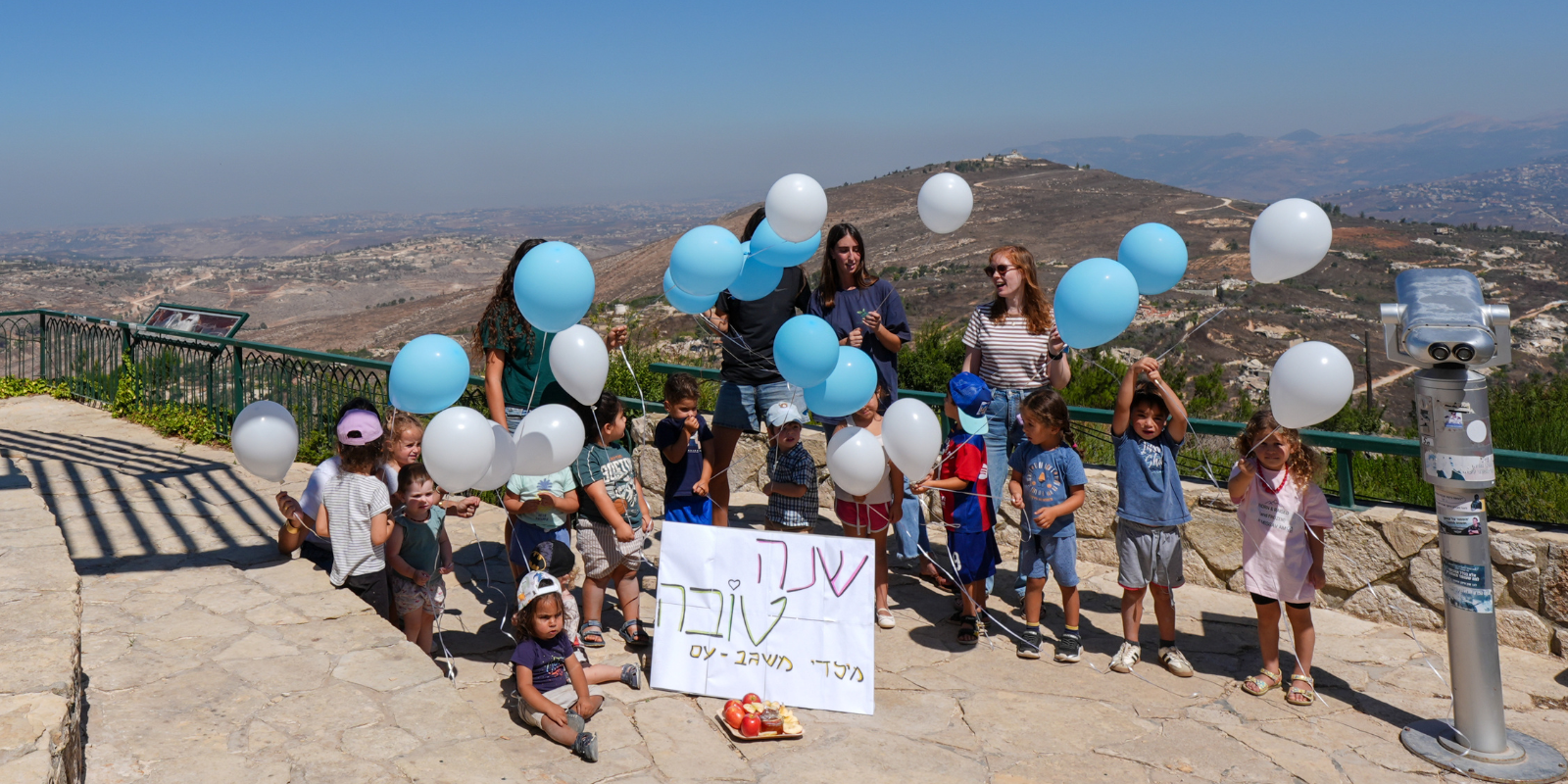
Most mornings, my car is full of backpacks, water bottles, half-awake kids, and very strong opinions about what song should play next. I drive a carpool to school with my own children and a few of their friends, and I let everyone choose one song for the ride. Lately, one song gets requested more than almost anything else, even though the kids are already guaranteed to hear it again once they arrive at school. That is because, here in Israel, the school bell is often not a bell at all. Instead, schools use songs between periods, usually connected to the season, the holidays, or something happening in Israel. On Fridays, for example, the bell is often a popular song taken from the Shabbat liturgy. You can send me an email and let me know if schools in America do this too, because I genuinely have no idea. Right now, one of the bells at one of my children’s schools is a song called “Kanfei Ruach,” or “Wings of Spirit,” and somehow that has also become the top request in carpool. Apparently hearing it during the school day is not enough. They need it once more on the way there. Naturally, it has become an earworm for me too. Eventually, I took the time to actually read the lyrics, and I realized that the song echoes one of the Bible’s most powerful images: the human being rising on wings like an eagle.
The words of the song come from Rabbi Abraham Isaac Kook, the first Ashkenazi Chief Rabbi of the Land of Israel. He writes, “Human being, rise upward, rise, for you possess great strength. You have wings of spirit, wings of mighty eagles. Do not deny them, lest they deny you. Seek them, and you will find them immediately.” What struck me most is that Rabbi Kook does not tell us to somehow grow wings. He tells us that we already have them.
That image is not something Rabbi Kook created from scratch. The very phrase “Kanfei Ruach” appears in the Bible itself. In Psalm 18:11, King David describes God soaring “al kanfei ruach,” “on the wings of the wind.”
The phrase appears in a description of God’s power and movement. Rabbi Kook takes that ancient biblical language and turns it inward. Suddenly, the human being is told: you have kanfei ruach too.
That is a striking shift. There are moments when we look at ourselves and see mostly the things keeping us on the ground. The things we are worried about. The mistakes we have made. The parts of our lives that feel too difficult to change. Rabbi Kook’s words do not pretend those things are not there. Instead, he challenges the assumption that they tell us everything about who we are.
That idea becomes even more powerful when read alongside the prophet Isaiah. Toward the end of Isaiah 40, the prophet speaks to people who are exhausted and discouraged. They feel as though God has forgotten them. Isaiah reminds them that human strength has limits. Even young people become tired. Even the strongest eventually stumble. And then he writes:
What I find especially meaningful is that Isaiah is not speaking to people who already feel strong. He is speaking to people who are tired. The image of soaring appears precisely when strength seems to be running out. The wings are not a reward for already feeling powerful. They are the image Isaiah gives to people who need to be reminded that exhaustion is not the whole story.
There is one more biblical layer to this image. Before the Israelites receive the Torah at Mount Sinai, God tells Moses to remind them what He has already done for them:
In Exodus, God carries Israel. In Isaiah, those who hope in God renew their strength and rise. And in Rabbi Kook’s words, the person is told to recognize the wings already within.
Maybe those images belong together. There are times when God carries us. There are times when faith gives us strength we did not know we had. And there are times when we are asked to recognize that some of the strength we are praying for has already been placed inside us.
Maybe that is why I keep thinking about this song, beyond the fact that a group of schoolchildren has made sure I hear it nearly every morning (at least once). A child listening to “Kanfei Ruach” on the way to school probably is not thinking about Psalm 18, Isaiah 40, or Mount Sinai. They are just singing along to a song they like. But there is something beautiful about children beginning their day with the words, “Rise upward. You have wings.”
There will be plenty of moments in their lives when they feel the opposite. Moments when something is hard, when they fail, when someone tells them they cannot do something, or when they tell themselves the same thing. Perhaps this is a message worth hearing so often it becomes an earworm. The strength to rise is not always something we need to find somewhere else. Sometimes, we need to remember that God has already given us wings.
Here’s the song below for you to enjoy!