








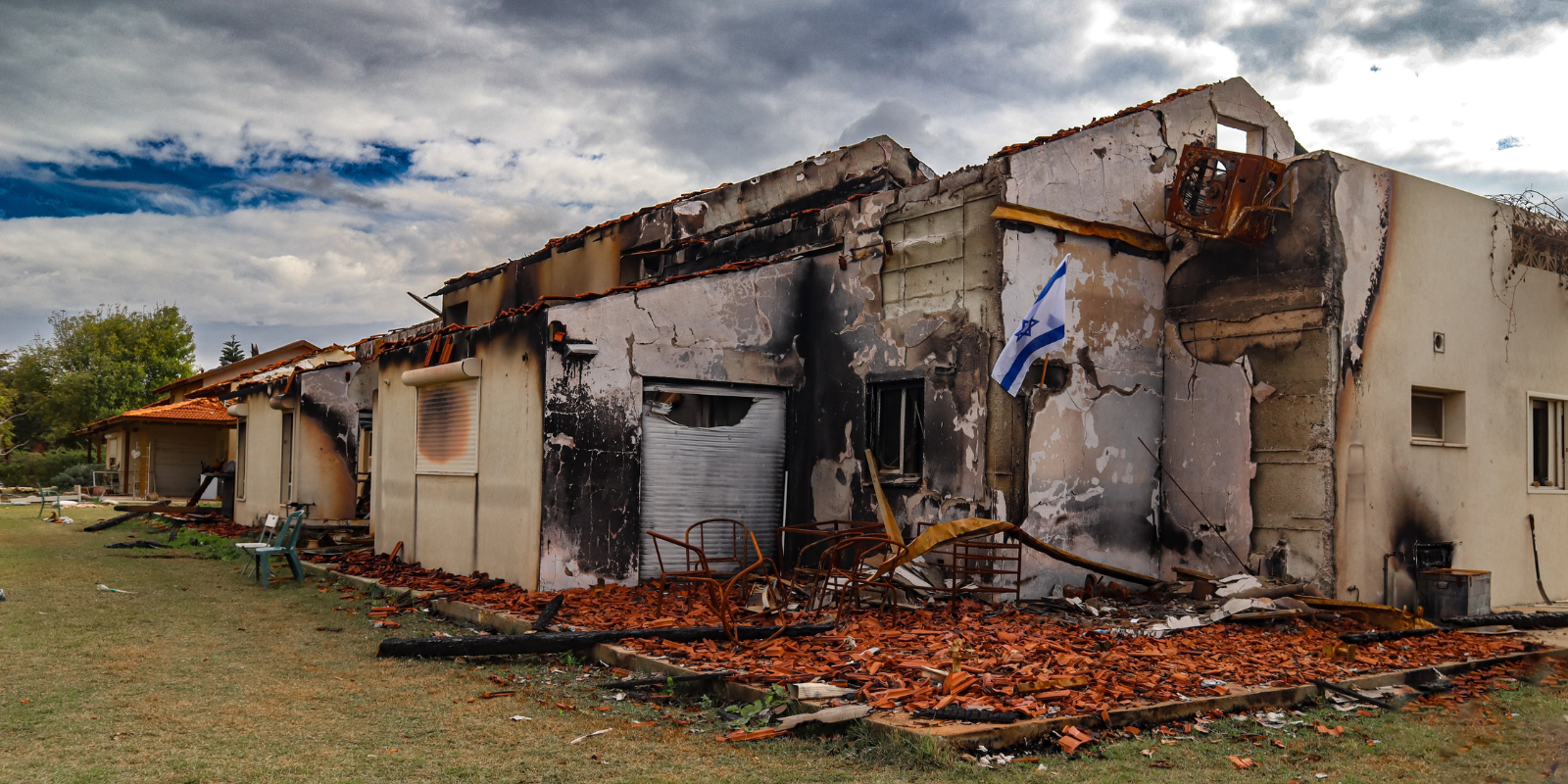
Moses spoke these words more than 3,000 years ago, in the last song he taught the people of Israel before he died. On the morning of October 7, 2023, we watched them come to life in the kibbutzim and towns of southern Israel.
Outside, Hamas terrorists went from house to house and hunted down young people across the fields of the Nova music festival. Inside, families crouched in the mamad, the reinforced safe room built into every modern Israeli home, while fathers held the door handles shut with their bare hands. Where the doors held, the terrorists set the houses on fire. They spared no one: babies and Holocaust survivors were murdered on the same morning. 1,200 people were murdered in a single day.
It was an intelligence failure of staggering proportions. For months, the young women serving as border surveillance soldiers reported Hamas fighters training for a raid along the fence. Their commanders brushed them aside. The most sophisticated intelligence system in the Middle East had the attack in its hands and decided it could not happen.
But we missed an older warning too, and we had no excuse for missing it. On September 23, 2023, just two weeks before the massacre, Jews around the world stood in synagogue and read the Song of Ha’azinu aloud. Its first word, ha’azinu, means “listen.” We did not.
Rabbi Dani Lavi, one of Israel’s leading Bible scholars, sees in Deuteronomy 32, the “Song of Ha’azinu,” a striking prophetic description of October 7 and the war that followed.
But why would Moses, at the very end of his life, describe a massacre that would take place thousands of years later in the Jewish state? And if he did, could it have been prevented?
A Song for Our Generation
The Bible contains two long passages of warning to Israel, in Leviticus 26 and Deuteronomy 28. Nachmanides, the great 13th-century commentator, teaches that the first was fulfilled in the Babylonian exile, and the second in the long and bitter exile that followed the destruction of the Second Temple.
The Song of Ha’azinu is different. It never threatens exile at all. Moses introduces it as a warning for “the last days” and it describes a people already living in its own land, strong and prosperous, that loses its way.
This song was written for us. It was written for our generation, the generation that has watched the prophets’ promises of ingathering come true before our eyes. We are the Jews who came home from Yemen and Ethiopia, from Moscow and Buenos Aires, from Paris and New York. We are the people Moses was singing about.
Jeshurun Grew Fat
Jeshurun, Yeshurun in Hebrew, is a name of love. It comes from the Hebrew yashar, upright, and it appears only four times in the entire Bible. When Moses blesses the tribes, he sings:
When Isaiah comforts a frightened nation, he brings God’s words:
It is the name a father uses for the child he adores.
Yet the very first time the name appears, God is rebuking us. Even as He describes His people growing fat and turning their backs on Him, He does not stop calling us by the name of His love.
We grew fat. Eighty years ago, the Jewish people had no army, no flag and no place to run. Today Israel fields one of the most powerful militaries in the world, ranked 15th of 145 nations, with nearly 170,000 soldiers on active duty and 465,000 reservists ready to be called up. We built a thriving economy and a start-up nation that the world envies. For the first time in two thousand years, Jews run to the Land of Israel rather than away from it.
Yet we forgot who we truly are. Throughout 2023, week after week, Israelis marched and protested against each other. Reservists threatened to stop showing up for duty. Brothers stopped speaking to brothers. Then came Yom Kippur, the holiest day of the Jewish year. In the center of Tel Aviv, secular left-wing protesters shouted down a public prayer service held by religious Jews and forced it to break up, because the men and women followed the traditional practice of praying in separate sections. Jews driving Jews away from prayer, on Yom Kippur, in the Jewish state.
Twelve days later, Hamas invaded.
A Non-God and a Non-People
The verse is built as a mirror, measure for measure. Israel provoked God with a lo-el, a “non-god,” so God provokes Israel with a lo-am, a “non-people.”
What is a non-god? Idolatry means serving a false god. A lo-el is emptier still: no god at all, nothing worth living for. When the great ideologies of the last century collapsed, Western culture was left with pure emptiness – wealth and entertainment. Tragically, secular Israeli culture followed right behind it. Who needs idols when you are happy to worship a “non-god” and the emptiness of secular culture?
For the Jewish people, this emptiness is far more dangerous than it is for anyone else. France can survive on a flag, a language and a good economy. We cannot, because God specifically set us aside as a holy nation with a unique purpose. At Sinai, God made us “a kingdom of priests and a holy nation”
Moses promised that the peoples of the world would look at us and say:
Isaiah spelled out our national mission:
Empty that mission out, and you are left with a nation that no longer knows why it exists.
When our holy nation forgot its unique purpose, God sent against us the ultimate “non-nation.” The Palestinians are a fake nation, a people with no history, no kings, no capital and no language of their own. From 1948 to 1967, when Jordan ruled Judea and Samaria and Egypt ruled Gaza, not one Arab leader demanded a Palestinian state, because “Palestinians” were simply Arabs. Palestinian identity is a recent invention used as a tool to delegitimize Israel and the Jewish people’s right to the land of Israel. It is a “non-nation” used by God to awaken the people of Israel so that we remember why we are here in the first place. “So I will make them jealous with those who are no people.”
The verse adds one more description of the fake Palestinian people: a goy naval, a “foolish nation.” In the Bible, naval means more than foolish. It means ungrateful. When David protected the shepherds of Nabal and later asked him for food, Nabal refused, and David said, “He has repaid me evil for good” (1 Samuel 25:21). For years, Israel supplied Gaza with electricity and water and gave thousands of Gazans permits to work inside Israel. Gaza repaid that kindness with October 7.
The Day Itself
Chadarim are the innermost rooms of a house, the place you run to when there is nowhere left to run. On October 7, the sword ruled the streets of Be’eri and Kfar Aza while terror filled the safe rooms. Then the verse names the victims of October 7: “To youth and maiden alike, The suckling as well as the aged.” Hamas murdered them all.
Hamas dragged 251 men, women and children into Gaza as hostages. Moses saw what would happen on that terrible day.
Then comes the question every one of us asked that day. Moses puts it this way:
On October 7, roughly 3,000 terrorists broke through the border and held Israeli towns for hours, while one of the strongest armies in the world failed to stop them. By every rule of military logic, that should have been impossible. But God’s judgment overrides military power, no matter how strong.
Did It Have to Happen?
Biblical prophecy is not a final, unchangeable verdict. Its outcome often depends on how people respond. The Sages of the Talmud offer a striking example. King Hezekiah of Judah witnessed one of the greatest miracles in the Bible, when the angel of the LORD struck down 185,000 soldiers of the Assyrian king Sennacherib in a single night as they besieged Jerusalem.
According to the Sages, God was ready in that moment to make Hezekiah the Messiah and to make Sennacherib the “Gog and Magog,” the great enemy whose defeat, according to Ezekiel’s prophecy, ushers in the end of days (Ezekiel 38-39). But Hezekiah failed to rise to the moment. He did not even sing a song of praise to God for the miracle, and so the final redemption was postponed.
The prophet Jeremiah teaches the same principle from the other side: a decree of judgment can also be reversed. “If at any time I announce that a nation or kingdom is to be uprooted, torn down and destroyed, and if that nation I warned repents of its evil, then I will relent and not inflict on it the disaster I had planned”.
The Song of Ha’azinu does not predict specific numbers. It describes a pattern, and that pattern can play out mildly or devastatingly, depending on how we respond. We already saw a milder version. In May 2021, during Operation Guardian of the Walls, Hamas fired more than 4,000 rockets at Israel, while Arab rioters attacked Jews and burned synagogues in Lod, Acre and other mixed Arab-Jewish cities. Many of the song’s warnings came true in those weeks, but at a fraction of the force of October 7. It was a warning, and tragically, we did not take it to heart. We read the headlines, buried our dead and went back to our lives. Two years later, the same warning returned with a vengeance.
And October 7, as terrible as it was, could have been far worse. Had Hezbollah’s forces stormed into the Galilee from the north that same morning, with Iran launching missiles alongside them, the catastrophe would have been beyond anything we can imagine. God spared us that. October 7 was not the full measure of the judgment Moses describes. It was another warning, louder than the one before. And each time we ignore the warning, the next one comes louder still.
A Song That Will Not Be Forgotten
Why would God allow such suffering? The song itself gives the answer. God told Moses:
The song is a memory God planted inside the nation, an alarm set to ring when we forget who we are. On October 7, it rang. Hamas did not ask its victims how they voted or whether they kept Shabbat. Many of the kibbutzim it destroyed were secular and proudly left-wing, home to peace activists who drove sick Gazans to Israeli hospitals. Hamas murdered them simply because they were Jews.
The horror of October 7 brought the people of Israel together. A nation that was tearing itself apart on Yom Kippur of 2023 stood shoulder to shoulder days later. Some 360,000 reservists answered the call. “Secular” soldiers who had never worn tzitzit, the fringes the Bible commands Jews to wear on their garments, asked for them before heading into Gaza. Jews in New York and London who thought of themselves as Americans and British discovered, on campuses filled with hatred, that the world saw them as Jews first. Many of them chose to return home.
None of this should surprise us. In my book, Countdown: American Jews and God’s Plan for Redemption, I show that the prophets foresaw this very moment: the day when the Jews of the West would discover that the exile is no longer safe, and the long road home would begin.
The “non-people” reminded us that we are a unique and holy nation.
The Song’s Final Verse
On October 7, fathers in Kfar Aza and Nir Oz held the doors of their safe rooms shut with their bare hands, bracing against the terrorists on the other side, some of them until their final breath, so that their children might live. No one had to teach them that love. It is the love of a father, and it runs beneath every harsh word of the Song of Ha’azinu.
For all its terror, Moses’ song does not end with the sword. After the slain and the captives, after the anguished question of how one could chase a thousand, the song turns:
God rebukes Jeshurun, but He never abandons Jeshurun.
And then Moses sings the final verse of his song, a promise addressed to our generation:
The blood spilled in Be’eri, in Kfar Aza and in the fields of the Nova festival has not been forgotten. The God of Israel will avenge it, and the nations of the world will rejoice with us on the day He does.
Moses knew we would forget. That is why he left us a song rather than a speech, words that would “not be forgotten from the mouths of their descendants”
In the final hours of his life, he pleaded with us:
Three years ago, we learned in blood that every word of Moses’ warning was true. Now we know that every word of his promise will come true as well.
Ha’azinu. Listen. This time, we are listening.