







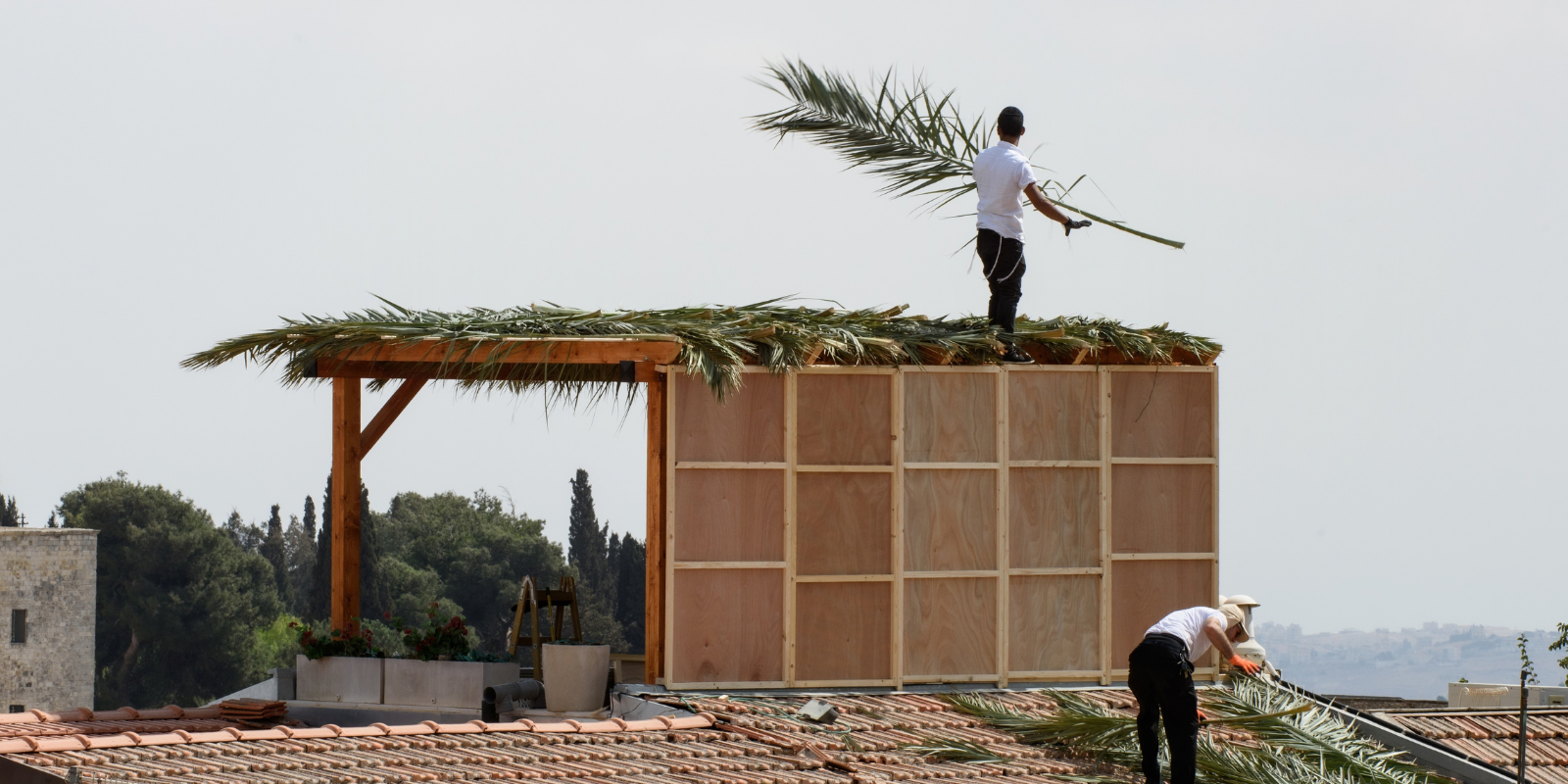
Rabbi Jonathan Sacks, the late Chief Rabbi of the United Kingdom, loved to tell a story about his first Sukkot as a married man, more than forty years ago. He and his wife Elaine had no car, and he had no tools. By his own cheerful admission, he had finished last in woodwork class every single year of school, and changing a light bulb marked the outer limit of his practical abilities. Now, for the first time, he had to build a sukkah (the temporary booth Jews live in during the holiday) on his own.
A friend offered to drive him to the lumberyard. Before they left, the friend proudly showed off his plans: detailed architectural drawings for a sukkah fit for royalty, complete with a proper door, windows, and a frame that could stand on its own. At the lumberyard he pulled a long list of beams, planks, hinges and screws from his pocket. Rabbi Sacks, who had no idea what he was doing, bought a few sheets of hardboard, a few planks and a bag of nails.
The results were exactly what you would expect. The friend built a palace. Rabbi Sacks built three wobbly walls of hardboard leaning against the side of his house, something closer to a giant cardboard box than a dwelling. It met the requirements of Jewish law, and that was about the kindest thing anyone could say about it.
On the second night of the holiday, a storm with hurricane-force winds tore through the neighborhood. The next morning in synagogue, the friend looked crushed. His magnificent sukkah had blown down, and he assumed the rabbi’s had met the same fate. When Rabbi Sacks told him it was still standing, the friend refused to believe it and came over to see for himself. After examining the flimsy structure, he found the secret. Because it could never have stood on its own, Rabbi Sacks had fastened it to the wall of his house with a single nail.
The friend was quiet for a moment. Then he said he finally understood the holiday. A person can plan a sukkah, a building, or an entire life down to the last detail, and a strong enough wind can still carry the whole thing away. But something attached to a solid, immovable foundation, even by one nail, will outlast any storm. Then he smiled and said, “That nail is faith.”
It is a wonderful story. It also exposes a strange feature of this holiday that most of us never stop to question.
The Bible sets Sukkot at the very end of the agricultural year, when the grain has been threshed and the grapes have been pressed. It even calls it the “Festival of Ingathering” (Exodus 23:16). For an ancient farmer in the Land of Israel, this was the most secure moment of the entire year. His barns were full. His family would eat through the winter. If there was ever a time to sit comfortably inside his sturdy stone house and enjoy the fruits of his labor, this was it.
So why does God choose precisely this moment to send His people out of their homes and into flimsy huts?
The Bible gives its own explanation for the booths, and at first glance it seems to have nothing to do with harvest at all:
The sukkah is a history lesson. It sends us back to the wilderness, to forty years of wandering through a land with no fields, no rivers and no permanent shelter. The Sages disagreed about what those wilderness booths actually were. Rabbi Eliezer taught that they were the Clouds of Glory, the miraculous cover God spread over the camp. Rabbi Akiva taught that they were real huts, the kind of makeshift shelters any nomad throws together in the desert (Babylonian Talmud, Sukkah 11b).
That still leaves the question of timing. Why teach the wilderness lesson in the fall, of all seasons, when the huts would make far more sense in the spring, near Passover, when the Exodus actually began?
Rabbi Shmuel ben Meir, the twelfth-century French commentator known as the Rashbam, found the answer in Rabbi Akiva’s flimsy huts and in the harvest itself. For forty years in the wilderness, he explained, our ancestors had no houses and no fields of their own. They lived in fragile booths, and every day they survived only because God protected them. Then he pointed to a warning Moses delivered just before the Israelites entered the Land:
“When you have eaten your fill, and have built fine houses and live in them… then your heart will grow proud and you will forget the LORD your God… and you will say in your heart, ‘My own power and the strength of my own hands have produced this wealth for me'” (Deuteronomy 8:12, 14, 17).
The danger of forgetting God is greatest exactly when life is going well. A hungry man in the desert has no trouble remembering who feeds him. A man with a full barn and a solid roof over his head begins to believe he did it all himself. So at the very peak of prosperity, God commands us to step outside, leave the house we built, and sit under a roof of branches that lets the stars and the rain through, just as our ancestors did in the wilderness. For one week, we remember that everything we have came from Him, and that our real security was never in the walls.
The Zohar, the classic work of Jewish mysticism, gives the sukkah a name that brings us right back to that hardboard box in England. It calls the sukkah tzila d’meheimnuta, “the shade of faith.” The walls and the branches are the smallest part of it. What actually shelters the person sitting inside is his trust in God.
Tonight, on the first night of Sukkot, Jews around the world will step out of their homes and into their booths. Some of those sukkahs will be grand, with lights and decorations and furniture carried out from the dining room. Others will be a few boards leaning against a wall. It does not matter very much. The storms of life come for the magnificent and the modest alike, and plans that look perfect on paper often blow away.
What matters is whether we are connected to God, the one foundation that cannot be moved. As the psalmist wrote, “Unless the LORD builds the house, its builders labor in vain” (Psalm 127:1). Rabbi Sacks’s friend learned that lesson on a stormy morning more than forty years ago. Every Sukkot, God invites us to learn it again, and to make sure that, whatever else we build, we have driven in that one nail.