








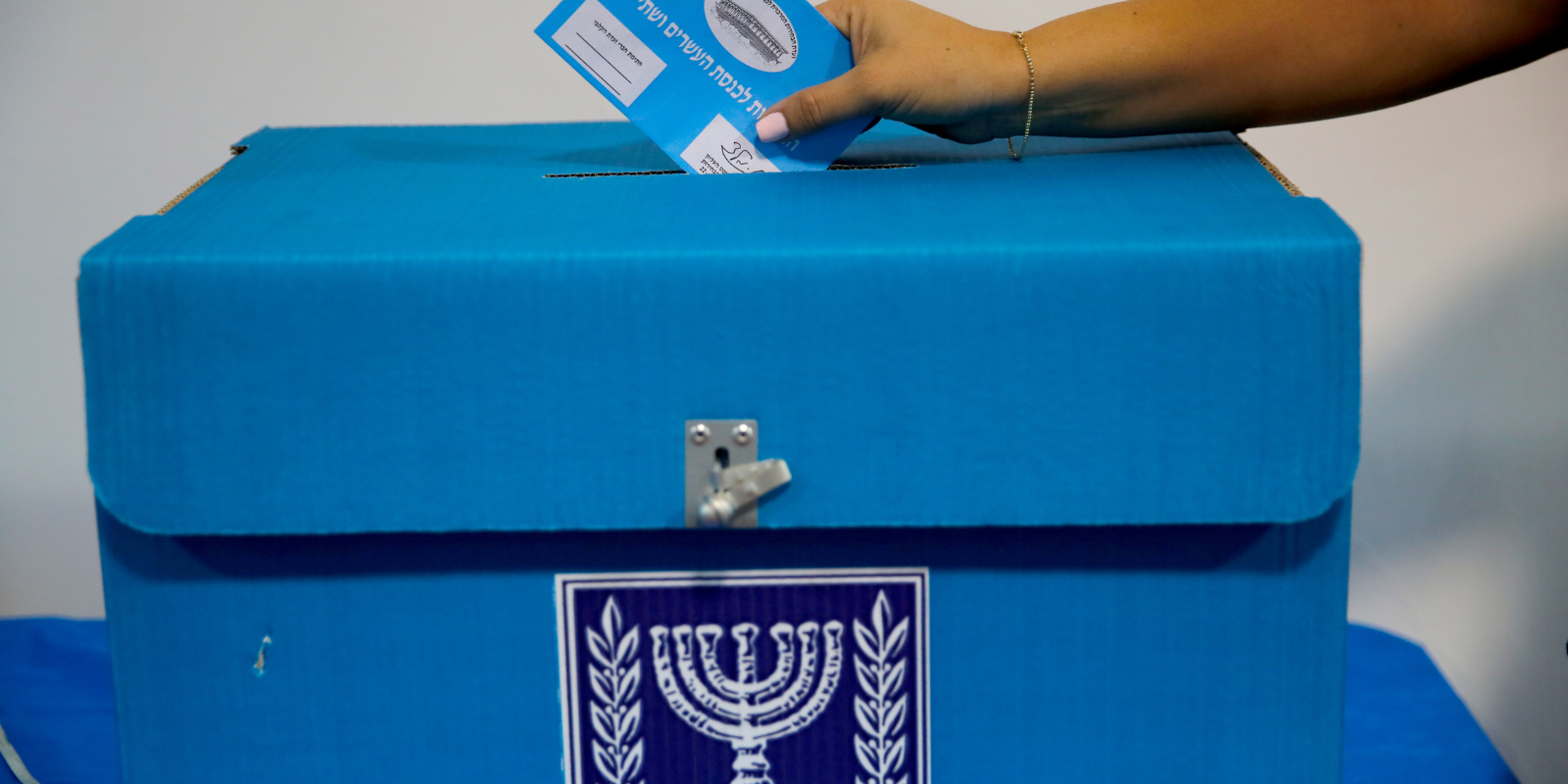
Israelis go to the polls on October 27, 2026. The Knesset dissolved in July, the billboards are already up along the highways, and the polls arrive weekly. It is the first Israeli election in nearly forty years to be held on the date the law originally set for it — every Knesset since 1988 has collapsed early — and the first time in more than half a century that a single government has stayed in office for an entire Knesset term. After a stretch when Israelis voted five times in under four years, the system is running on schedule.
Into the middle of the campaign falls the Torah portion of Shoftim, read each year in the weeks before Rosh Hashanah (Jewish New Year).
It opens with familiar instruction:
Two verses later comes the line engraved on courthouse walls around the world: “Justice, justice shall you pursue.” The portion goes on to legislate every institution a nation requires — courts, prophets, cities of refuge, the conduct of war, the elders who must answer publicly for a body found abandoned in a field.
And in the middle of it, a verse that has troubled readers for three thousand years.
God is not commanding a monarchy here. He is quoting His people in advance — predicting the exact sentence they will one day say, and the exact reason they will say it. Not because a king will bring justice. Not because a king will bring holiness. Because everyone else has one.
Four centuries later, the prediction came true almost word for word. The elders came to the prophet Samuel and demanded a king “to judge us like all the nations” (I Samuel 8:5), and when Samuel warned them what a king would cost them in sons, daughters, fields and taxes, they did not budge. “No,” they answered, “but we will have a king over us, that we also may be like all the nations, and that our king may judge us, and go out before us, and fight our battles” (I Samuel 8:20).
Here is what puzzles me. The Torah is not shy about prohibiting things. It bans the practices of Egypt and Canaan by name. It forbids the diviners and soothsayers of the surrounding peoples in this very portion. So why, when Israel announces that it wants a king for no better reason than that the neighbors have one, does the next verse begin, “You shall surely set a king over you”?
The Sages were divided on it. Some held that appointing a king is indeed a positive commandment. Others explained that the passage was written only in response to Israel’s complaining — a concession, not an ideal. Rabbi Moses Maimonides ruled like the first opinion and made the monarchy a commandment. Don Isaac Abarbanel read it closer to the second. He had served as royal treasurer to Afonso V of Portugal and later financed Ferdinand and Isabella’s war in Granada, and he wrote his commentary on the books of Samuel after fleeing a Portuguese king who had condemned him to death in absentia. He knew what kings did with power from the inside, and he argued that Israel had never needed one.
But look at what God actually does with the request, because that is where the answer lives.
He grants it — and then, in the space of six verses, He makes it impossible for Israel’s king to be anything like the kings around him. He may not accumulate horses, and above all he may not send the people back to Egypt to buy them. He may not amass silver and gold. He may not multiply the marriage alliances that were the ordinary instrument of ancient diplomacy, “lest his heart turn away.” And then the strangest requirement of all: he must write out a copy of the Torah for himself, keep it with him, and read from it every day of his life, “so that his heart not be lifted above his brothers” (Deuteronomy 17:20).
Every other king in the ancient Near East was a god, or the son of a god, or the god’s appointed voice. Israel’s king is a man with homework.
You asked to be like the nations, God says. Fine. Have your king. He will simply be a king unlike any king on earth.
This is the pattern that runs through the whole of Jewish history, and it is the heart of what we call Universal Zionism. Universal Zionism holds that Israel’s particularity — our stubborn, inconvenient, endlessly resented difference — was never a wall built to keep the world out. It is precisely what we have to offer the world. God did not choose one family out of humanity in order to abandon the rest. He chose one family so that “in you all the families of the earth shall be blessed” (Genesis 12:3), and He set that family in one specific land so that the blessing would have an address.
Theodor Herzl’s Zionism was Saul’s Zionism: a state, an army, a flag, a seat at the table, the ordinary dignity of a people that can defend its own children. Israel achieved it, and thank God for it. Herzl himself suspected it would not be the whole story — in his novel Altneuland he imagined a Jewish state that would pioneer advances the rest of the world would want to copy. David Ben-Gurion, who was no rabbi, reached for Isaiah’s language to say the same thing, insisting that Israel be “a light unto the nations” (42:6) and built on the highest moral principles, though he meant it in civic terms: equal justice under law, civil liberties, a people finally emancipated among the family of nations.
Survival is not an answer to the question of purpose. It is only what makes the question askable.
The Christians who stand with Israel today grasp this instinctively, and they have often grasped it faster than we have. They are not asking us to become more like them. They are asking us to be more like ourselves — to be the nation of that Book, in that Land, and to hold the line the rest of the world keeps trying to talk us out of holding. That partnership is not a marriage of political convenience. It is two peoples reading the same chapter of Deuteronomy and drawing the same conclusion from it.
Which brings us back to the king and his scroll.
Notice how many times this short passage returns to the same organ. His heart must not turn away. His heart must not be lifted above his brothers. The scroll is not there to make the king learned. It is there to make him remember, every single day, that he is one of us and under the same law as the rest of us.
King Solomon, who built the Temple and prayed at its dedication that the foreigner who comes from a distant land should be heard by God in heaven, so “that all the peoples of the earth may know Your name” (I Kings 8:43), is the king who ultimately broke each of the three prohibitions. He gathered the horses and imported them from Egypt. He amassed the silver and gold. He built the alliances. And in a verse that reads like Deuteronomy 17 coming home to collect, Scripture records that in his old age “his heart was not wholly with the Lord his God, as was the heart of David his father” (I Kings 11:4). The most universal king in Israel’s history was undone by the very openness that made him great. He had so much to give the nations that he forgot he had to remain distinct in order to give it.
Universalism without boundaries is not a light to anyone. It is just assimilation with better public relations.
So the country will vote on October 27, and the campaign will be fought where campaigns are always fought — on security, on the economy, on who serves in the army and who does not, on the future of Gaza. These are real questions.
But the portion we read this Shabbat is asking a quieter question underneath all of that, and it is the one the elders got wrong when they stood in front of Samuel. Not who should govern. Not even how. But whether the point of all this — the state, the army, the elections that finally run on schedule — is to become a nation like all the nations, or something else entirely.