








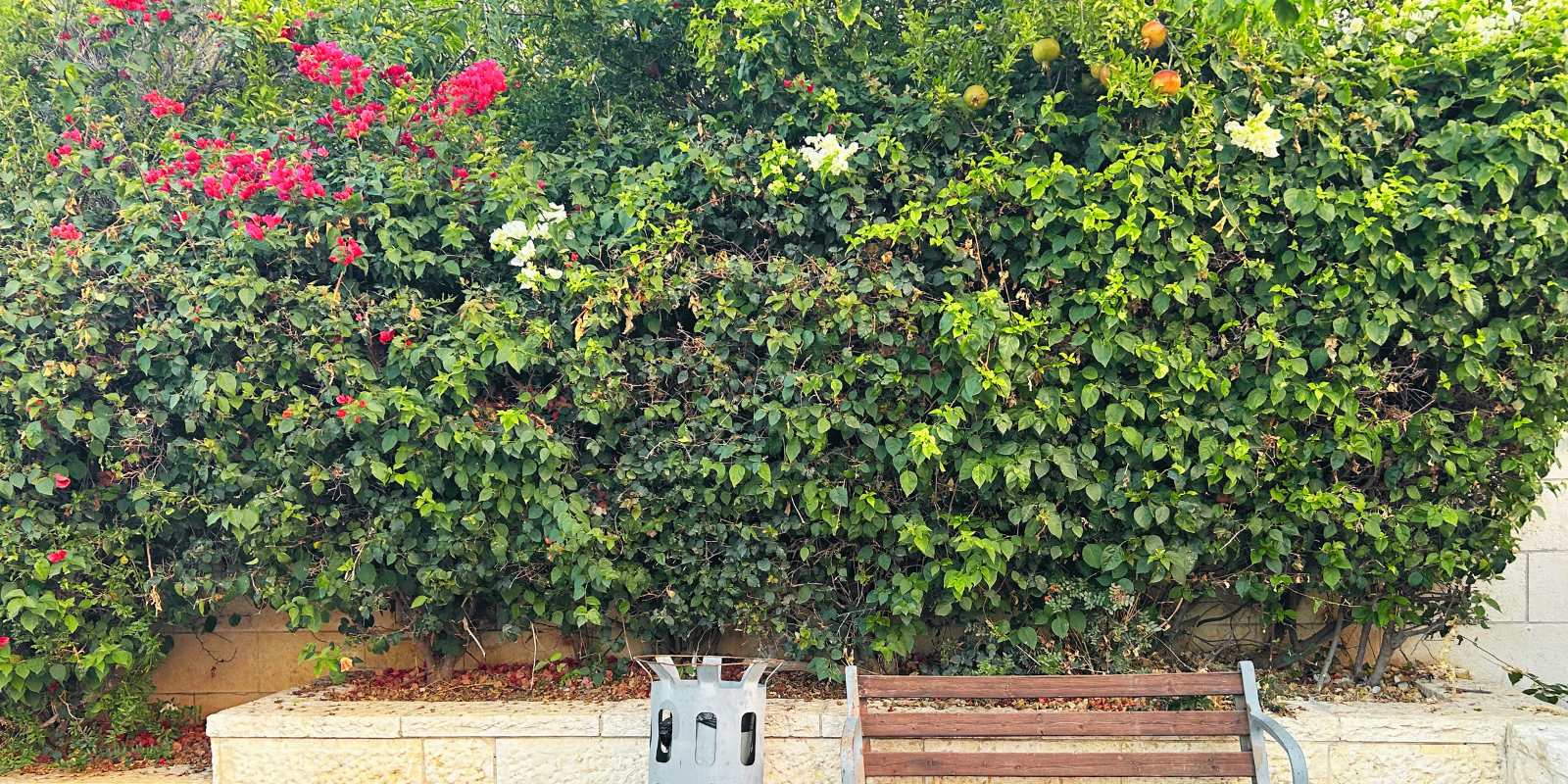
Many mornings, before my husband and children are awake, I head out for a walk. I enjoy the exercise, of course, but that’s not really why I go. Walking gives me something that’s increasingly hard to find in modern life: uninterrupted time to think. And when you have time to think, you begin to notice things you might otherwise miss. A few days ago, as I walked down the Anabe valley path in Modi’in, I couldn’t help but notice how dry everything looked. It hasn’t rained here in months. The grass has turned yellow. Some of the trees are covered with that sticky sap they seem to produce every summer. Everything looked exactly as you would expect after months of relentless heat. Then I noticed something that didn’t seem to belong.
Tiny green pomegranates. They were small, round, hard, and, I imagine, incredibly sour. I smiled to myself.
Rosh Hashanah can’t be far away.
If you’ve never lived in Israel, that connection might seem strange. But one of the things I love most about living here is that you don’t really need a calendar to know the Jewish holidays are approaching. The land tells you.
The pomegranate is one of the Seven Species with which the Torah praises the Land of Israel, and by Rosh Hashanah it has become one of the traditional foods on the holiday table. Every year, weeks before the shofar is sounded, before apples are dipped in honey, and before families gather for the New Year, the first tiny pomegranates begin to appear.
I love that.
Before Rosh Hashanah reaches our calendars, it has already reached the trees. That struck me even more because we’re now in the Seven Weeks of Consolation, the period between Tisha B’Av, when we mourn the destruction of the Temple, and Rosh Hashanah, when we begin the year anew. The calendar is already moving toward renewal, and, in its own way, so is the land. As I stood there looking at that little pomegranate, I realized that the remarkable thing wasn’t that it was ripe. It wasn’t. It wasn’t sweet. If I picked it today, it would probably be impossible to eat. But that wasn’t the point.
The point was that, in the middle of a landscape that looked dry and tired, there was already evidence that the next season had begun.
I wonder if that’s one of the reasons God gave us seasons in the first place. Not simply to mark the passage of time, but to remind us that change often begins before we can see its full results. Long before that little pomegranate turns deep red and finds its way onto a Rosh Hashanah table, it begins as something small, green, and easy to overlook.
Sometimes, if we’re paying attention, that’s enough to remind us that God is already preparing the next season.