








Imagine standing on the banks of the Chebar River in Babylon, far from everything you have ever known. You are among the first wave of Jews deported by Nebuchadnezzar — torn from your home, your city, your land. Jerusalem is still standing, the Temple still intact — for now. But Nebuchadnezzar has tasted blood, and everyone knows he will be back.
And you are asking a question that you can barely bring yourself to say out loud.
Is God still with us?
This was not a philosophical question. It was an existential crisis. For generations, Israelite theology had been inseparable from Israelite geography. God dwelled in the Temple. God’s covenant was enacted in the land. To be torn from that land was to lose the visible, tangible proof that God was present at all. The exiles by the Chebar River were not doubting God in the abstract. They were looking at the wreckage of everything they had known, and wondering whether God was still with them at all.
Into that silence, God sent a prophet named Ezekiel.
What makes Ezekiel so remarkable is not merely what he said, but where he said it. He was a priest — a kohen — who should have been serving in the Temple in Jerusalem. Instead, he was living in exile in Babylon, among the captives. And it was precisely there, in that place of spiritual desolation, far from the holy city, far from the altar and the incense and the sacred vessels, that the word of God came to him. God had not stayed behind in Jerusalem. He had followed His people into exile.
The Talmud states it plainly: “In every place where Israel was exiled, the Shekhinah (divine presence) was with them.” (Megillah 29a) Rabbi David Kimhi, the great 12th-century Provençal commentator known by the acronym Radak, notes that Ezekiel’s chariot vision appearing to him in Babylon was deliberate: the location itself was a sign that the exile and the divine presence were inseparable. God was making a statement not just through the content of the vision, but through where He chose to give it.
We read that as a truism today. Of course God is everywhere — even a child knows that. But for the exiles by the Chebar River, it was anything but obvious. Every piece of evidence pointed the other way. The Temple was gone. The land was gone. The Babylonian gods had seemingly triumphed over the God of Israel. The rational conclusion, the obvious conclusion, was that Israel’s God was either absent or defeated.
Ezekiel came to tell them that the rational conclusion was wrong.
From that foundation, Ezekiel built his great themes of responsibility and renewal.
The destruction of the Temple, he insisted, was not a verdict about God’s existence. It was a call to repentance.
The exile had happened because of the nation’s choices — and because choices had caused it, choices could reverse it. This was not a message of despair. It was a message of radical human agency. God had not abandoned Israel. Israel had wandered from God. And wandering can be reversed.
The greater the distance, the more dramatic the return.
Nowhere in all of prophecy is that truth expressed more powerfully than in Ezekiel’s vision of the Valley of the Dry Bones. The prophet sees a valley strewn with bones — not fresh bodies, not recently fallen soldiers, but dry, scattered, sun-bleached bones. The image of total desolation is deliberate. God asks Ezekiel:
And the bones themselves speak. They say what the exiles by the Chebar River were thinking: “Our hope is lost: we are cut off.” (Ezekiel 37:11)
Then God tells Ezekiel to prophesy to the bones.
What follows is one of the most extraordinary passages in the entire Bible. Breath enters the bones. Sinew appears. Flesh covers them. They rise. An entire army stands on its feet. And God explains what the vision means:
Notice that the promise has two parts — spiritual revival and physical return to the land. The two cannot be separated in Ezekiel’s vision. The dry bones do not merely come to life and stay where they are. They are brought home.
Ezekiel’s vision embodied the idea that repentance is always available, regardless of how far the nation has fallen. The farthest point of exile is not the end of the story. It is the beginning of the turn.
We are living proof of that teaching.
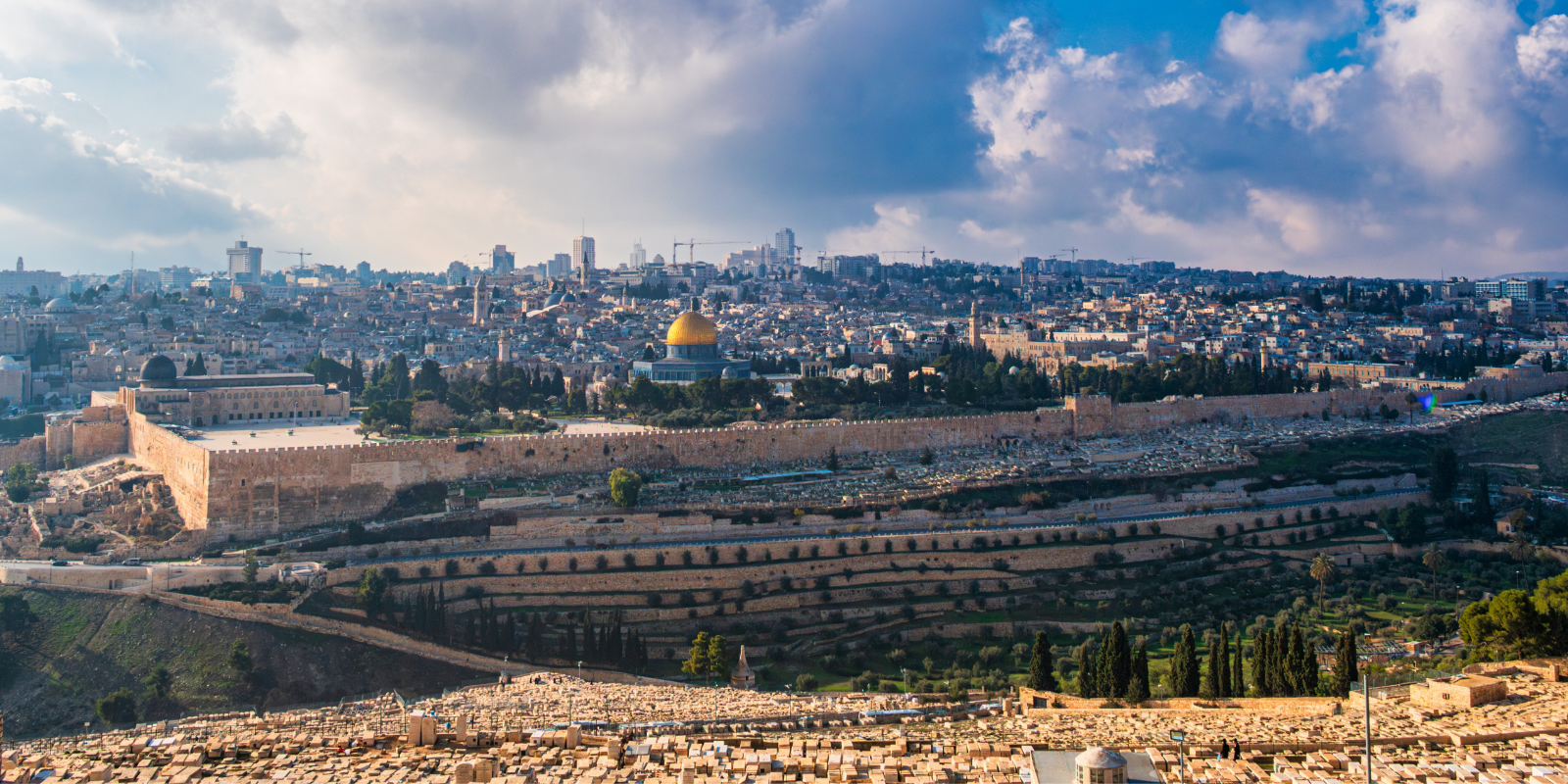
Two and a half thousand years after Ezekiel stood by the Chebar River and declared that dry bones can live, the Jewish people have returned to their land. The exiles have come home — not all of them, not yet, but millions. Cities have been rebuilt in the Judean hills. Hebrew is spoken in the streets of Jerusalem. The dry bones are standing.
That is not a coincidence. That is a fulfillment.
Ezekiel’s message was never just for the exiles of Babylon. It was for every generation that has stared at the wreckage of what it once knew and asked, in a whisper: Is God still with us?
The answer, then and now, is yes. Even in exile. Even in loss. Even when every rational conclusion points the other way.
Even when the bones are dry — God can make them live again.
To learn more about the book of Ezekiel, watch Rabbi Mark Fishman’s Bible Month video today!