








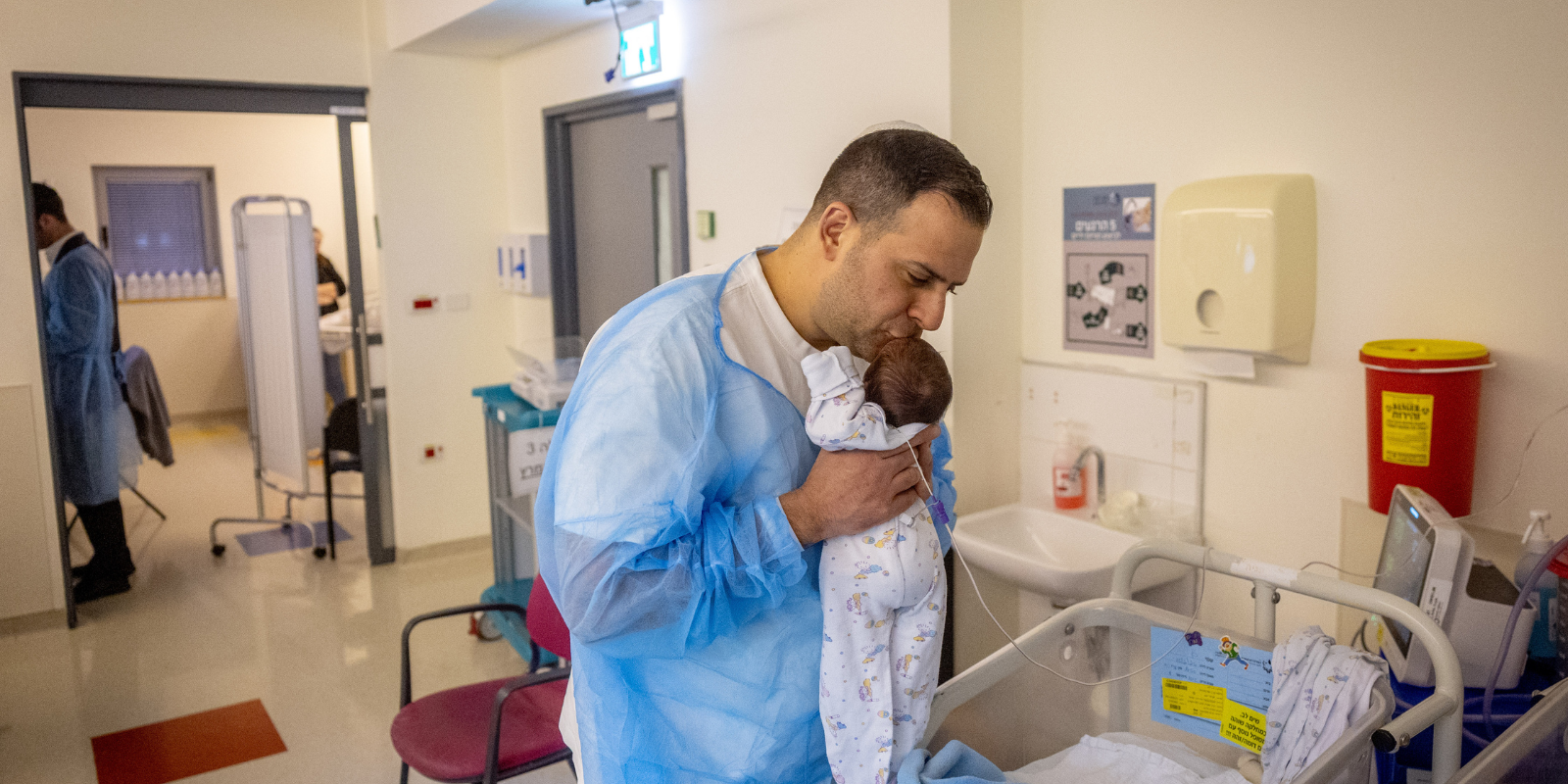
On Sunday evening, somewhere near the Nevatim Interchange in southern Israel, a baby was born in the back of an ambulance.
The Mobile Intensive Care Unit from Israel’s Magen David Adom emergency service had been transporting a 23-year-old woman to the hospital when labor suddenly accelerated. The paramedics pulled over and delivered the baby right there on the roadside. The newborn’s first cry had barely filled the ambulance when another sound followed: an alert warning of an incoming missile launch toward southern Israel.
Paramedic Elad Pas quickly instructed the driver to stop in the safest spot they could find. The crew put on their protective gear. Then Pas did something instinctive and profoundly human. He held the newborn in his arms and shielded the baby’s tiny body until the threat passed.
Sirens. A roadside birth. A paramedic protecting a newborn life in the shadow of a missile attack.
It is difficult to imagine a more Israeli scene.
Israelis sometimes joke that every war is followed by a baby boom. The comment is usually made half-seriously, with the kind of dark humor that develops in societies accustomed to living under pressure. But like many jokes, it contains a kernel of truth. Even during the most difficult moments of Israel’s history, including wars, terror waves, and national trauma, life has continued with a stubborn determination.
In Israel, maternity wards remain some of the busiest places in the country even during wartime. Families continue to grow. Children continue to be born. The Jewish story has always been one in which life insists on continuing, even when history seems determined to interrupt it.
The Hebrew Bible understands this tension well. One of the most striking descriptions of Israel’s story appears in the book of Ezekiel, where the prophet describes the nation itself as a vulnerable newborn child:
The Hebrew word used here, chayi, is simple and direct. Live.
Ezekiel’s metaphor is powerful because it captures something essential about the history of the Jewish people. Israel’s existence has often seemed fragile, exposed, and vulnerable. Again and again throughout history, enemies have attempted to destroy the Jewish people. Empires have risen and fallen. Threats have come from every direction.
And yet the story keeps continuing.
The prophet’s words describe a divine command that echoes through generations: Live.
Not merely survive, but live.
That command could easily describe the scene inside that ambulance near Nevatim. A newborn child had just entered the world in the middle of a war zone. A missile alert sounded overhead. Protective gear went on. And a paramedic instinctively wrapped his arms around a life that had existed for only a few seconds.
In that moment, the ancient biblical metaphor became something concrete.
The child was vulnerable. The danger was real. And someone stood there protecting life.
There is another biblical idea that deepens this picture. The book of Psalms reminds us that children themselves are one of the ways a nation endures:
The imagery is striking. Arrows are not symbols of fragility. They represent strength, continuity, and the ability to project life forward into the future.
In a world where Israel’s enemies invest enormous resources in weapons designed to destroy, the Bible points to something far more powerful: the next generation.
Missiles may fall on Israel.
But Israel’s true “arrows” are its children.
In the months since the horrific attacks of October 7, Israelis have witnessed story after story that carries this same message. Survivors of unimaginable trauma have begun welcoming new babies into their families. Communities that experienced loss have celebrated new life. Even in the midst of grief and war, children continue to be born.
This is not denial of reality. Israelis are painfully aware of the dangers that surround them. Sirens are real. Missiles are real. The threats are real.
But so is life.
And that life is often expressed in the most ordinary and extraordinary way possible: a newborn baby entering the world.
Which brings us back to that roadside moment near the Nevatim Interchange.
A young mother in labor.
An ambulance pulled over in the desert.
A newborn’s first cry.
A missile alert sounding overhead.
And a paramedic holding a baby, shielding him until the danger passed.
In that moment, the ancient words of Ezekiel no longer sounded like distant prophecy. They sounded like a description of what was happening right there in the ambulance.
“I said to you in your blood: Live.”