








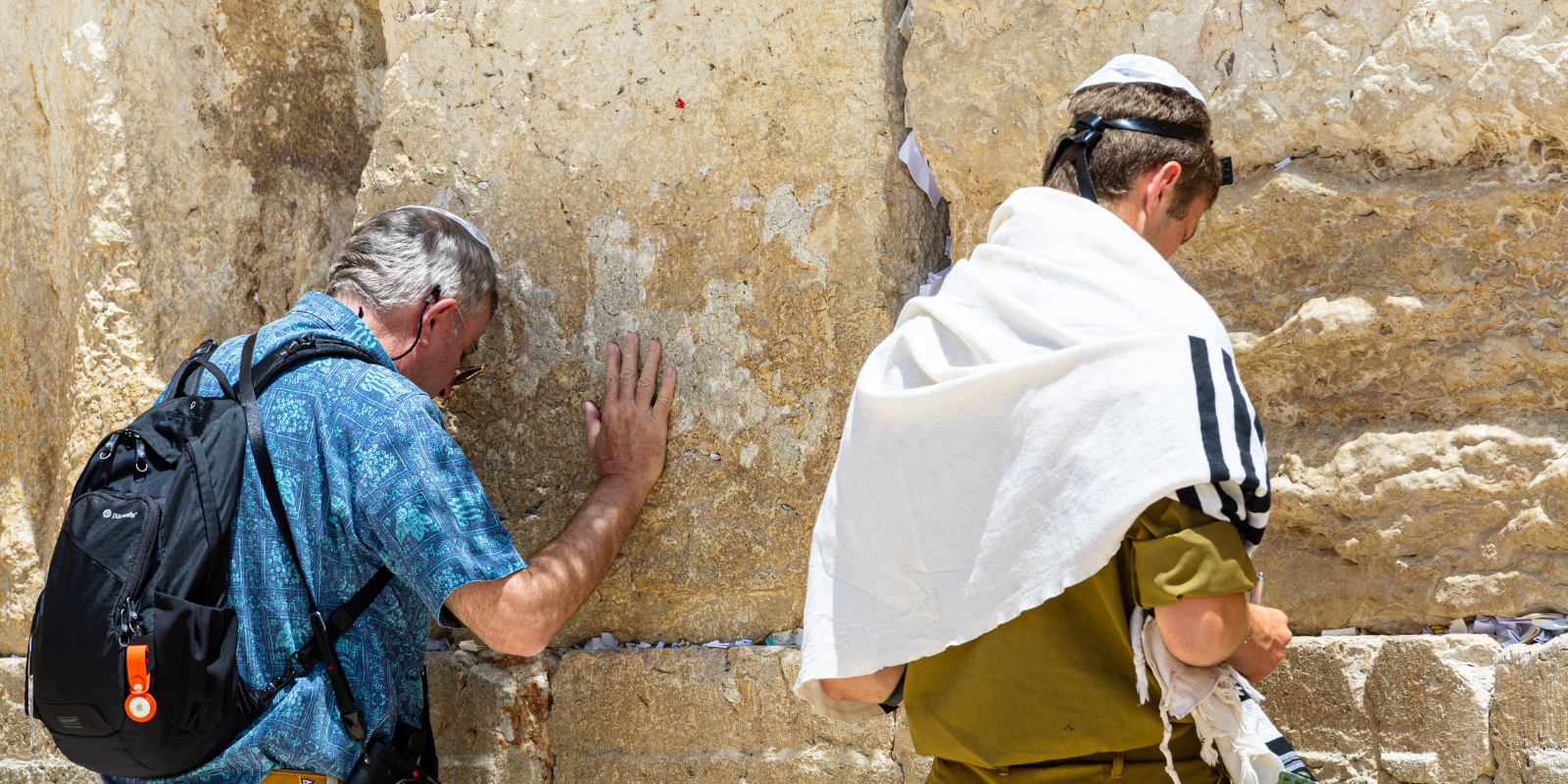
One of the tragic side effects of living in a war for the past three years is that on any given day, especially in more populated areas, you will see more than one, if not quite a few, young men (mostly men) moving through the world on crutches, in an accessibility scooter, or leaning on some other support device. Most of them are amputees. It is one of the quietest and most harrowing visual reminders of what Israeli men and women have been sacrificing every single day since October 7th, 2023. This morning, as I was dropping my kids at camp, I watched two young men walk out of the synagogue together. Both were missing a leg. They were wrapped in tefillin, the small leather boxes containing scrolls of parchment that men above the age of thirteen bind to their arm and forehead every morning during prayer. Inside those boxes sit the words of the Shema, the declaration from Deuteronomy that Israel has recited for three thousand years: Shema Yisrael, Hashem Elokeinu, Hashem Echad. Hear, O Israel, the LORD is our God, the LORD is One.
I love watching people pray with their bodies, not just their lips. And I think what moved me so deeply in that moment was watching these two young men maintain that physical connection to God after living through what I can only assume was hell. Their bodies had been changed by war. Their devotion had not.
That moment gave me a Torah flashback to the prophet Ehud.
If you don’t know Ehud’s story, buckle up, because it does not read like a typical Bible narrative. Israel is under the thumb of Eglon, king of Moav, a man so obese the text describes him as “a very stout man”.
God raises up Ehud ben-Gera, a Benjamite, to deliver Israel. Ehud straps a homemade double-edged dagger to his right thigh, gets a private audience with Eglon under the pretense of delivering a secret message, and then, with the guards having checked only his left side (because that’s where right-handed men carried their weapons), Ehud reaches across his body with his left hand, draws the blade, and drives it into the king. He locks the doors on his way out. The servants, assuming the king is simply using the bathroom, wait so long to check on him that Ehud is long gone before anyone finds the body.
It’s a wild story. But look at the actual Hebrew describing Ehud. Judges 3:15 says
It describes a hand that was bound or restricted. (For the record, two of my own kids are lefties, so I’m not knocking the left hand here. If anything, this story makes the case for it.)
So here’s the question worth sitting with: of all the men in Israel, why did God pick the one nobody would have put money on? Because Ehud was not anyone’s obvious choice for a national deliverer, and he did not wait around for someone to convince him otherwise. He did not spend years building his resume, training an army, or waiting for the right moment when Israel finally believed in him. He strapped a blade to his thigh, walked up to the most powerful man in Moav, and did the thing. The guards checked the side where a right-handed man would carry a weapon and never thought to check the other, not because Ehud had a secret advantage, but because nobody was watching him closely at all. He was the guy nobody expected. He used exactly that.
This is not a small theological point, and I don’t think it’s an accident that this story ambushed me on a morning I watched two amputee soldiers walking into shul wrapped in tefillin. What struck me wasn’t that they’d overcome something. It’s that they didn’t wait for their circumstances to look a certain way before they kept showing up to pray, to serve, to live. Neither did Ehud. He didn’t wait for the timing to feel right or for Israel to hand him a title. He picked up what he had and moved.
If you are waiting until you feel like the obvious choice, the qualified one, the person everyone would pick, stop waiting. Ehud was not that guy, and he still walked into the palace of a king and changed the course of his nation’s history. Israel’s deliverance did not come from Ehud matching anyone’s idea of a hero. It came from the fact that he moved.
The next time you talk yourself out of something because you don’t feel like the obvious choice, remember the judge nobody expected. God was never waiting for the obvious choice either. He was waiting for someone to move.