




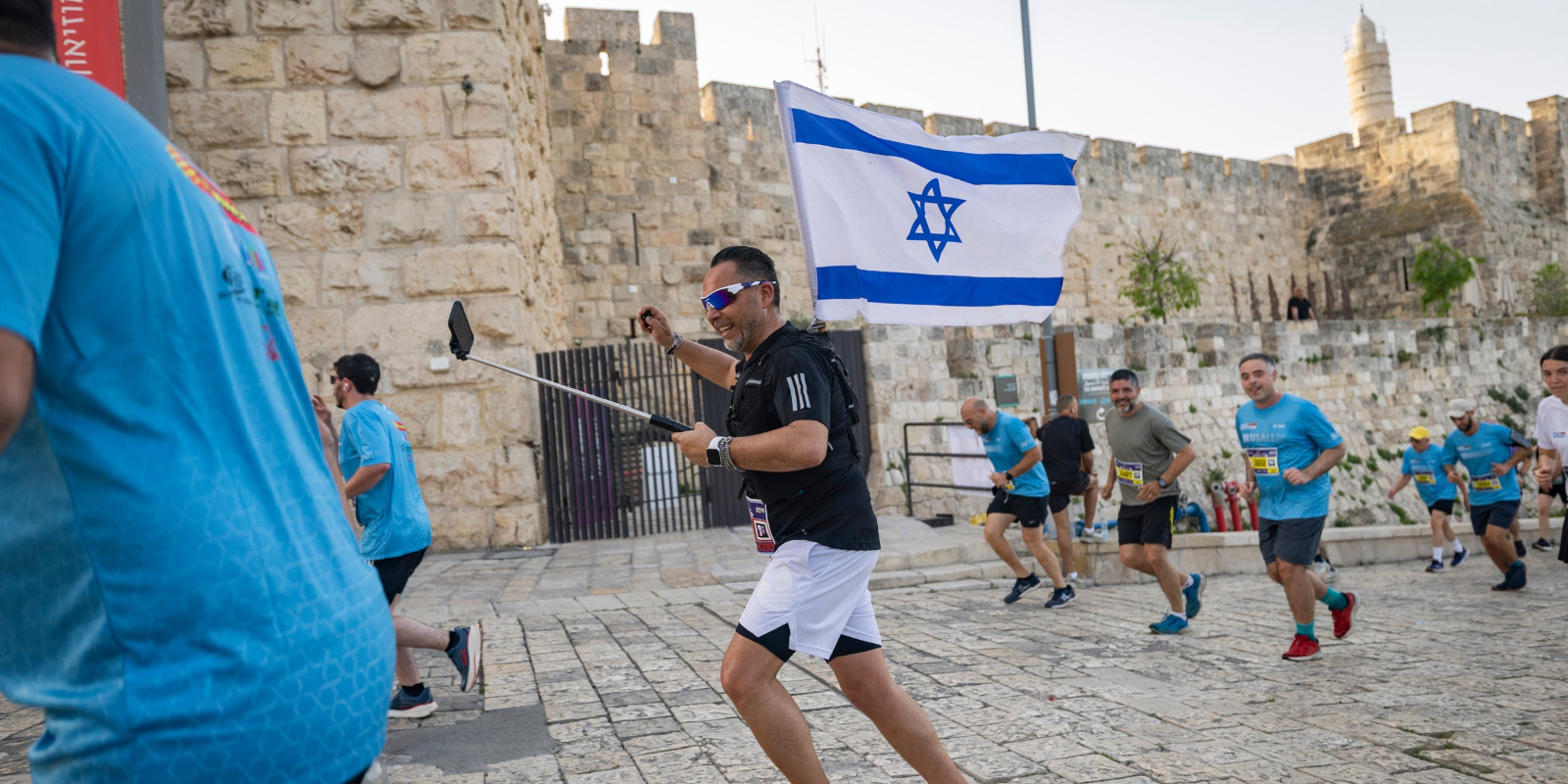
Last Sunday, tens of thousands of runners poured over the Verrazzano-Narrows Bridge to celebrate fifty years of the five-borough New York City Marathon. Before the gun went off, a handful of Jewish runners gathered in a tent on Staten Island and prayed. They have been doing it every year since 1983.
Their prayer group is a minyan, a quorum of ten Jewish men required for communal prayer. It started with one runner, Peter Berkowsky, who was mourning his father and needed ten men to recite Kaddish, the prayer Jews say in memory of a parent. More than forty years later, the minyan still meets at the start line, and it owes a great deal to the man who founded the race.
Fred Lebow came into the world as Fischel Lebowitz, born in 1932 to an observant Jewish family in Transylvania. The Nazis murdered much of his extended family. While still a boy, he lost contact with his parents and spent years crossing Europe on his own before finally landing in America in 1951. In 1970 he and a fellow club officer staged the first New York City Marathon, with 127 runners looping around Central Park on a $1,000 budget. The prize money came out of his own pocket.
His little race became the biggest marathon on earth, and Lebow never forgot the runners in that tent. One year the marathon was scheduled for Simchat Torah, the joyful holiday celebrating the completion of the yearly Torah reading. After a call from Berkowsky, race day shifted to early November, where it has stayed ever since. When the minyan began bringing a Torah scroll to the start, Lebow made sure they had a tent. In 1992, after a battle with cancer, he celebrated turning sixty by running the course with the number 60 on his chest. That morning he joined the minyan and wrapped tefillin, the small leather boxes holding Torah verses that Jews bind on the arm and head for morning prayer.
This week’s Torah portion, Chayei Sarah, has a surprising amount of running in it. Abraham sends his servant to find a wife for his son Isaac, and the servant arrives at a well with ten camels. A young woman named Rebecca appears with a water jar. The servant runs toward her and asks for a sip of water. She gives him a drink, offers to water his camels too, and then she runs:
Ten thirsty camels drink a lot of water, and Rebecca runs back and forth until every one of them is satisfied. Then she runs home to tell her family, and her brother Laban runs out to meet the guest. The Hebrew root ratz, “run,” appears four times in a single chapter.
The Torah could easily have said that they “went.” Biblical Hebrew never wastes a word, and running reveals what a person wants. Rebecca and Laban run to the very same stranger, but Rashi, the great medieval commentator, notes that Laban ran only after spotting his sister’s new gold jewelry. Rebecca runs to give. Laban runs to get. Same well, same verb, opposite hearts.
Fred Lebow had every reason to run like Laban. He arrived in America with nothing, and the marathon could easily have been his ticket to fame and fortune. Instead, he ran like Rebecca. He poured his own money into a race for strangers, and as it grew to tens of thousands of runners, he still made sure ten men had a place to pray. Ten camels at a well. Ten men at a starting line.