




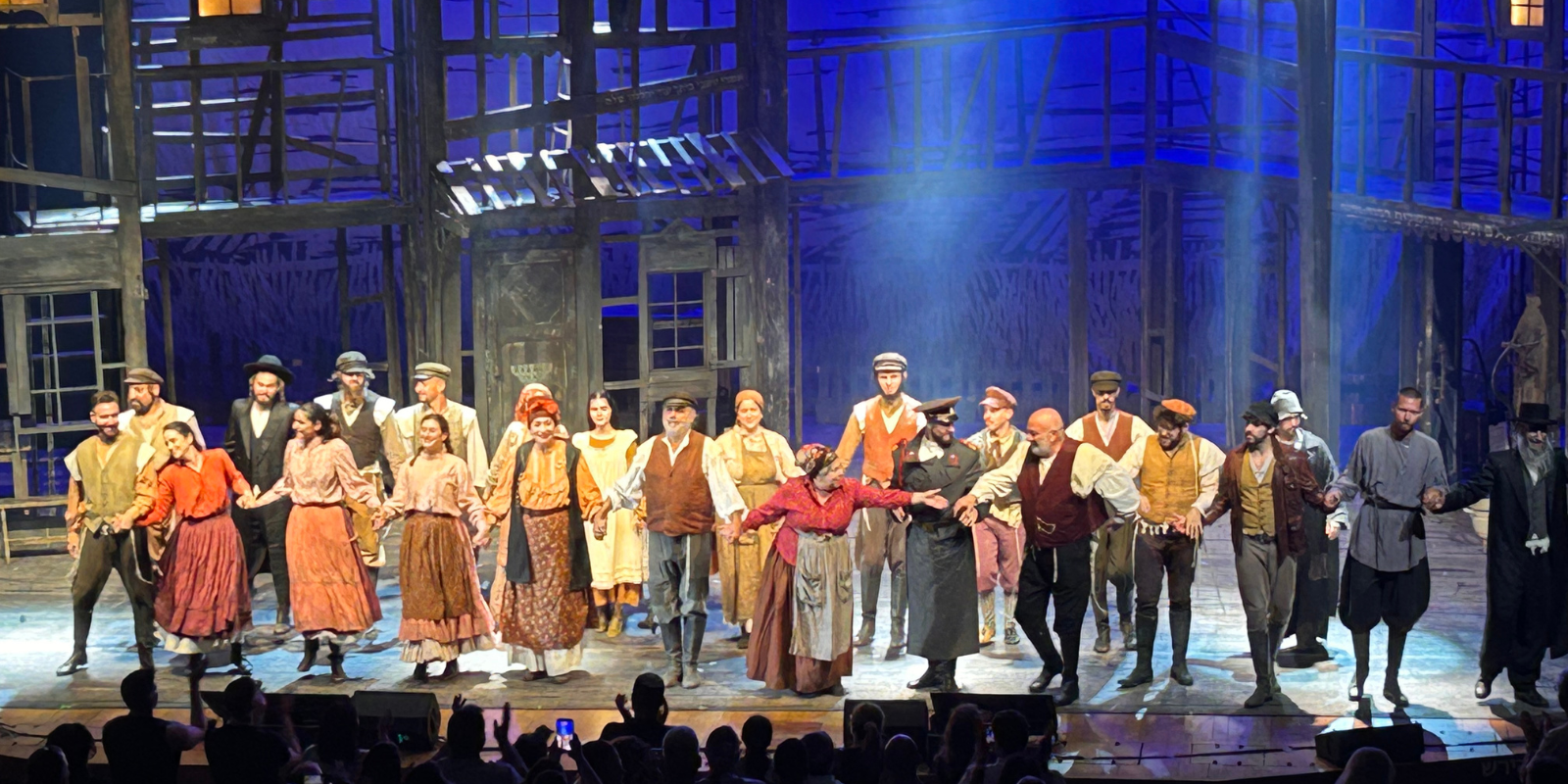
One of my favorite movies of all time is Fiddler on the Roof. From the time I was little, I knew every song by heart. I knew and know the storyline backwards and forwards. Somehow, despite being nearly three hours long, it never felt long to me. It just felt… familiar. About ten years ago, I even had the privilege of seeing it on Broadway, and I still remember that evening fondly. So when I saw that the Tel Aviv Cultural Center here in Israel was putting on Fiddler on the Roof for less than twenty dollars a ticket, I did not hesitate.
What I did not realize was that I had bought tickets for the anniversary of my aliyah. What a way to celebrate. For those who have never seen it, Fiddler on the Roof follows Tevye, a Jewish milkman struggling to preserve his faith, his family, and his traditions in a small village in Czarist Russia as the world around him begins to change. As I watched, it felt like I had been thrown a hundred years into the past. I had this sudden urge to call out to Tevye. “I’m here! We did it! After all these years, we’re back in the Promised Land. The traditions you’re working so hard to preserve are being nurtured, loved, and passed on in the very place your ancestors spent generations praying to return to.”
That alone would have made the evening unforgettable.
But there was another surprise.
For the first time in my life, I watched Fiddler on the Roof in Hebrew.
Now, Fiddler on the Roof was not originally written in Hebrew. It was written in English (actually based on a story written in Yiddish!). But something fascinating happened in the translation for me. Throughout the musical, familiar biblical words and names suddenly sounded… biblical again. One song in particular caught me by surprise. In Miracles of Miracles, Motel, the humble tailor who falls in love with Tevye’s daughter, sings about some of the great heroes of biblical history, and the Miracles they experienced. I had heard the song countless times before. But this time, instead of Samson, Joshua, Mordechai, Moses, and Pharaoh, I heard the Hebrew, Shimshon, Yehoshua, Mordechai, Moshe, and Paroh.
For just a moment, I felt like a time traveler.
One minute I was in a tiny Jewish village in Russia. The next, I was standing beside Yehoshua outside the walls of Jericho, with Mordechai in the streets of Shushan, and with Moshe confronting Paroh. Then, just as quickly, I was back in my seat in a theater in my homeland.
It was as though three thousand years of Jewish history had shared the same stage. And it made me notice something I had never fully appreciated before.
Living in Israel has changed many things about the way I experience my own Tradition. But most poigniantly, it has changed the way I experience the Bible.
I have always read Tanach, The Bible, in Hebrew. But now Hebrew no longer belongs only to the pages of Scripture. It is the language my neighbors speak. It is the language I hear on the train. It is the language children use on the playground. It is the language of the cashier at the grocery store.
The language of the Bible is very much alive. And by extension, that has made the Bible itself feel more alive.
As I watched Tevye cling to “Tradition,” I found myself thinking of Moses’ charge to the Jewish people just before they entered the Promised Land:
Tevye understood what Moses understood centuries earlier. A people preserves its faith by passing it from one generation to the next. Tradition is not simply about looking backward. It is about carrying God’s story, language included, forward.
If you’ve explored Bible Plus, you’ve probably noticed that while every course is taught entirely in English, our instructors pause to explain the original Hebrew behind a word, name, or verse when it enriches the text. You do not need to know Hebrew to study the Bible more deeply, but every so often, a glimpse of the original language opens a window that no translation can fully capture. If you’d like to explore the Bible in greater depth, Bible Plus gives you access to hundreds of teachings, with new courses added every month. Choose the annual plan for the best value, or subscribe month to month and begin studying today.h fresh depth, one insight at a time.