








Thirty-five years ago, when I was eleven years old, I read The Hobbit for the first time. I remember reading for hours at a time, completely sucked into J.R.R. Tolkien’s incredibly detailed world of elves, dwarves and, of course, hobbits.
Last month, I read it again — this time out loud, chapter by chapter, with my own eleven-year-old son. It was pure pleasure, for both of us. I’m not sure which one of us enjoyed it more!
But reading The Hobbit as an adult, I saw things I had missed entirely as a child. Tolkien was not simply writing a children’s adventure. He was a veteran of the First World War, a survivor of the Battle of the Somme, where nearly sixty thousand British soldiers fell in a single day. With his own eyes, he witnessed the obliteration of an entire generation. He understood that evil is real, civilization is fragile, and that all will be lost unless good men and women rise up to fight for God and humanity.
Tolkien published The Hobbit in September 1937. Hitler was Chancellor of Germany, growing in power by the day. The Nuremberg Laws stripping Jews of their citizenship were two years old. Millions of Jews across Europe were about to enter a darkness that would swallow them whole.
In other words, The Hobbit is describing a world as frightening as our own.
Rereading the story with my son, one chapter stood out to me above all others: Bilbo and the dwarves’ dangerous journey through the dark, and incredibly creepy, Mirkwood Forest.
Lost and starving in the massive forest, Bilbo and his friends are desperate. Their food is gone. The trees press in on every side, black and endless. In desperation, the dwarves push Bilbo — their designated “burglar” and all-around problem solver — to climb the tallest tree he can find and see what lies beyond.
He climbs until his arms ache and finally breaks through the canopy into open air and sunlight. He looks out in every direction. And what he sees kills the last bit of hope he possessed:
“Gaze as much as he might, he could see no end to the trees and the leaves in any direction. His heart, that had been lightened by the sight of the sun and the feel of the wind, sank back into his toes: there was no food to go back to down below.”
He climbs back down and delivers his depressing news to the waiting dwarves: “The forest goes on for ever and ever and ever in all directions! Whatever shall we do?” The dwarves, as you would expect, were shattered by the news.
Then the narrator steps in and says: “Actually, as I have told you, they were not far off the edge of the forest; and if Bilbo had had the sense to see it, the tree that he had climbed, though it was tall in itself, was standing near the bottom of a wide valley, so that from its top the trees seemed to swell up all round like the edges of a great bowl, and he could not expect to see how far the forest lasted. Still he did not see this, and he climbed down full of despair.”
Bilbo and his friends were close to the edge of the forest. They were almost there! Yet just before they reached the end, they gave up hope.
This is an unusual moment in the story, in which Tolkien criticizes Bilbo — his hero. But is the criticism fair? Bilbo did everything right. He risked his life to climb to the top of a massive tree. He reported exactly what his eyes saw. How can Tolkien fault a poor starving hobbit for failing to see what simply could not be seen from where he was standing?
On June 4, 1940, Winston Churchill stood before the British House of Commons. France was collapsing, and a Nazi invasion of Britain was imminent. Many in that room privately believed the war was already lost.
Churchill acknowledged the scale of the disaster. But then he shifted his tone: “We shall never surrender, and even if — which I do not for a moment believe — this island or a large part of it were subjugated and starving, then our Empire beyond the seas, armed and guarded by the British fleet, would carry on the struggle…”
“Which I do not for a moment believe.” Churchill knew the danger better than anyone in the room. For years, he warned the British Parliament and greater public of the Nazi menace, but few were willing to listen. He had no illusions about what Britain was facing. But he drew a hard line between what his eyes saw and what he was willing to conclude from it. He was standing at the top of the tree, staring into an endless forest — but he refused to believe that all was lost.
Nearly 1,900 years earlier, in the year 70 CE, the Roman Emperor Titus destroyed Jerusalem and burned the Temple to the ground. It was the greatest catastrophe in Jewish history to that point. The Temple — the center of Jewish worship, the place where God’s presence rested among His people — was gone. Jerusalem lay in ruins.
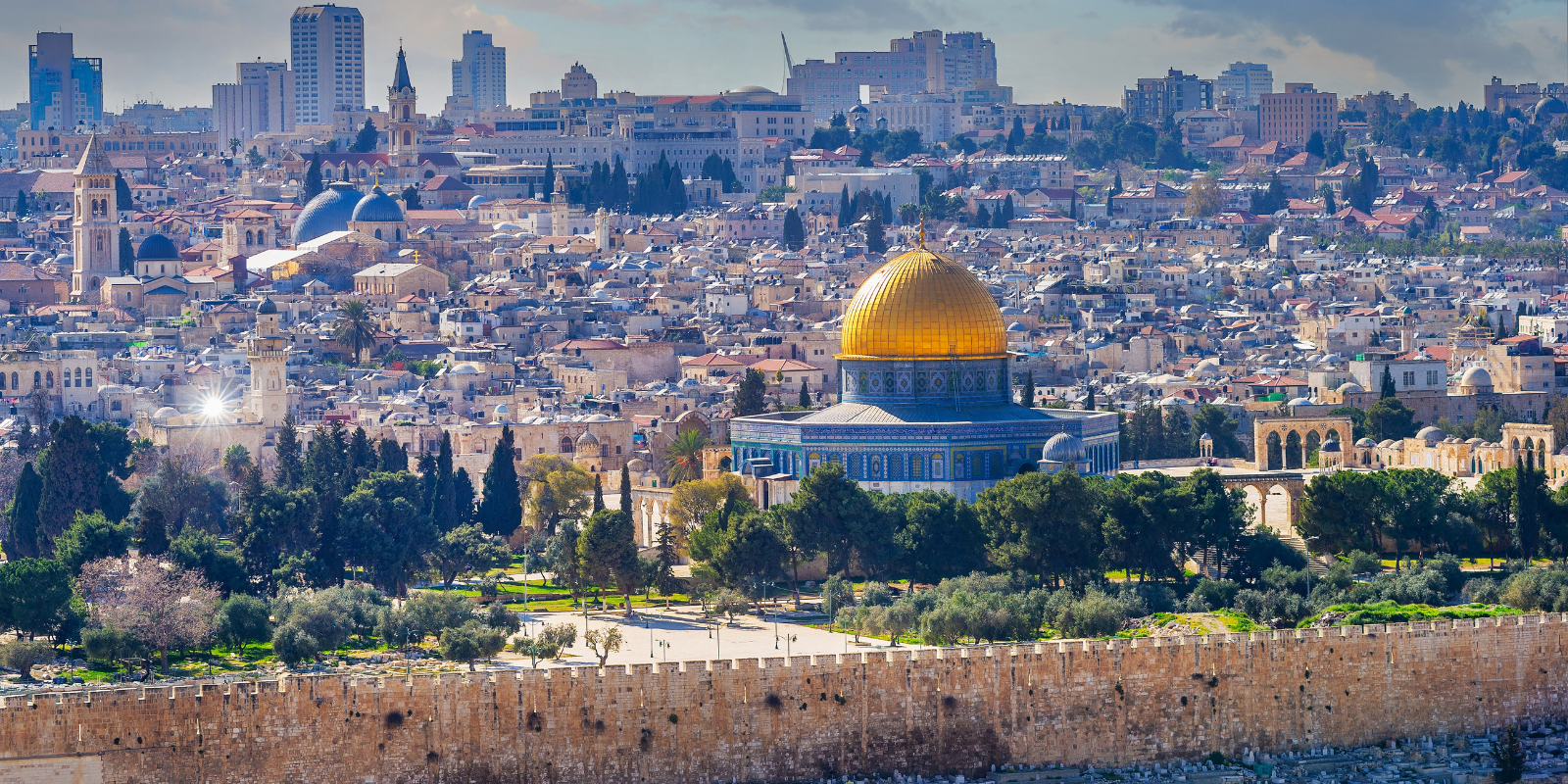
In the aftermath, four of the greatest Jewish scholars of the generation walked together through what remained of the city. At a distance, they looked upon the site of the Temple’s innermost chamber — the Holy of Holies, where God’s presence had dwelled — and saw foxes running freely through it.
Three of the four sages began to weep. The fourth — Rabbi Akiva — laughed.
To put it kindly, this was a socially awkward and deeply inappropriate response to such a painful sight. The others turned to him, stunned. “Akiva, why do you laugh?” He looked at them and responded: “Why do you weep?”
Then Rabbi Akiva explained himself. The prophet Isaiah writes:
This is a strange verse. Uriah prophesied at the time of the First Temple, and Zechariah at the time of the Second Temple — they lived centuries apart. What are they doing in the same sentence? Rabbi Akiva explained: the Torah is linking their prophecies together.
Why link them? Because their prophecies are bound together — if one comes true, so must the other. Uriah warned: “Therefore, because of you, Zion shall be plowed as a field; Jerusalem shall become heaps, and the Temple Mount like the high places of a forest” (Micah 3:12). Zechariah promised: “Old men and women will sit in the streets of Jerusalem” (Zechariah 8:4).
Rabbi Akiva told them: “As long as Uriah’s prophecy was not fulfilled, I feared that Zechariah’s prophecy might not be fulfilled either. But now that Uriah’s prophecy has been fulfilled, it is certain that Zechariah’s prophecy will be fulfilled.”
The other sages cried out: “Akiva, you have comforted us! Akiva, you have comforted us!”
The three sages saw the foxes, saw the ruins, saw total devastation — and they could not see beyond it. The destruction was the whole story, the final chapter, the end. And so they wept.
Rabbi Akiva saw the same ruins, the same foxes, the same devastation. But he understood something his colleagues did not: the destruction before his eyes was not the whole story. Though he could not see it right now, he knew that beyond the destruction there was comfort, joy, and redemption.
This is Tolkien’s criticism of Bilbo. Not that Bilbo’s eyes deceived him. But Bilbo made the same mistake as the three weeping sages. He took one giant leap — from “this is what I see” to “this is how things are and always will be.” He saw endless trees and no way out, and concluded that the forest must go on forever.
That leap is the error. It is the error of a man — or hobbit — who has forgotten that he is standing in a valley that limits his view, that the bowl shape of the terrain makes the forest look endless from any tree within it, and that the edge may be closer than he can possibly know.
Jewish tradition describes the era immediately preceding the final redemption as the ikveta d’Meshicha — literally, “the footsteps of the Messiah.” The Sages describe this period not as a time of obvious triumph, but as one of confusion, moral collapse, and the overwhelming sense that the darkness is total and permanent. The footsteps of the Messiah do not sound like a victory parade. They sound like Mirkwood Forest.
The Sages are telling us something that goes against every instinct: the darkness getting worse is not a sign that redemption is far away. It is a sign that redemption is close.
Today, we are wandering through our own dark and frightening Mirkwood Forest.
Antisemitism is spreading like a disease across America and Europe, from elite universities to city streets to the halls of government. Marxist antisemites are winning elections in major American cities. President Trump inexplicably handed the mullahs of Iran a lifeline, giving new life — and potentially billions of dollars — to the most murderous regime on earth. The enemies of civilization are loud, organized, and gaining ground. The forest looks endless. There is no edge in sight.
But consider what God has done since that dark morning on October 7. Israel has crushed one enemy after another. What looked, in those first horrifying hours, like a catastrophe without end has turned into something else entirely. We are not at the beginning of the forest. We are close to the other side. We just cannot see it from where we are standing.
Do not make Bilbo’s mistake. Do not weep with the three sages when you should be seeing what Rabbi Akiva saw. Do not look at the endless trees and assume there is no way out.
The light is there. Redemption is coming. Keep walking – and we’ll be there soon enough.