








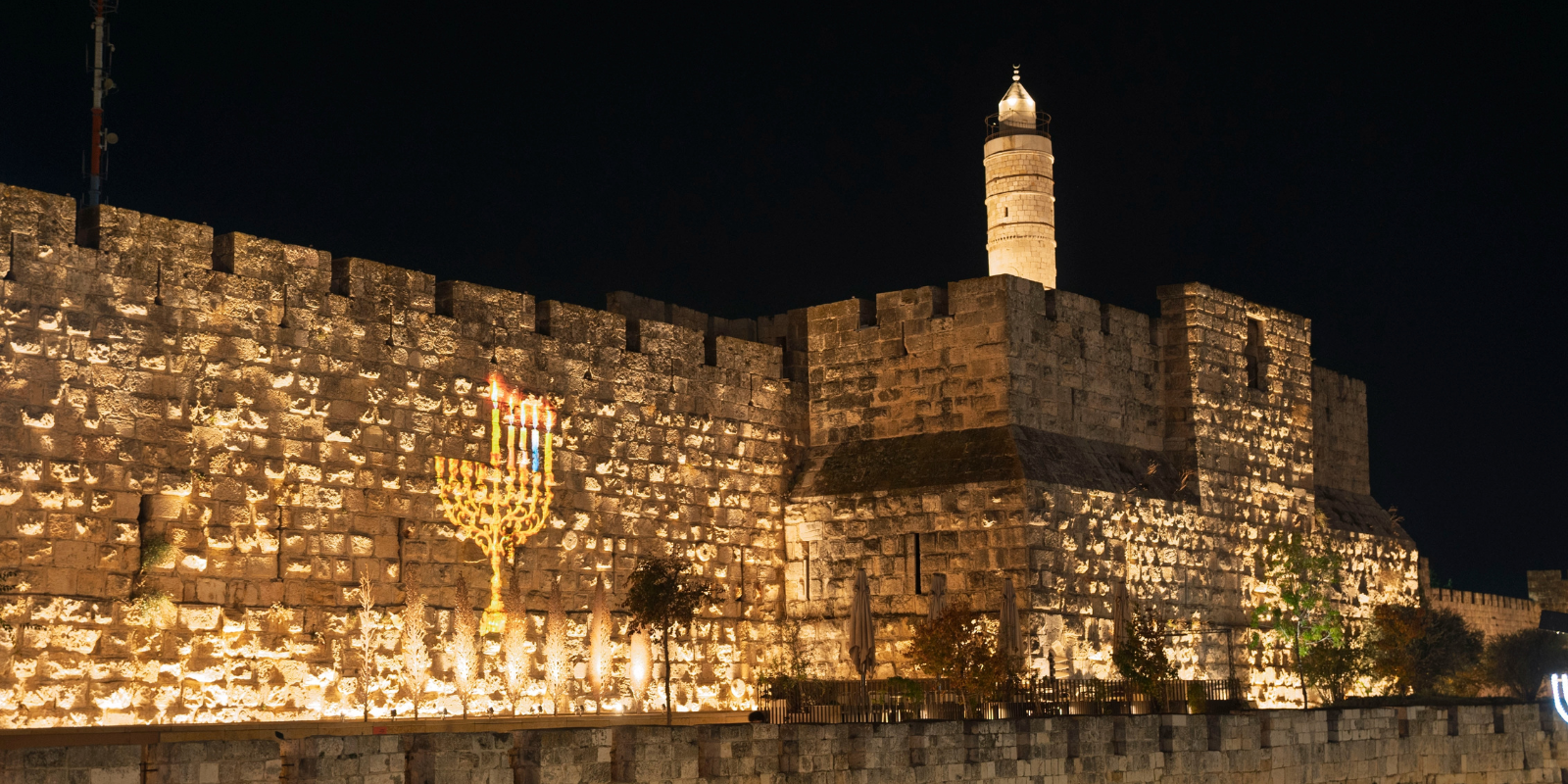
Among the survivor testimonies preserved by Yad Vashem, Israel’s national Holocaust memorial and museum, are accounts of Jews lighting Hanukkah candles in places where even a small flame could bring deadly danger. In one testimony, Holocaust survivor Yechezkel Hershtik remembered walking through mud, along a river, while being transferred on foot between camps in Romania. It was Hanukkah. On the fifth night, his father and several other heads of families stopped near a bridge and lit Hanukkah candles on its wall. Then they continued walking. A few moments later, fear caught up with them. The candles might be mistaken for signals to enemy airplanes. Two people went back to put them out before the group could move on.
In another testimony, survivor Zissel “Zissi” Charlotte Baum Fleishman remembered Hanukkah in the Augsburg labor camp in Germany. There was no silver menorah, no safe Jewish home, no polished table. So the prisoners used what they had. They carved a hole into part of a potato, stole oil from the machines they worked on, pulled threads from their sheets and blankets, and made wicks. Then they lit the Hanukkiah, the Hanukkah menorah, in a window facing the river, where no houses stood and no one could see. They sang Maoz Tzur, “Rock of Ages,” and recited the blessings from memory.
Jewish light does not wait for perfect conditions. It appears on bridges, in barracks, in windows facing empty rivers, in the hands of people who have almost nothing left except memory, faith, and nerve.
Numbers 8 opens with Aaron being commanded to light the Menorah in the Mishkan, the Tabernacle. The Hebrew word beha’alotecha does not simply mean “when you light.” It comes from the root alah, meaning to go up, ascend, or rise. Rashi, the great medieval Jewish commentator, explains that Aaron had to kindle the flame until “the flame rises by itself.” Aaron was not merely touching fire to wick. He was raising a flame until it could stand on its own. So the question is obvious: If God did not need the light of the Menorah, why did He command Aaron to light it every day?
The Torah says:
The Menorah was not there to illuminate God’s house for God’s benefit. The Creator of light does not need help seeing. The Menorah was there to train Israel in the responsibility of holy light. Light is not decoration. Light is not self-expression. Light is not a vague spiritual mood. In the Torah, light has discipline, direction, and purpose.
The Menorah stood inside the Mishkan, and later inside the Beit HaMikdash, the Holy Temple. It was made of pure gold and crafted with exact detail. Every branch, cup, knob, and flower mattered. Its flames were not random. They were tended. They were placed. They faced toward the center.
Proverbs gives us the inner meaning of that flame:
In Hebrew, a lamp is a ner. A human being carries a God-given ner within. Wisdom is a lamp. Courage is a lamp. Faith is a lamp. Moral clarity is a lamp. Compassion is a lamp. The ability to comfort, teach, build, protect, lead, create, and strengthen others is a lamp. These gifts are not random personality traits. They are entrusted flames. And entrusted flames are not private property.
Aaron was known in Jewish tradition as ohev shalom v’rodef shalom, a lover of peace and pursuer of peace. He drew people near to Torah. But he did not do it by watering Torah down or making holiness smaller. He did not drag Torah down to the people. He raised people up to Torah. That is real love. Real love does not leave people in darkness and call it kindness. Real love sees the hidden flame inside another person and says, “You were made for more.” Aaron’s task was to raise the flame until it could rise by itself.
The seven branches of the Menorah sharpen the lesson. The Menorah was one vessel, but it held multiple lights. Each branch had its place. Each flame mattered. Yet all the lamps faced toward the center. Unity in the Torah does not mean sameness. It means different strengths directed toward one holy purpose. A God-given strength kept private begins to shrink. Wisdom that never teaches, courage that never defends, faith that never steadies another person, blessing that never becomes responsibility, all of it misses the point. The flame was not raised so it could admire itself. It was raised so it could serve. God did not ask Aaron to light the Menorah because Heaven was dim. He asked Aaron to teach Israel how to carry light in a dark world. Not decorative light. Not sentimental light. Holy light. Directed light. Light with backbone. If God gave you a flame, raise it. Guard it. Aim it toward holiness. Then use it.