






During the intermediary days of Passover, my family, like so many families in Israel, headed outdoors to enjoy the beauty of the land at the loveliest time of year. Despite the war, and in some ways in defiance of it, we found an extraordinary activity in the south called Shvil HaSalat, the Salad Trail. There, with a safe room nearby in case of ballistic missile attacks, my children happily picked, tasted, and devoured the fruits and vegetables of the land.
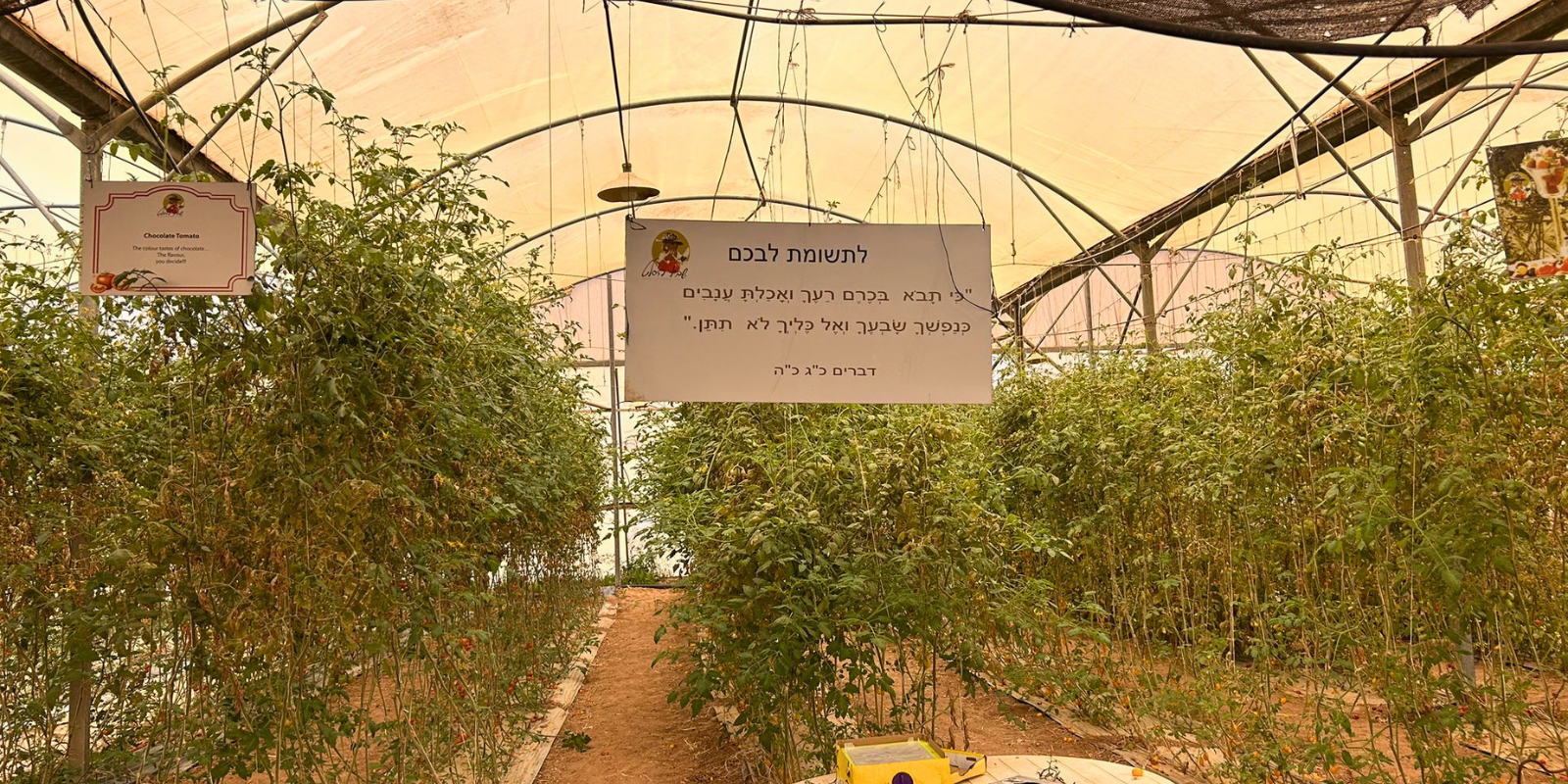
To me, one of the best parts about living in Israel is the fact that everywhere you go, verses of Torah appear. You find them on graffiti-covered walls, in grocery stores, at historic sites, and in places that have no business being as spiritually loaded as they somehow are. In Israel, if a verse feels relevant, someone will find a way to hang it up. And honestly, it usually is relevant. The Salad Trail was no exception. As my children gleefully grazed on kumquats, carrots, strawberries, and tomatoes, a verse hanging in the greenhouse caught my eye:
At first glance, the verse could be mistaken for a rule. In fact, that is essentially how our tour guide had explained it: you can eat whatever you want, but you cannot bring anything home. And on the simplest level, that is exactly what the verse is saying.
But why does the Torah bother saying it?
Why preserve a law about someone eating grapes in his neighbor’s vineyard?
Because the book of Devarim, Deuteronomy, is never merely listing rules. It is building a nation.
Devarim is Moses’ final address before the people of Israel enter the land. It is the Torah’s great transition from wilderness to nationhood. In the desert, dependence on God was obvious. Food came from heaven. Water came from a rock. The entire people lived in a state of open reliance. But in the land, life would become more settled, more prosperous, and more complicated. People would own vineyards, fields, flocks, and homes. And once that happened, a new question would arise: what kind of society would they build?
That is where this seemingly small verse becomes so powerful.
The Torah does not abolish private property. Your vineyard is still your vineyard. Your produce is still your produce. But neither does the Torah treat ownership as absolute. If someone enters your vineyard hungry, he may eat. He may satisfy his hunger from what grows there. What he may not do is fill a basket and walk away with it.
The distinction is everything.
The Torah is creating a moral society in which human dignity matters more than hard-edged possessiveness, but in which dignity is not turned into entitlement. The hungry person is not treated as a trespasser for taking what he needs in the moment. At the same time, he is forbidden from converting that moment of need into acquisition. He may eat. He may not harvest. He may receive immediate relief, but not claim ownership.
This is what a covenant grows from.
Rabbi Jonathan Sacks wrote that Deuteronomy is “a programme for the creation of a moral society in which righteousness is the responsibility of all.” He was exactly right. Devarim lays out the structure of a people who will not only live in the same land, but bind themselves to one another under God. It teaches that freedom is not the right to take whatever one can. Freedom is the ability to live within moral boundaries willingly, faithfully, and with restraint.
That is also why this verse feels so fitting on Passover.
Passover celebrates liberation, but not liberation as chaos. The Israelites did not leave Egypt so that every man could become a Pharaoh to his neighbor. They left Egypt to become a covenantal people. They were freed from slavery in order to enter obligation. That is the heart of biblical freedom. Not lawlessness, but holiness. Not appetite without limit, but desire disciplined by the presence of God.
A free person is not someone who grabs. A free person is someone who understands his limits and knows when to stop.
That greenhouse sign, then, was doing far more than enforcing a farm policy. It was expressing an entire Torah vision of life in the Land of Israel. Here, you may enjoy the produce. Here, you may rejoice in what grows from this soil. Here, you may eat until you are satisfied. But you may not forget that blessing comes with limits, and those limits are not a burden. They are what keep blessing from collapsing into selfishness.
That is one of the deepest beauties of life in Israel. Torah is not confined to the synagogue or the study hall. A greenhouse becomes a house of study. A family outing becomes a moment of biblical reflection. A sign hanging over tomatoes becomes a lesson in nationhood, covenant, and freedom.
As my children laughed and ate their way through the Salad trail, I kept thinking that this is what it means to come home. Not only to walk the land of the Bible, but to live inside its language. Not only to taste the fruit of the land, but to be shaped by the words that explain how that fruit is meant to be enjoyed.
That is the real achievement of Deuteronomy. It takes the grand drama of redemption and translates it into daily life. Into fields. Into vineyards. Into greenhouses. Into the kind of people we are meant to become.
And that is why the verse stayed with me. In the middle of war, in the middle of Passover, in the middle of a greenhouse in southern Israel, the Torah was still doing what it has always done: teaching us that redemption is not only about leaving Egypt. It is about learning how to live, in our own land, as a people worthy of freedom.
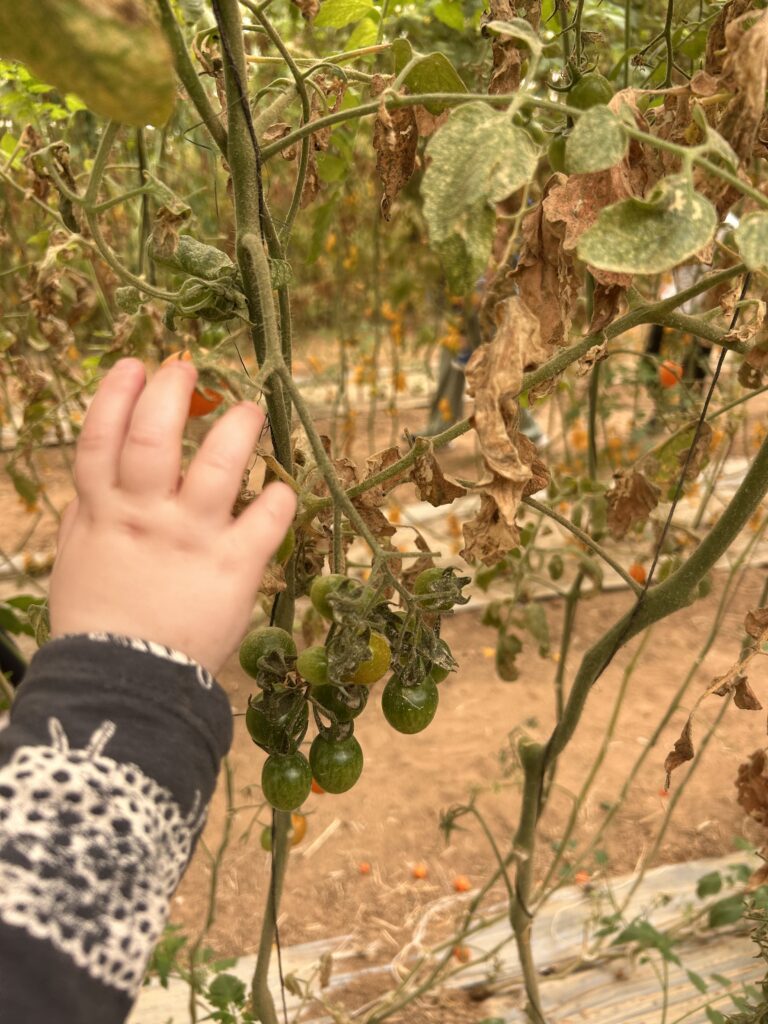
My one and a half year old really enjoyed the tomatoes. The self-restraint, we’re still working on!