








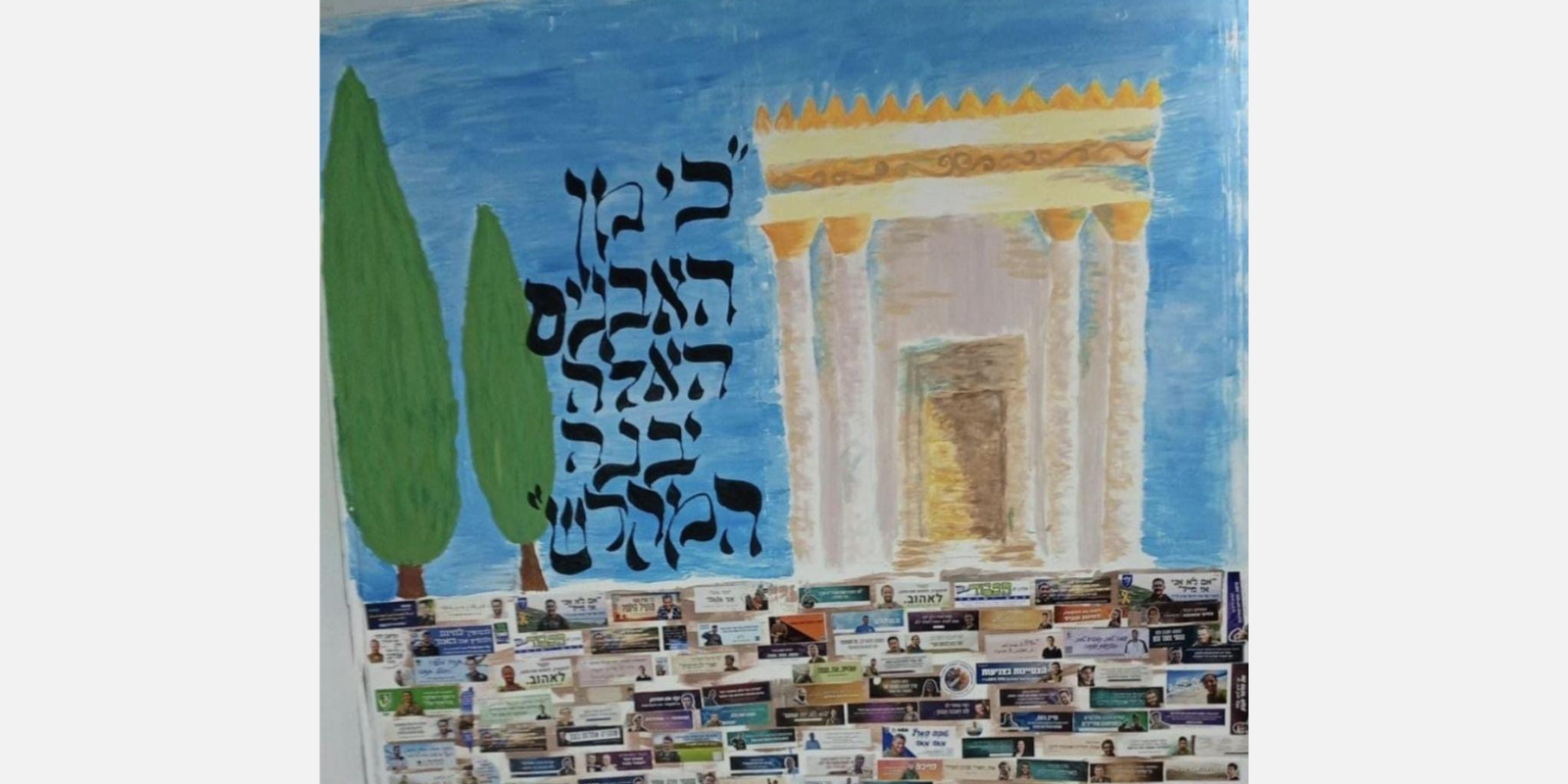
Every fall in Israel, you can feel the excitement from Eilat in the far south to the northernmost towns near the Galilee. For American readers, the closest comparison is a nationwide Color War for elementary and middle school children. It has the energy, teamwork, themed challenges, and long afternoons filled with activity that summer camps are known for, except it takes place in every community and lasts for weeks. This is Chodesh Irgun, the monthlong program run by the national religious youth movement Bnei Akiva. Each shevet works after school on murals, skits, dances, videos, and large scale creative projects. Entire neighborhoods watch as children build something together with pride and a sense of belonging.
This year, the Bnei Akiva branch in the community of Carmi Katif created a mural that captured national attention. At first the painting looks cheerful. A bright sky, tall cypress trees, and the Beit HaMikdash, the Holy Temple, painted in warm white and gold. But the “stones” at the base of the Temple are not stones at all. They are stickers. These stickers have become part of the visual landscape of Israel. You see them on bus stops, school walls, storefronts, playground gates, and public spaces, each one a quiet reminder of a life the nation refuses to forget. Each sticker in the mural carries the face of a fallen soldier alongside a short quote or memory. The children arranged these images into the foundation of their Temple and wrote above it, “Ki meavanim eilu yibaneh haMikdash,” which means, “For from these stones the Holy Temple will be built.”
Long before these children painted their mural, the Bible offered a sentence that describes exactly what they were doing.
The children of Carmi Katif were doing just that. They cherished Jerusalem’s stones by honoring the people who defend them.
This brings us to the central question. Why would children choose fallen soldiers as the building blocks of their painted Temple?
The answer begins with how the Hebrew Bible treats stones. Stones are never set dressing. They carry memory and meaning. Jacob places a stone at Bethel after encountering God. Joshua sets twelve stones at the Jordan River so that future generations will ask about their significance. When Solomon builds the First Temple, Scripture pauses to highlight the human effort behind the stones. It says:
The shaping, lifting, and difficult labor happened far from the holy site. Holiness rested on human work.
The children of Carmi Katif were expressing that same idea. They built their Temple from the faces of young men who carried the responsibility of protecting the nation. They were not making a political statement. They were turning their reality into something they could hold. The mural does not glorify death. It honors responsibility. Israelis do not admire loss. They admire the love of life that drives people to protect others. The children chose to build their Temple on the lives these soldiers lived, not on the way those lives ended.
This instinct reflects the way the Mishkan, the Tabernacle, came into being. It was created through hitnadvut, voluntary giving. Ordinary men and women contributed wood, wool, gold, artistic skill, and time. The first sanctuary rose because people stepped forward with willing hearts. The children’s mural expresses the same truth. Holiness grows out of human commitment.
The mural is more than art. It is a declaration from the next generation about how they understand the story of Israel. Children who build their Temple on the strength and devotion of their protectors are not shrinking from reality. They are learning to build with courage, gratitude, and responsibility. A generation that thinks this way is a generation prepared to shape the future.