








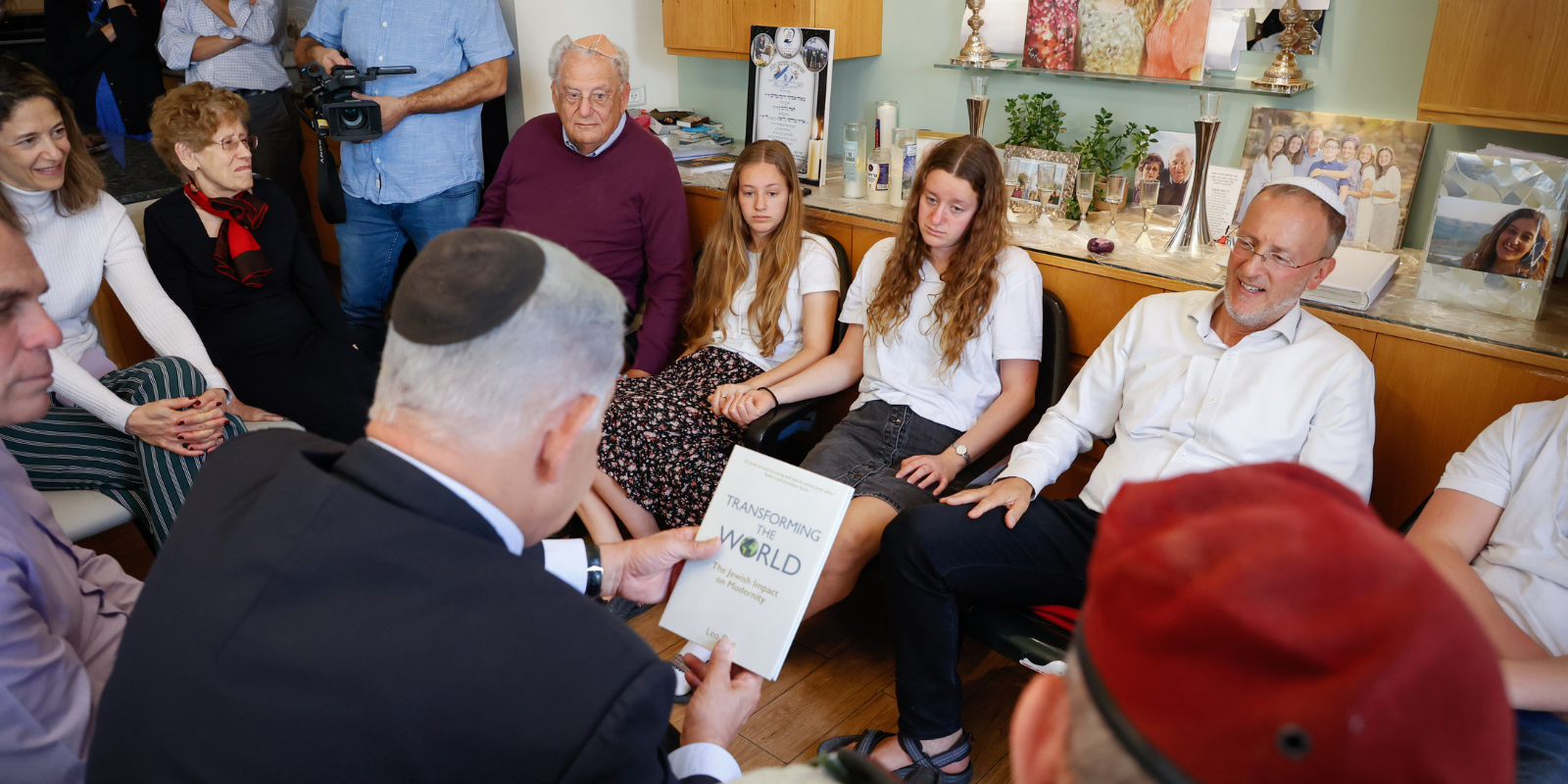
On the second day of Passover, 2023, Rabbi Leo Dee loaded his car and set off for a family vacation in the Galilee. His wife Lucy took a separate car with two of their daughters, Maya and Rina. Somewhere on Route 90, near the Hamra Junction in the Jordan Valley, a terrorist opened fire on their car. Maya and Rina were killed on the spot. Lucy was airlifted to Hadassah Hospital in Jerusalem with two bullets, one in her brain stem and one in her lower spine. She died two days later. Rabbi Dee buried his wife and two daughters within the span of a single week.
He still lives in Efrat. He is still there, in the biblical heartland of Judea, a few miles from Bethlehem, on the road that Abraham once walked. He is not leaving.
One of our most watched courses this season on Bible Plus is Rabbi Elie Mischel’s three part series on the modern history of Judea and Samaria, filmed right there in Efrat, in the hills of Judea. Watching it in the days leading up to Yom HaZikaron, Israel’s Memorial Day for fallen soldiers and victims of terror, I could not stop thinking about Rabbi Dee. About what it means to lose everything and stay. About what kind of faith that requires. And about what the Bible actually says about this land, this people, and this particular kind of grief.
So here is the question I want to sit with on this Erev Yom HaZikaron, the eve of Memorial Day: What does God say to a people who have buried their children in the land they were promised?
The answer is in the book of Jeremiah. The prophet is speaking to a nation in the middle of catastrophe, exile, loss. And right in the middle of it, he records something devastating and then something extraordinary:
“Restrain your voice from weeping, your eyes from shedding tears, for there is a reward for your labor, declares the Lord. They shall return from the enemy’s land. And there is hope for your future, declares the Lord. Your children shall return to their own land.” (Jeremiah 31:16)
Read that carefully. God is not telling His people to stop grieving because everything is fine. He is not minimizing the loss. He is saying: the grief is real, AND the return is real. Both are true at the same time. The tears are not wasted. The labor is not wasted. And the children, in some form, are coming home.
This is exactly what Rabbi Mischel’s course makes visible. He tells the story of Kfar Etzion, a small Jewish settlement in Judea, south of Jerusalem, that was massacred by the Jordanian Arab Legion on May 13th, 1948, just hours before David Ben Gurion declared Israeli independence in Tel Aviv. One hundred and thirty three defenders were killed. The town was burned to the ground. The widows and orphans were evacuated to Jerusalem, and for nineteen years they looked out from the hilltops of the city toward the ruins of their home.
And then came 1967. The Six Day War. And the children of Kfar Etzion, now grown, drove back to the ruins of their town in the very same armored car that had evacuated them as babies. They rebuilt. They stayed. Today, Kfar Etzion is a thriving community, and Rabbi Mischel buys his trees from the nursery there.
Jeremiah knew this story before it happened. “Your children shall return to their own land.” Not as a vague comfort, but as a promise with a delivery date.
This is what makes Yom HaZikaron so different from any other memorial day in the world. Israel does not grieve in a vacuum. The siren sounds, the country stands still, the tears come, and then, within twenty four hours, the celebrations begin. Not because the grief is forgotten. Because the grief and the return belong to each other. They always have. That is the biblical pattern, from Rachel weeping for her children in Jeremiah, to the exiles returning from Babylon, to the pioneers of Kfar Etzion driving home in 1967, to Rabbi Leo Dee waking up every morning in Efrat, still there, still standing.
There are now 530,000 Jews living in Judea and Samaria. The vineyards of Samaria are producing wine. The cities of Judah are being rebuilt. The children are returning to their own land.
Tonight, as the siren sounds across Israel, remember that you are not watching a tragedy. You are watching a prophecy. The grief is part of it. So is everything that comes after.
To learn the full story of Judea and Samaria, from the biblical promises to the pioneers to today, watch Rabbi Elie Mischel’s three part series Reclaiming the Biblical Heartland on Bible Plus