







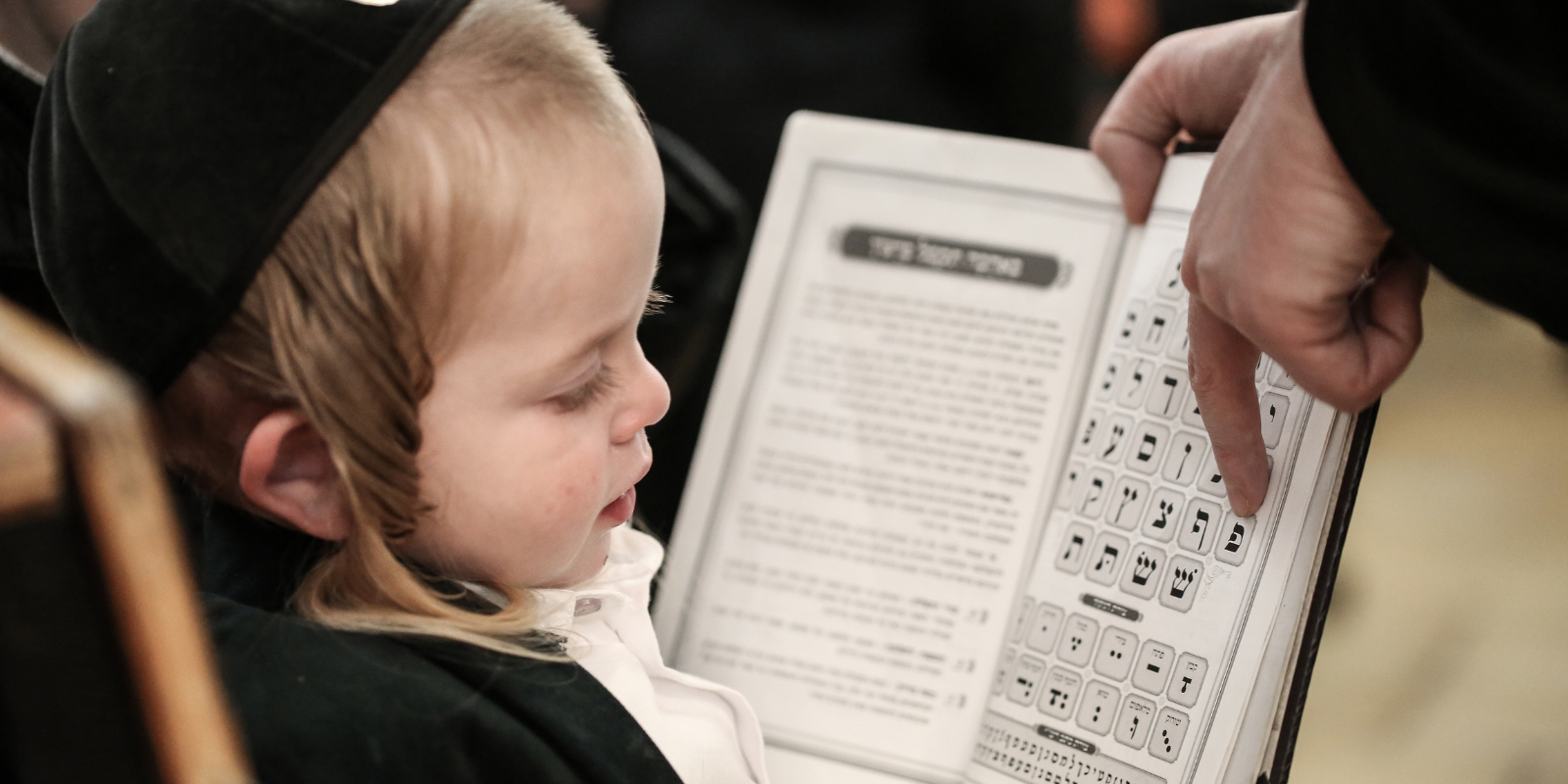
In my sons’ school, every morning begins with a song. The boys file in, find their seats, and before anyone opens a Bible, before the teacher reads the first verse of the day, they sing together. I love picturing it: a room full of young voices, still a little sleepy, filling the air with a melody before the learning starts. For a long time I thought of it as a sweet way to open the day, a little gift the teachers give the children before the real work begins.
Then I re-read a biblical verse that made me think about this daily custom a little differently.
Moses had spent forty years leading Israel out of Egypt and through the wilderness, and he had delivered 612 commandments covering every corner of national and personal life: how to farm, how to judge, how to wage war, how to build a Temple, how to crown a king. Now God summoned him and Joshua to the Tent of Meeting for one final instruction. This was the moment for a grand summation, a last word to carry Israel through the centuries.
Instead, God handed Moses a writing assignment.
That is the 613th commandment. Not a law about the Land, not a ritual, not a theological declaration, but an instruction to copy the text, teach it, and get it into people’s mouths. In its plain sense, “this song” refers to the poem that follows. But the rabbis of the Talmud read it as a personal obligation on every Jew to write their own Torah scroll.
Why would God spend the last commandment on copying down the Torah? A single scroll in the Tabernacle would preserve the text perfectly well. Why does every household need its own? And why, of all the words available, does God call His Torah a shira, a poem or song? Most of the Torah is not lyrical at all. It is law, census, genealogy, and instructions for building furniture.
The Sefer HaChinuch, a thirteenth-century work that explains the reasons behind each commandment, gives an answer that sounds practical. God wants every Jew to have a scroll “so that he can always read from it and not need to walk for it to the house of his fellow.” Then it adds something unexpected. Every Jew should write a new scroll, even if he inherited one, “so that each and every one of Israel reads from new scrolls, lest their souls be sick of reading the old scrolls their fathers left them.”
Sick of the old scrolls. The Chinuch is saying that a text can die in your hands. A scroll that belonged to your grandfather is your grandfather’s. A scroll you commissioned and watched a scribe produce letter by letter is yours, and you will open it. The commandment does not protect the survival of the text; God guaranteed that Himself. It protects the survival of the reader’s appetite.
The word shira answers the second half of the puzzle, and here two nineteenth-century giants of Lithuanian Jewry go in different directions.
The Netziv, Rabbi Naftali Zvi Yehuda Berlin, asked the question head-on in the introduction to his Torah commentary: how can the whole Torah be called a poem when it plainly is not written in poetic language? His answer is that the Torah has the nature of poetry even where it lacks the form. The essence of poetry is concision: a few carefully chosen words carry volumes of meaning, and because a poem compresses, it can hold several layers of meaning at once and leave the reader the work of uncovering them. The same is true of the Torah. God chose every word deliberately, and every verse contains more interpretations than any single reader will exhaust. This is why the most studied text in human history still yields new insights thousands of years later. A poem rewards the reader who returns to it a hundred times, which is exactly why a fresh scroll matters. The text is inexhaustible only to someone who keeps opening it.
Rabbi Yechiel Michel Epstein, author of the Aruch HaShulchan, heard something else in the word. The Talmud is full of arguments, and the Sages said of these disputes, “these and those are the words of the living God” (Eruvin 13b). That, he writes, is why the Torah bears the name of a song. One voice makes a tune. Many voices in tension, interwoven, make harmony. The arguments are not a flaw in the tradition. They are the music.
I want to suggest a third reason. The Talmud describes a rabbi who glimpsed the next world and reported back, “I saw an upside-down world” (Pesachim 50a). Anyone paying attention to the last few years knows the feeling. Truth is not obvious in this world; it has to be reached for. The Sages also say, “Moses is true and his Torah is true” (Bava Batra 74a). The Torah is the fixed point, the thing that does not turn upside down, and it is how a person in a confused world finds his way back to the world of truth. Music does something similar. A melody can lift a person out of the room he is standing in and put him somewhere clearer. Rabbi Jonathan Sacks called music the language of the soul, and that is the point. Words address the mind. A song reaches the part of a person that knows which way is up.
All three explanations lead to the same place, and the verse itself points there. God did not stop at “write it.” He continued: “teach it to the people of Israel; put it in their mouths.” Not in their libraries or their arks, but in their mouths.
The Sages derive from these words that a teacher has not finished the job when the student understands the material. He must keep going “until it is organized in their mouths,” until the student can say it himself and teach it to others. Rabbi Yochanan went further still (Megillah 32a): whoever reads Scripture without a melody, or studies Mishnah without a tune, is the subject of Ezekiel’s terrible verse, “I gave them statutes that were not good” (Ezekiel 20:25). Read flat, the Torah only arrives halfway.
Now the picture comes together. The last commandment of the Torah is a literacy program. Every household gets its own scroll, so that no one has to walk to a neighbor’s house to read. Every generation writes its own fresh copy, so that no one grows sick of it. Every student drills until the words sit in his mouth, and then he sings them, because a song is what people carry with them when they leave the room.
What a nation talks about is what a nation becomes. Moses understood that a people can own a text and lose it, can venerate a scroll and never open it. So the Torah ends where it began at Sinai, with a voice, and it asks every Jew to make sure that voice comes out of his own mouth. Not a relic but a song, not inherited but written, not stored but spoken.
Which is why my sons sing before they open the book. Their teachers understood something before I did. The song is not the warm-up before the learning. It is where the learning is meant to end up, and every morning the boys get a taste of the destination before they set out.
King David put it plainly: “Sing to the Lord a new song” (Psalm 96:1). Not an old song from an old scroll, but a new one, in your own voice, every morning. That is what Moses asked of every generation that would come after him. Open the book. Read it out loud. And when the words have become yours, sing them.