








When I was a child, my school bus came at the ungodly hour of 6:45 in the morning. But there was something about being outside so early that I absolutely loved. I relished the sounds, sights, and sensations of the world just waking up. One of my favorite parts of the morning was walking across our front lawn on the way to the bus. The grass would be covered in dew, and as I walked through it, the cool, wet blades would brush against my ankles. I used to imagine it was a little wake-up call for my feet.
I’d climb onto the school bus with slightly damp shoes, wet ankles, and a smile on my face. It’s one of those memories that feels so distinctly like childhood. Who else has the time, or perhaps the presence of mind, to delight in something as simple as the feeling of dew on their ankles? As I’ve gotten older, I think some of that childish wonder has inevitably faded. And now that I live in Israel, where we don’t even have a front lawn, my own children aren’t experiencing that particular morning ritual.
But I still remember it vividly. The coolness of the grass, the quiet of the early morning, and the absolute delight of something so ordinary.
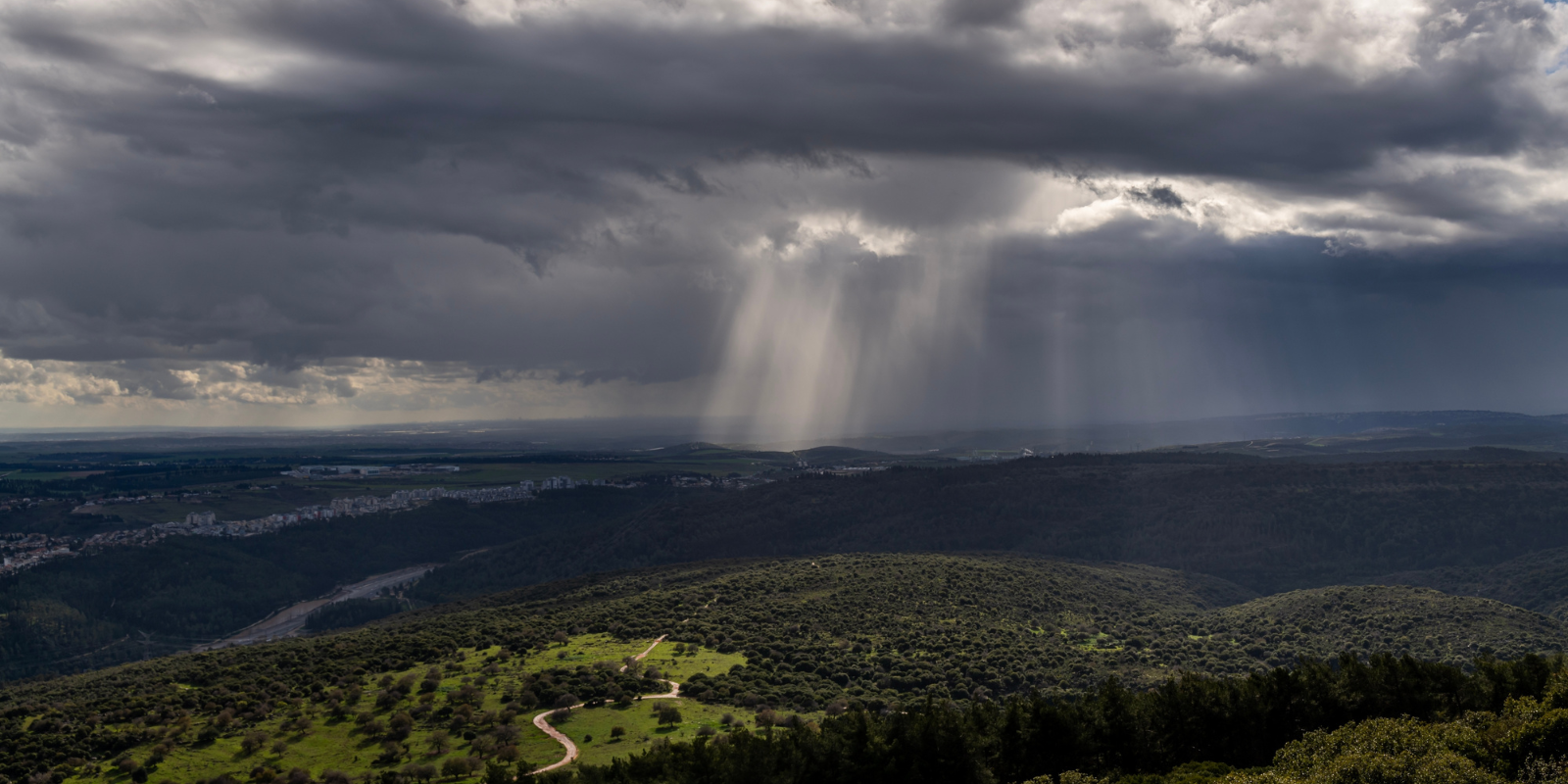
This past Saturday night, on the seventh of Cheshvan (a month in the Hebrew calendar), Jews in Israel began including a special seasonal request in our daily prayers. Three times a day, during the Amidah, one of Judaism’s central prayers, we now say V’ten Tal U’Matar Livrachah, meaning “Grant us dew and rain for a blessing.” This addition marks the beginning of our annual prayers for rain as Israel enters its rainy season.
In Israel, where agriculture and our natural water resources depend heavily on seasonal rainfall, these prayers are particularly significant. After the long, dry summer, we are ready for rain. Interestingly, we don’t begin asking for rain immediately after Sukkot, even though the rainy season is approaching. The sages explain that we wait until the seventh of Cheshvan out of consideration for the pilgrims who had traveled to Jerusalem for the holiday. Many had long journeys home, and we wanted to give even the last travelers time to return before praying for rain that would make their journeys more difficult.
But here’s something I never really stopped to consider.
Why do we pray for both dew and rain? After all, they’re both water. And if we’re asking Hashem for rain to replenish our land, why specifically mention dew? The Talmud teaches something fascinating about dew. Unlike rain, dew is never withheld. It is a constant presence in the world, a blessing so dependable that we barely notice it. Rain, on the other hand, is something we wait for. Something we look toward the heavens and actively ask Hashem to send. Its arrival can be dramatic, powerful, and transformative. Rain can turn a dry landscape into one bursting with life.
And I think there’s something profound about the fact that we ask for both in the very same breath.
At the end of Deuteronomy, as Moses prepares the Israelites for going into the Land of Israel, he uses these very same images to describe his teachings:
Even the words of Torah are compared to both rain and dew. There is wisdom that nourishes us gently and consistently, and wisdom that arrives with a force powerful enough to transform us. Both are necessary for growth. But there’s another aspect of this prayer that I find particularly fascinating.
We know how rain works. We understand evaporation and condensation. We can study weather patterns, track approaching storms, and predict rainfall with remarkable accuracy. We understand the science behind those tiny droplets of dew that used to collect on my childhood lawn.
And yet, every year, on the seventh of Cheshvan, we begin asking God to send rain.
Thousands of years of scientific discovery haven’t changed the words of our tefillah.
I find something deeply meaningful about that. Judaism doesn’t ask us to choose between understanding the natural world and recognizing God’s presence within it. Just because we understand how something happens doesn’t mean we can guarantee that it will. We can understand every step of the process and still have no control over whether the rain will actually come.
And perhaps that’s where dew and rain come together.
Dew represents the remarkable consistency of the natural world, the countless processes that unfold every day without our intervention. Rain reminds us how much we still depend on forces beyond our control. We can understand exactly how clouds form and still be unable to make them release a single drop of rain where and when we need it. For all our knowledge, there is still so much we cannot control.
And so, every year, we return to the same words: V’ten Tal U’Matar Livrachah.
We ask for the dew that arrives so predictably, and for the rain we so desperately depend on but cannot guarantee. Both are blessings from God, one so constant that we hardly notice it, and the other so uncertain that we actively pray for it. And perhaps that’s what makes V’ten Tal U’Matar Livrachah so meaningful. We recognize that whether a blessing arrives quietly and consistently or in a way that changes everything, both are blessings from above.