








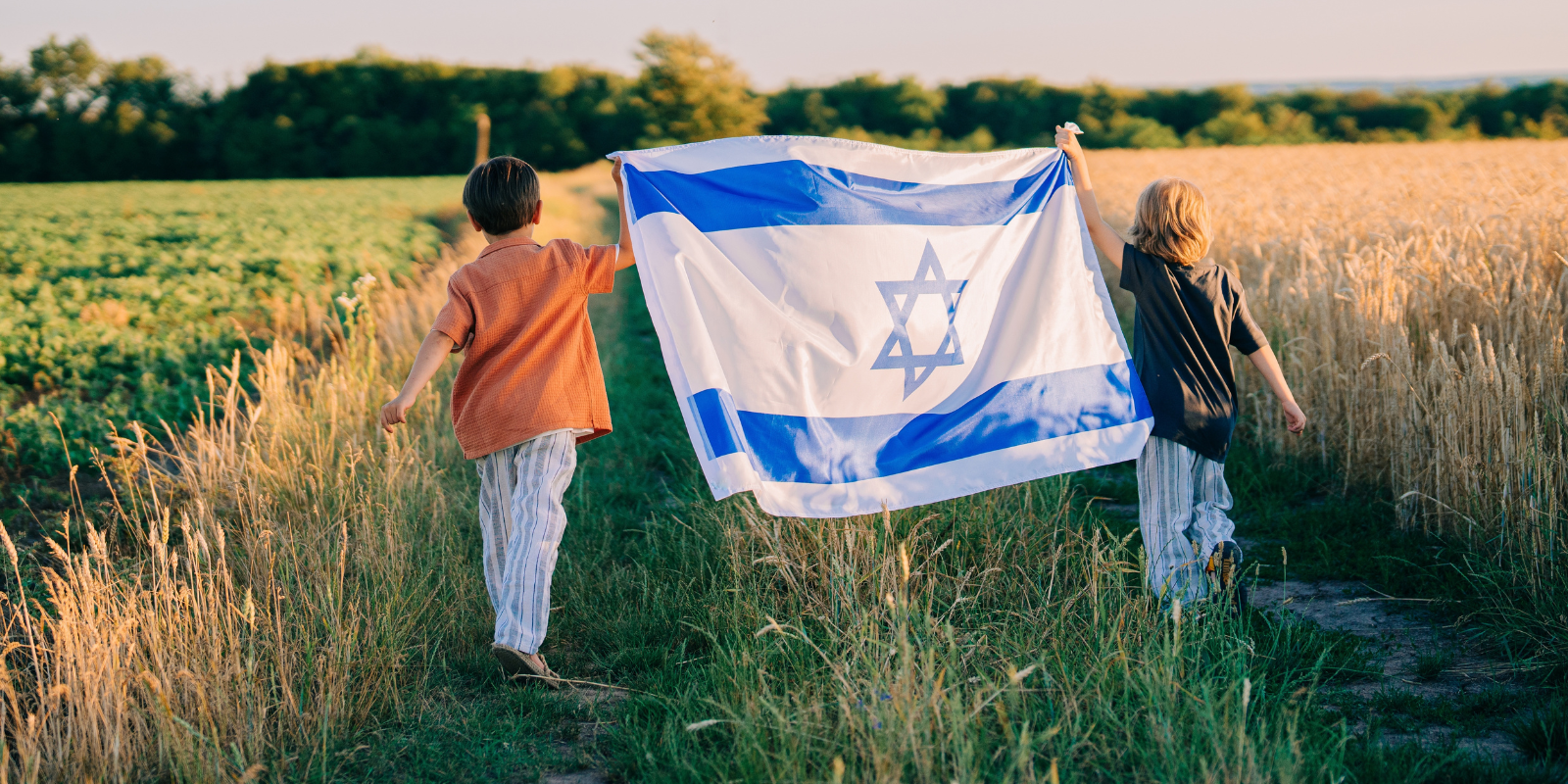
As many of you have read over the years, I was formerly a preschool teacher, before making Aliyah. I loved my work with kids. It was immersive, creative, and I could see firsthand so much learning and growth in a single school year. But nothing in a preschool classroom prepared me for what happened when my own children stood on the actual hills of Judea for the first time. I had spent a decade teaching Bible stories from a carpet square in Brooklyn. Now my kids were climbing the same terraced slopes where Abraham once walked, driving past the fields where Ruth gleaned wheat, looking up at the same walls that surrounded Jerusalem three thousand years ago. The stories didn’t change. Everything else did.
Ask yourself this: why does the Torah insist on teaching our children through land, not only through law? Genesis says it plainly. God doesn’t hand Abraham a code of ethics and leave it there. He tells him to move his feet:
Walk it. Not imagine it.
Abraham is commanded to physically cross the land, so that the promise isn’t theoretical. It becomes a place he can point to. This is the first lesson in Jewish education about the Land: it has to be experienced, not just recited. That principle carries forward into how Israel was taught to teach its own children. When Joshua led the nation across the Jordan River, God didn’t simply want the miracle remembered as a story. He wanted a monument.
Twelve stones, pulled from the riverbed and stacked on the western bank, existed for one reason: so a child would ask a question, and a parent would have to answer it with the truth of what God did in that exact place. The land itself becomes the curriculum. A stone by the Jordan is worth more than a hundred lectures, because a child can touch it. This is not incidental to Jewish education. It’s the model. Deuteronomy commands parents to teach their children constantly, in every setting, using the land itself as the backdrop:
V’limadtem otam et beneichem l’daber bam, b’shivtecha b’veitecha u’v’lechtecha vaderech, u’v’shochbecha u’v’kumecha — “And you shall teach them to your children, speaking of them when you sit in your house, and when you walk on the road, and when you lie down, and when you rise up” (Deuteronomy 11:19).
Notice what comes right after that command. God ties the whole instruction to a promise about the land itself: that if Israel teaches this way, their days will be multiplied on the very ground He is describing (Deuteronomy 11:21). Teaching and land are not two separate ideas here. They are bound together in one sentence.
There is a reason this matters so urgently right now. The world is full of people trying to convince the next generation that the Jewish connection to this land is recent, political, invented. A child who has only heard about Abraham, Deborah, David, and Solomon as characters in a storybook has no defense against that lie. But a child who has stood at Beth El, who knows the Jordan River is a real river he can find on a map, who has heard the actual Hebrew of a covenant spoken over actual hills, carries something no revisionist can talk him out of. He carries a memory of standing there.
This is why I wrote every letter of God’s Land from A to Z around a real location instead of an invented character. Not because Bible stories aren’t beautiful on their own, but because Torah itself teaches us that faith planted in real ground grows roots that faith planted only in imagination never can. Every page puts a real place in a child’s hands, in the actual words God spoke over it, in Hebrew and English both.
Abraham walked the land so the promise would be real to him. Joshua built a monument so it would stay real to his children. Moses commanded that it be taught on the road, at home, lying down and rising up, so it would never be real to only one generation. That’s the model. Not a lecture about Israel. A child, standing on the actual ground, asking what these stones mean, and a parent who is ready with the answer.
Bring that answer home. Get God’s Land from A to Z today.