






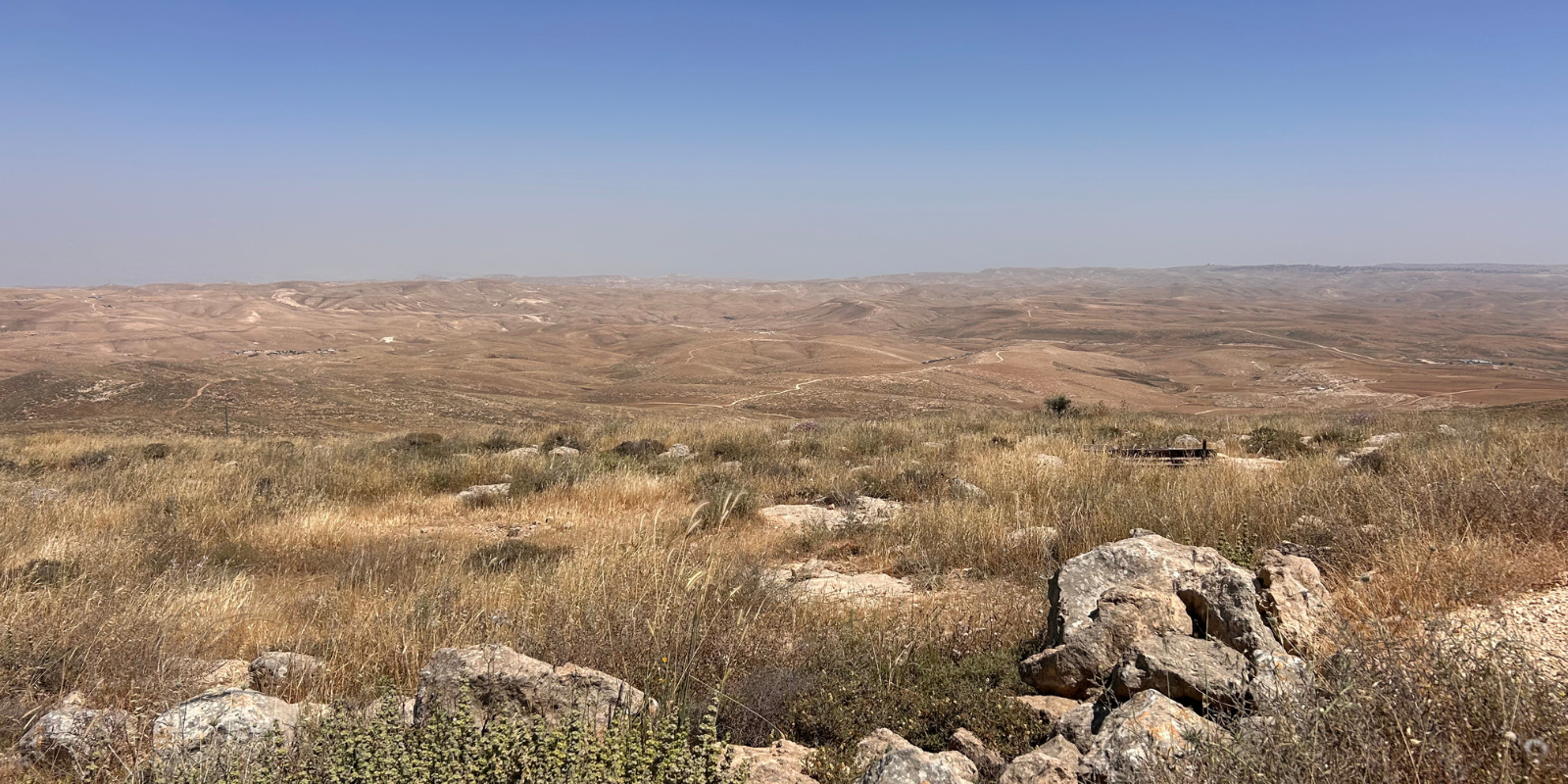
There is a concept in the Israeli workplace, and I suspect a similar idea exists in American offices too. In Israel, it’s called a yom gibush, a bonding day. Once or twice a year, a company loads everyone onto a bus and takes them somewhere out of the office, out of context, so the people you spend your working life with become people you actually know. Think happy hour and a field trip rolled into one. Last month, the entire Israel365 staff took our yom gibush deep into the Judean Hills, to a region called Har Hevron, the Hevron Mountain area. Some of us write the essays you read here. Some of us appear in the videos on Bible Plus. Others work entirely behind the scenes, and you’ll never know their names, but their fingerprints are on everything we send you. That day, we were just a busload of Israelis heading into some of the most contested, least understood, and most biblically saturated land in the country.
We tasted wine grown on hills that have belonged to the Jewish people since before there was a Jewish people to speak of. We walked through ancient Sussya, a settlement so old that archaeologists are still uncovering its synagogue floor. We sat in Dahlia Har Sinai’s home for a bread-baking workshop that felt less like a cooking class and more like a return to something we’d forgotten how to do with our hands. And we ate a late lunch at a restaurant overlooking the very hills that a young shepherd named David once ran through, writing what would become the Tehillim, the Psalms, while fleeing for his life. I sat down that day with the two people whose voices you’ll hear in a new interview now live on Bible Plus, and I left the Judean Hills without a signed lease on a new home, but I won’t pretend I wasn’t tempted.
Here is the question that kept surfacing for me that entire day, and it’s the question I want to flush out with you today: why does it matter that David ran through these specific hills? Couldn’t the story of Israel’s greatest king have unfolded anywhere?
It couldn’t, and the text makes that clear. When Saul was hunting David like an animal, David didn’t flee to safety in some anonymous wilderness. He fled into Midbar Ziph, the Wilderness of Ziph, a real, mapped, specific stretch of land in the same Judean Hills we walked last month. Listen to how precisely the text pins down the location:
This is not vague poetry. This is geography. The text names the mountain. It names the wilderness. It tells you Saul searched every single day and failed every single day, in this specific place.
Why does the specificity matter so much? Because this is not a spiritual metaphor floating somewhere above the actual world. God’s protection happened here, on this rock, in this dust, under this sun. David wasn’t inspired by an abstract idea of faith while wandering some symbolic desert. He was terrified, hunted, and hiding in a real canyon you can still walk into today, and it was there, in that terror, that he wrote lines like “I will lift up mine eyes unto the hills, from whence cometh my help” (Psalm 121:1). That verse isn’t decoration for a wall hanging. It is a man in a specific mountain range, looking at specific hills, telling you exactly where his help came from.
This is what struck me hardest during our trip. The region we now call Har Hevron isn’t a stage set for biblical stories that already happened and finished. It is 13,000 people, spread across communities with names like Ma’on and Karmel, names lifted directly from the pages of the same Bible David wrote in these hills, still living there, still building there, still, in the truest sense, walking in David’s footsteps. Israel’s pioneers a century ago proved that the land could be revived. The families of Har Hevron are proving it all over again, today, in real time, in some of the driest and most difficult terrain in the country.
Come meet the people living, working, and raising families on the very land God promised Abraham, a promise that belongs to everyone who has ever put their trust in that God. Bible Plus just published my conversation with the two people leading this community, and what they’re doing out there has nothing to do with nostalgia. It’s the promise, still being kept, in real time.
David ran through those hills as a fugitive with nothing but a sling and a prayer. Today, ordinary families are building homes, vineyards, and futures in the exact same dust. Scripture was never confined to the past tense. Go watch this interview, and see for yourself that it isn’t now.
Bible Plus is our online Bible study platform, built for anyone who wants more of the Hebrew Bible in their life. Sign up for as low as $5 a month with an annual subscription, or $7 a month if you’d rather go month to month. Inside, you’ll find an incredible community of people who all want the same thing: to go deeper into the Old Testament, taught by real scholars and teachers who know the text and the land it came from. New courses are added every month, and you can hop around and choose whatever speaks to you. There’s no set path here. Go at your own pace, and let the Bible meet you where you are.