






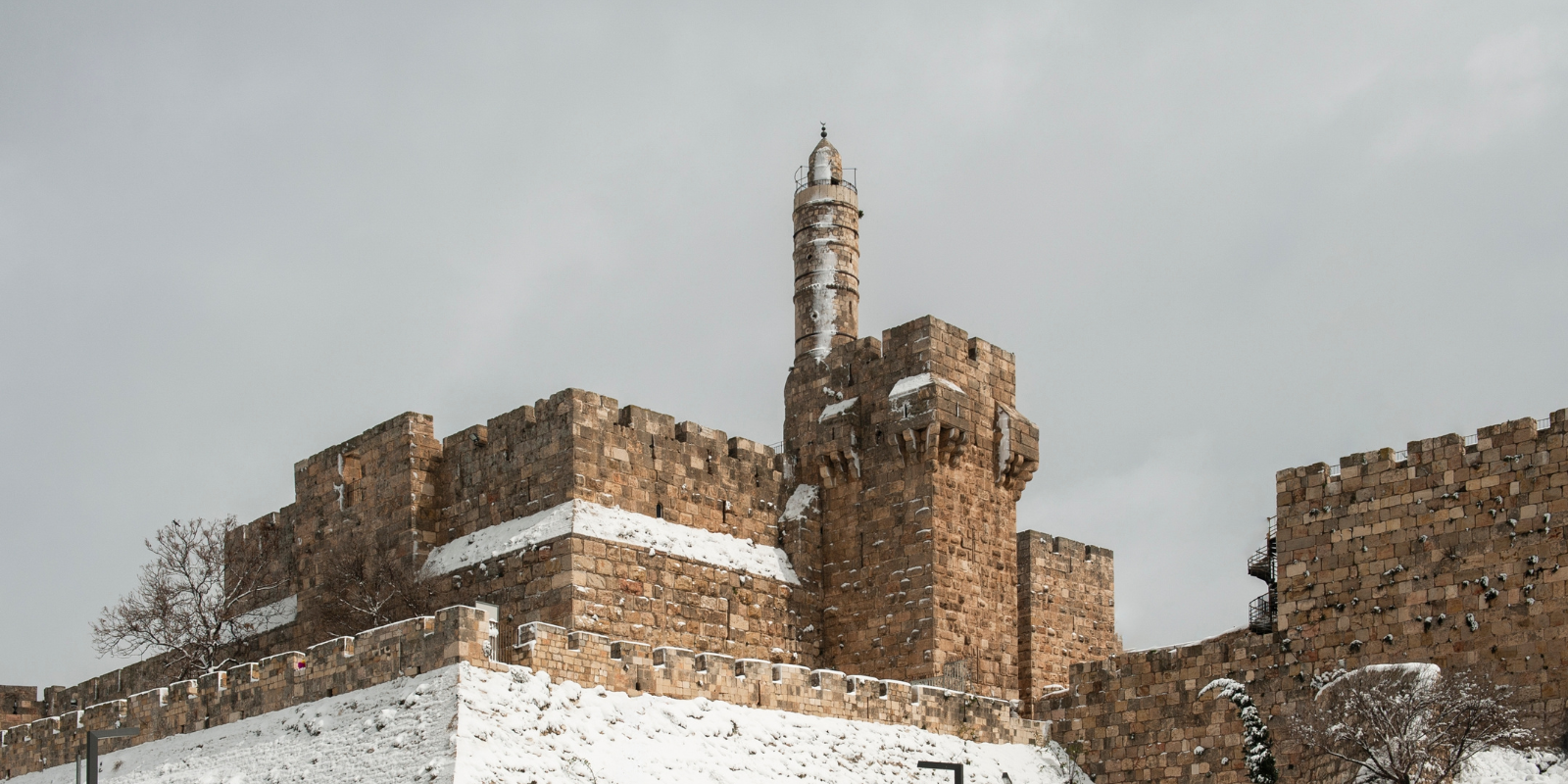
If you read my latest Daily Inspiration, you already know that we recently celebrated my brother’s wedding in America, mazal tov! It was magical, celebratory, filled with music, covenant, and family. And then, in what felt like a plot twist worthy of its own script, the largest snowstorm the Tri-State area had seen in decades rolled in. Our flight home to Israel was predictably canceled. Let me tell you, there is a particular spiritual discipline involved in spending hours on customer service trying to reroute a family of six across continents. But inside this blizzard of emotion, celebration, and sudden change of plans, something else was unfolding. Three of our four children were experiencing snow for the very first time. Not snow on a screen. Not snow in a storybook. Snow falling. Snow covering. Snow transforming the ordinary world into something hushed and bright.
Snow feels innocent.
But in the Hebrew Bible, snow is never just aesthetic. So why does King David, in the aftermath of moral collapse, reach for snow as his image of redemption? Psalm 51 opens without ambiguity: “When Nathan the prophet came to him after he had gone to Bathsheba.” This is David after adultery. After deception. After bloodshed. There is no attempt to sanitize the moment. He begins with ownership:
And then he writes:
The Hebrew is exact: umisheleg albin, from snow I will become white. Snow is the sharpest contrast David can summon. Scarlet stains fabric beyond repair. Snow overwhelms the landscape in brightness. The image is not delicate. It is absolute.
But David is not asking to become unaware. He has already acknowledged his guilt. Snow in this psalm is not about innocence lost and regained. It is about transformation after full knowledge.
The psalm unfolds in deliberate stages. First confession. Then purification. Then something even more radical:
The phrase lev tahor bera li Elokim is uncompromising. A pure heart. The verb bera, create, is the same verb used in Genesis 1:1. David does not request repair work. He asks for new creation. Repentance, in his understanding, is not behavior modification. It is internal re-creation.
And he does not stop there:
Snow in Scripture carries that promise. The prophet Isaiah echoes the same image:
The Hebrew kashéleg yalbinu speaks of reversal, not gradual improvement. The stain is not ignored. It is whitened.
Standing at the window that morning, watching my children watch the snow, I understood something about the psalm I had not noticed before. Snow covers everything. Streets, rooftops, trees. Nothing is selectively brightened. The whole landscape is altered at once.
That is what David seeks. Not partial adjustment. Not selective correction. A total reorientation of the heart.
A snowfall does not remove the structures beneath it. The terrain remains. The roads are still there. But visually, the world is reset. Psalm 51 makes the same claim about the human soul. Renewal does not rewrite history. It transforms what comes next.
And the does not end in introspection. After confession and cleansing, David declares:
Renewal restores responsibility.
Rabbi Jonathan Sacks, in his book, To Heal a Fractured World, argued that faith is not measured by private feeling but by public action. God does not invite us to retreat from brokenness. He calls us to address it. In Jewish language, that work is called tikkun, repair, not as slogan but as obligation.
David understands this instinctively. Once the heart is purified, life must move outward again. Cleansing is not an escape from responsibility. It is the return to it.
The snow outside my family’s window that week was beautiful. It slowed highways and grounded flights. It forced adjustments. It was a wonderland for my kids.
But the snow of Psalm 51 carries a far more disruptive claim. No stain is final when brought before God with honesty. No failure is beyond renewal. And renewal is not for comfort. It is for rebuilding.
That is the center of the psalm. A heart that has been shattered and then remade.
Psalm 51 insists that even a fractured life can be returned to purpose. Snow may feel innocent when it falls from the sky. In David’s prayer, it becomes something far stronger. It becomes the sign that a soul can begin again and then rise to repair what was broken.