





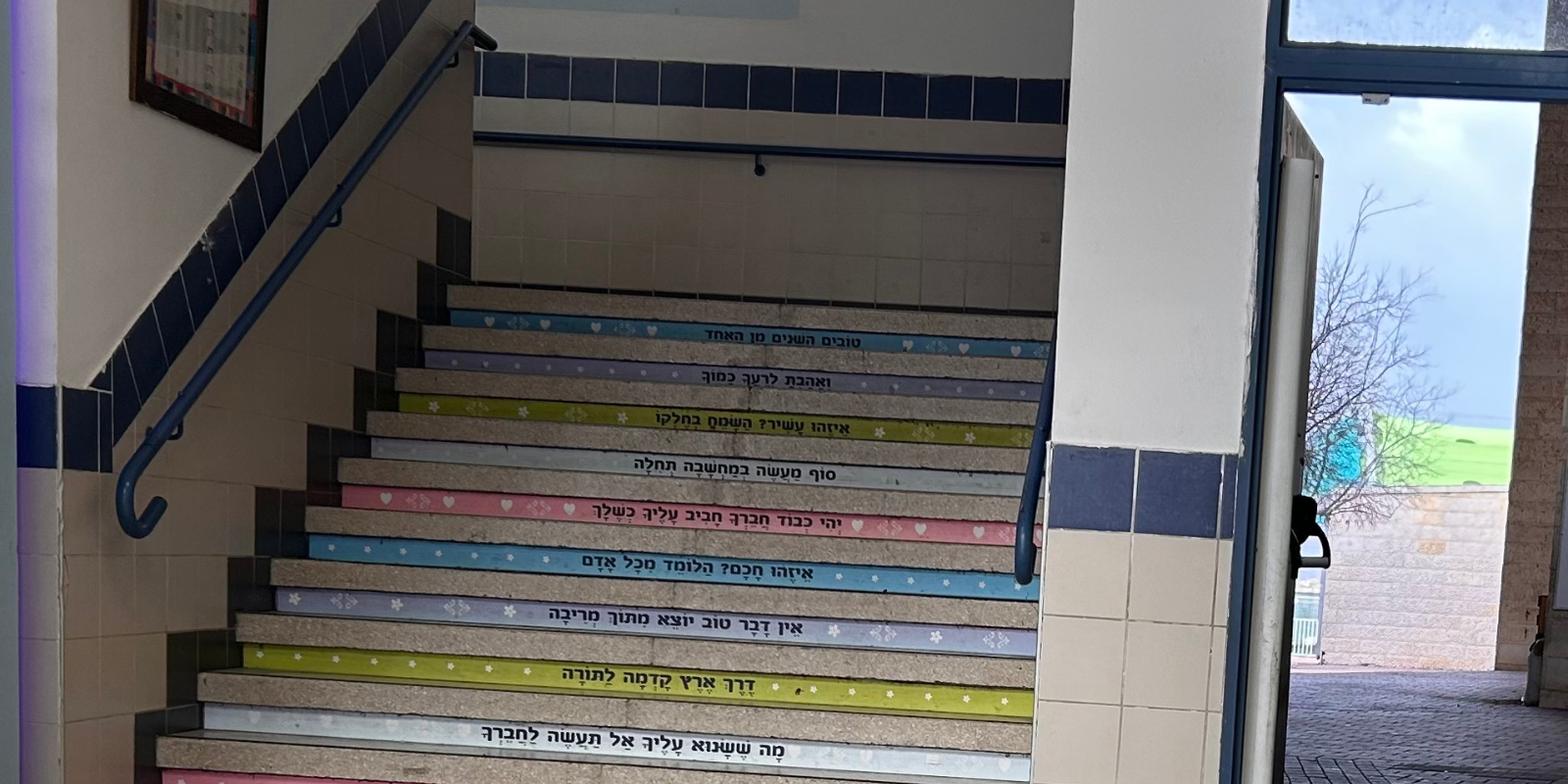
The other day, I paused while dropping off one of my children at school to take in the scene around me. It was prayer time, and I could hear a symphony of children’s voices chanting and singing the morning prayers, each class at its own pace, creating this layered chorus that somehow all worked together. Outside, the security guard (picture this older Israeli man who looks rough around the edges but is really a softie at heart) was playing Israeli soft rock classics from the 1980s. Then the bell rang. Israeli schools use music instead of bells, changing the songs with the seasons. Since Tu B’Shvat, the holiday celebrating trees, had just passed, the bell was an Israeli song about planting and growing. I stood there overwhelmed by how blessed I am to send my kids to school in Israel. It’s such an immersive experience, and even growing up going to Jewish Day school over the years, it’s nothing like I had as a child.
Standing there, taking it all in, one verse kept running through my mind:
It’s a classic verse, quoted constantly, and rightfully so. I’ve referenced it before in my writing. But that morning in the school lobby, I thought about it a bit differently than I normally do. What are we actually passing down when we tell our children our story?
My husband and I made aliyah to Israel for many reasons, but one thing we knew from the start was that even in this incredible and exciting move, with it, there would be sacrifice. When we made Aliyah, we came with two children, and they were quite little. We knew they would settle in just fine. They’d immerse themselves, become fully Israeli, speak Hebrew without an accent, and carry the incredible advantage of being bilingual. The sacrifice wasn’t about their potential struggles. It was about us giving something up so they wouldn’t have to. We were leaving my family behind, the material comforts of American life, and moving to a country where we would be home but also always immigrants to some extent. My Hebrew is great now. I’ve had two children born here. I can navigate the medical and educational systems with ease. I love living here. But nothing replaces that sense of familiarity I get in America: American license plates, American trees, signs in English that I don’t have to think about. No matter how good my Hebrew gets, I have a conscious understanding that the story I’m helping my children write looks drastically different than story I understood as a child. And I think that’s the point.
When I think of v’higadeta l’vincha, telling your son, I think of it as changing the trajectory. We’re teaching the next generation so they won’t have to repeat our mistakes, our struggles, our uprootings. We’re making the sacrifice. We’re changing the course of the family so they are set up for success.
And truthfully, this is the role of each generation. We give our children a leg up. With that advantage, they innovate, create, push further than we ever could. Then they give their children a leg up. Generation after generation, we’re not just repeating the same story. We’re advancing it.
Look at the Exodus story. What were the people who actually left Egypt teaching their children? They had urgent, practical lessons: how to pack in a rush, how to mark a doorpost with blood to avoid the plague, how to run from an army. Their children, born in the desert, learned different lessons: about manna, about trusting God in a very physical way, about the long game of getting to the Promised Land.
And yet, we’re still telling the Exodus story over and over again thousands of years later. Why? Not because we need to know how to escape Egypt. Not because we need to know which days to collect the maana. We’re telling this same story even though the story itself will change from generation to generation, and it should.
“You shall tell your son on that day, saying: ‘It is because of what the Lord did for me when I came out of Egypt'”
Notice the language: “what the Lord did for me.” Not for my ancestors. For me. Each generation makes the story personal, immediate, relevant to their own lives.
Here’s what we’re really teaching our children: the story will change. I hope it does. If it doesn’t – we have bigger problems. My Egypt looks different from my parents’ Egypt, and my children’s challenges will look different from mine. But the thread running through it all, God’s protection and our faith in Him, stays the same. Same book, different chapter.
My children won’t struggle with Hebrew the way I do. They won’t feel like immigrants the way I do. They won’t have to explain to their kids why we live in Israel. It will just be home. But they’ll have their own challenges, their own Egypt to leave, their own wilderness to cross. The lessons I’m giving them, standing in that lobby, surrounded by Hebrew prayers and multiplication tables and the memory of fallen soldiers, aren’t about my struggles. They’re about preparing them for theirs.
That’s what v’higadeta l’vincha means. We’re not just passing down information. We’re giving them tools, identity, rootedness. We’re making sure they know where they come from so they can decide where they’re going. We’re teaching them the old story so they can write the next chapter, their chapter, while holding onto the same thread of faith that’s carried us through every generation.
The sacrifice my husband and I made, the American familiarity we gave up, the distance from family, the permanent slight awkwardness of being immigrants, isn’t a burden I’m passing to my children. It’s a bridge. They get to walk across it into a future we created for them. They get to be fully themselves in a way we couldn’t be, because we changed the trajectory.
But here’s what won’t change: their understanding that God brought us here. That He protected us then and protects us now. That faith in Him is the through-line connecting every generation’s story, even when the details shift completely.
This is the entire point of the Jewish story. We don’t teach our children so they can repeat what we did. We teach them so they can do what we couldn’t, while holding fast to what never changes.