


Finding light in dark times is not an easy feat. It’s Maccabian, if we’re going for a theme. The very word suggests impossible odds, a battle against forces that should, by all logic, crush you. Yet we look towards these stories for inspiration, not because they promise easy victories, but because they show us what the human spirit does when backed into the darkest corner imaginable. I want to share two such stories with you, separated by decades but united by the same stubborn refusal to let darkness have the final word.
So here’s the question: What makes a Jew light Chanukah candles when the world has gone mad?
In December 1943, Jews in the Lodz Ghetto celebrated Chanukah under conditions that defy imagination. This was their fourth winter locked behind ghetto walls, their fifth winter of war. Food was scarce. Heating materials were nearly impossible to find. Most residents said they’d rather go hungry than freeze, and many traded their last scraps of bread for something, anything, to burn. Yet when Chanukah arrived, families scraped together money to buy candles. At 50 pfennigs each, a full eight nights required 36 candles plus the shamash, totaling at least 18 marks. For families barely surviving, some spent 36 marks just on the lighting ceremony alone.
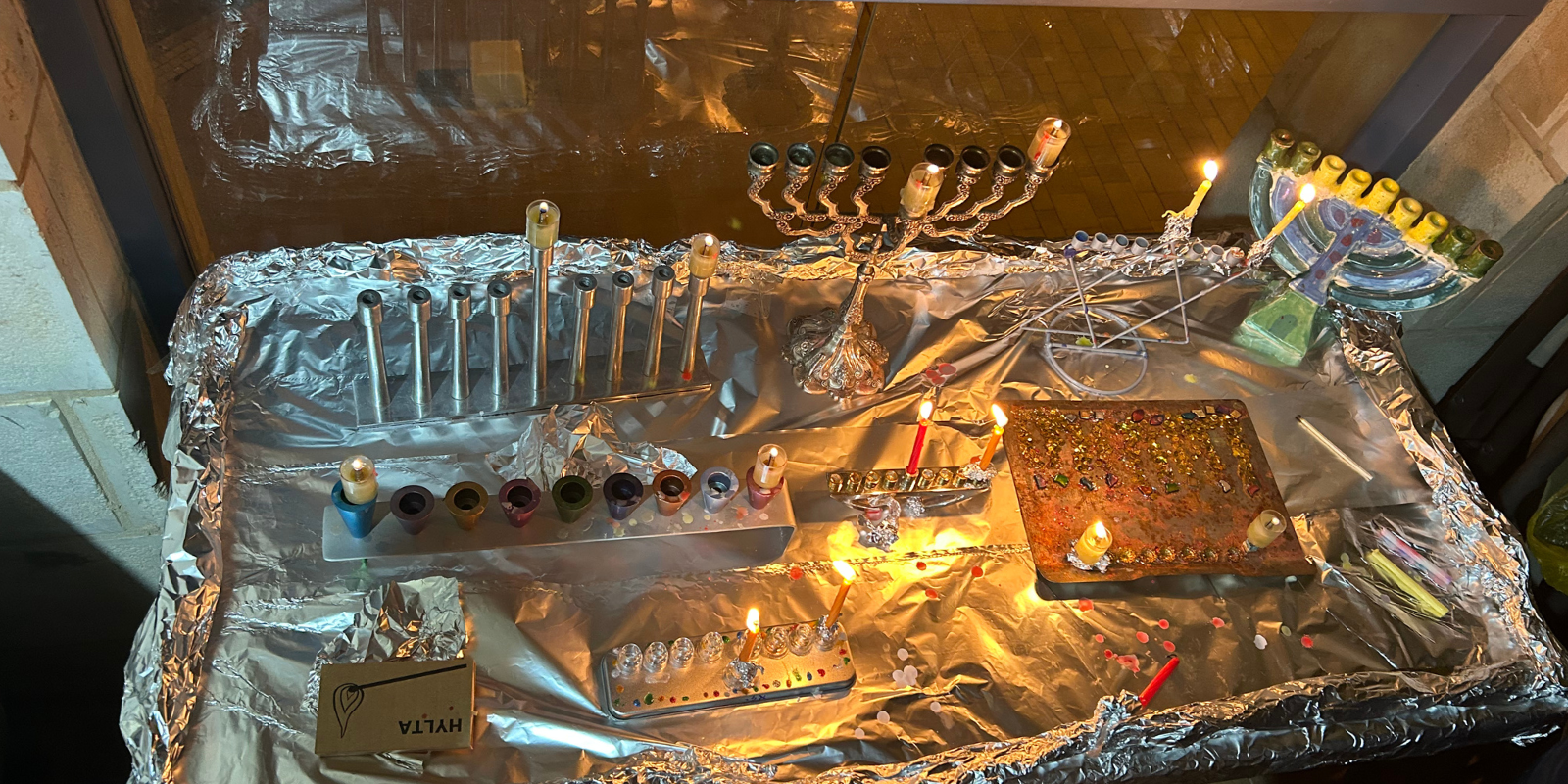
They did so anyway. Men had smuggled their menorahs from the city into the ghetto alongside prayer books and tefillin. Simple brass menorahs, elaborate copper ones, old family heirlooms, and crude handmade versions all came out of hiding. Friends climbed through dark stairwells and damp hallways to gather in cramped apartments, often just a single room serving as both living space and celebration hall. People wore their best clothes. A daughter would be given the honor of singing the blessing. Jews from surrounding areas met with German Jews from the west, all celebrating together. Children received small gifts: a toy, a slice of hoarded cake, a hair ribbon, empty cigarette packets folded into decorations, a pair of socks. After the candles were lit, they sang in Yiddish, Hebrew, and Polish, songs meant to lift spirits for a few precious hours.
As they parted, they squeezed each other’s hands wordlessly, sharing a single hope: that Chanukah 1943 would be their last in the ghetto, their last in wartime. Eight months later, in summer 1944, the Nazis liquidated the ghetto and deported nearly all 80,000 remaining Jews to Auschwitz and Chelmno.
Now jump forward 80 years. In December 2025, newly released video footage shows American-Israeli hostage Hersh Goldberg-Polin and several others marking Chanukah deep in Hamas’s underground tunnels. They had been taken hostage on October 7, 2023. The video captures them in captivity, attempting to light an improvised candle, asking for oxygen to help the flame catch, then joining together in a Chanukah song. Hersh Goldberg-Polin, Carmel Gat, Eden Yerushalmi, Alex Lubanov, Almog Sarusi, and Ori Danino were all murdered in captivity in September 2024. Watching them hold onto their Jewish identity in that underground darkness is both heartbreaking and staggering in its courage.
The Hebrew Bible gives us language for this kind of defiance. In hebrew, the word for light, or אור, is the vocabulary of hope itself. The prophet Michah declares, “Though I sit in darkness, the Lord is a light unto me” (Micah 7:8).
But Scripture doesn’t leave light as abstract metaphor. It ties light directly to oil, shemen la-ma’or – or the pure olive oil used to kindle the Menorah in the Mishkan. When the Maccabees reclaimed the desecrated Temple and found only enough oil for one day, that physical flame became the symbol of spiritual resistance. The miracle wasn’t just that the oil lasted eight days. The miracle was that they lit it at all.
This is what Jews do. When the Greeks tried to extinguish Torah, we fought back with both swords and oil. When the Nazis tried to reduce us to numbers and ash, we sang Chanukah songs in freezing ghettos. When terrorists dragged our children into tunnels, those children sang the same songs their ancestors sang. The candles say what words cannot: you have not broken us, you will not break us, we are still here.
The message to darkness is always the same. We will light our candles. We will sing our songs. We will pass our traditions to the next generation no matter what hell you drag us through. In the Lodz Ghetto, those families knew they might not survive another winter, but they lit their menorahs with dignity. In the tunnels beneath Gaza, those hostages knew they were in mortal danger, but they kindled whatever flame they could find. Both groups understood something the world keeps forgetting: the Jewish people don’t survive on optimism or luck. We survive on memory, on the Bible, and our faith that God sees us even when we sit in darkness.
So yes, finding light in dark times is a Maccabian feat. It requires the kind of strength that doesn’t make sense on paper, the kind that lights a menorah when you’re starving, that sings a blessing when you’re buried alive. That’s not just Jewish history. That’s Jewish present. And the flame still burns.
See the incredible, and heartbreaking resiliency of “The Beautiful Six” Hostages celebrating Chanukah together in Hamas captivity.