



Before I begin my essay, I want to wish our dear Christian readers, a Merry Christmas.
May your day be filled with light, blessing, and the warmth of those you love. We are so grateful that you are part of our family, and as we approach the coming year, I look forward to continuing to build these relationships with you.
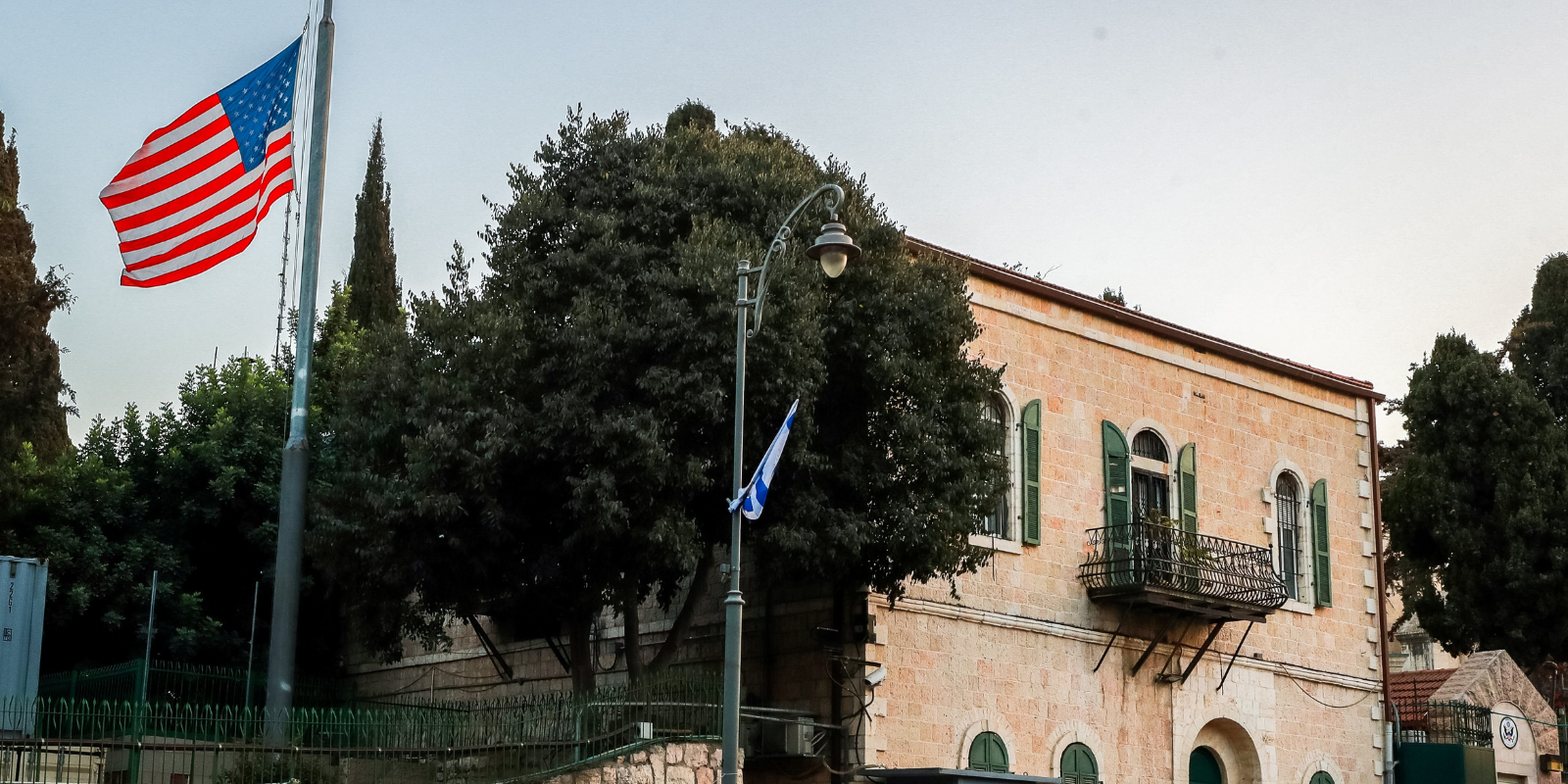
A few weeks ago, I had to go to the US embassy in Tel Aviv to renew my daughter’s passport. It’s a tedious process that requires excellent organizational skills (thank God my husband excels at that). We finally arrived at the little booth where they review your paperwork, and I have to tell you, it’s such a funny experience. You’re looking into this pocket of America. There’s carpeting on the floor. Inside the cubicle, there are Christmas decorations. Everything is in English. In contrast to the way Israeli offices and buildings look (concrete, Hebrew signage, that distinctly Middle Eastern efficiency), you feel like you’re peering through a window into another world entirely.
There’s a strange homesickness about it that I can’t quite put my finger on. Behind me is a stop sign that says yetziyah (exit), and in front of me, as I peer through the glass, it says “STOP.” I feel this same funny contrast when I step into the airport at JFK or Newark to visit my family. It takes a minute to recalibrate, to stop speaking Hebrew, to breathe different air. That being said, I’ll take a Dunkin’ Donuts any day.
This funny phenomenon (standing between two worlds, neither quite home and both somehow home) is what I imagine Joseph felt when he saw his brothers for the first time after all those years. It’s what Moses meant when he named his son Gershom, saying, “I have been a stranger in a strange land” (Exodus 2:22).
What does it mean to be a stranger in a strange land, and what does God want us to learn from this displacement?
The Hebrew Bible returns to this theme relentlessly. Moses is a stranger in Midian. Abraham is a stranger in Canaan. Joseph is a stranger in Egypt. Ruth is a stranger in Bethlehem. The entire Jewish people are commanded to remember: This is the architecture of biblical identity.
When Moses names his son Gershom (from the root ger, meaning stranger or sojourner), he’s making a theological statement. He’s a Hebrew raised as an Egyptian prince, now living as a shepherd in Midian, married to a Midianite woman. He doesn’t belong anywhere. And yet, he belongs to God. That’s the point.
The biblical ger is not merely someone who lives in a foreign country. The ger is someone who lives with one foot in each world, who sees both the inside and the outside, who experiences the disorientation of never quite being home. And this disorientation is not a bug in the biblical program. It’s a feature.
When Joseph stands before his brothers in Egypt, he is unrecognizable to them. He speaks Egyptian. He wears Egyptian clothes. He has an Egyptian name and an Egyptian wife. He has power they cannot fathom. But when he finally reveals himself, he weeps so loudly that all of Egypt hears him. In that moment, he is neither Egyptian nor Hebrew. He is both and neither, standing in that strange space between worlds, holding the tension of two identities.
This is where God does His deepest work.
When you are a stranger, you see what natives cannot see. You notice the carpeting in the embassy booth because it’s different from the tile in the Israeli office. You notice the Christmas decorations because they’re not Hannukah Banners. You notice the Dunkin’ Donuts because it’s not an Aroma Cafe. The stranger has double vision. The stranger sees contrast, difference, the particular shape of each culture. The stranger is awake in a way that those who are comfortable are not.
Abraham is called to leave everything familiar (his land, his birthplace, his father’s house) and go to a place he does not know. God makes him a stranger on purpose. Because only a stranger can build something new. Only someone who doesn’t take the culture for granted can create a counter-culture. Only someone who has experienced displacement can build a home that matters.
This is why the Torah commands us, over and over, to care for the stranger. Not because we feel sorry for strangers. Because we too are strangers. Because the entire biblical project is about building a people who live as strangers in the world, who refuse to settle into the Empire, who remember the experience of Egypt even when they’re standing in Jerusalem.
When I stand at that embassy window, looking into little America while simultaneously standing in Israel, I feel Moses’ words in my bones. I am a stranger in a strange land. I am home, and I am not home. I speak Hebrew with an American accent. My children are Israeli, but I am not. I belong here, and, sometimes I feel like I don’t. And this displacement, this perpetual sense of standing between worlds, is not something to overcome. It’s something to embrace.
Because this is how God shapes His people. In the disorientation. In the contrast. In the perpetual sense of standing between worlds. This displacement is not a problem to solve. It’s the condition that teaches us to see clearly, to love deeply, to build what matters.
Stand in the tension. Be the stranger. This is where you’ll find God.